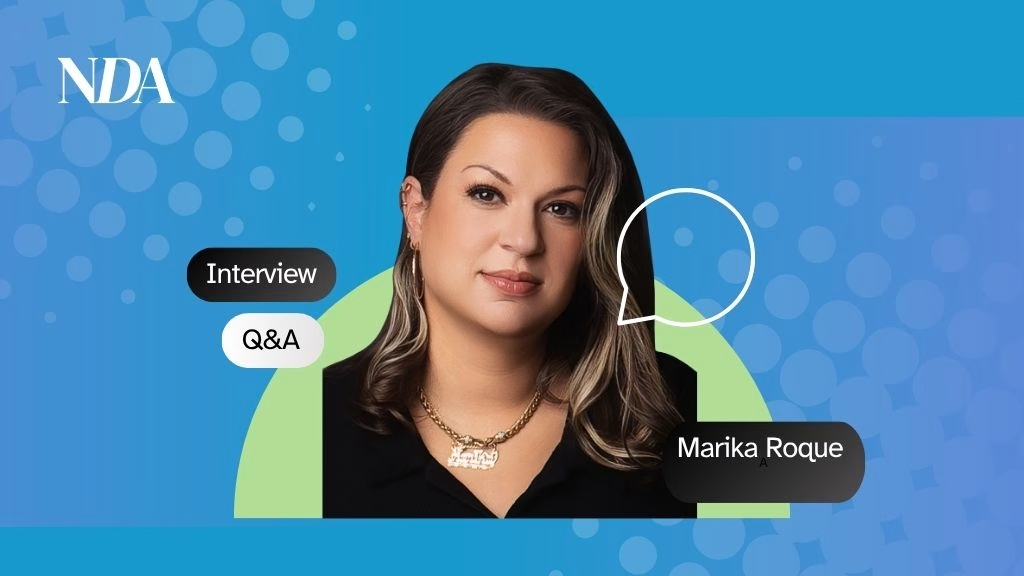
Marika Roque is the Chief Strategy Officer at Kerv, an AI-powered creative technology platform. With a rich background in media and technology, Roque leads Kerv’s strategic initiatives, forging partnerships with industry giants like Disney and Warner Bros. Discovery to deliver data-driven creative solutions.
Sitting down with New Digital Age at Possible in Miami, Roque discusses Kerv’s global expansion, the hurdles of cross-market standardisation, and the critical technical infrastructure required to power the next generation of interactive advertising.
Tell me what has been going on with Kerv, specifically regarding your recent partnership with Disney.
On the Disney side, we are a very large integrated partner, and they have publicly started to expand with us in EMEA, and we are also working on LATAM in parallel.
We announced it only a few months ago and we already have some really great deals flowing through, which from a go-to-market perspective is unheard of for that size of an organisation. We have turn-key CTV ad creatives that push interactivity and have companion units enabled across more Disney marketplaces than any other partnership they have.
What are the primary industry issues you see when moving into the EMEA market compared to the US?
EMEA presents a fragmentation challenge that you just do not see in the US; you have all of these different languages and a mix of massive and boutique markets that each need to be looked at in a unique way.
The industry is currently struggling with how to be seamless across these borders. AI-driven tools are needed more in EMEA because the manual workload of shifting strategies for a campaign in Turkey versus a pan-European buy is too high. Our infrastructure is built to help publishers and brands shift and jive all of those elements within a flip of a dime.
How is the industry currently handling the speed of creative production?
The demand for speed is at an all-time high, which is why we build everything in our own tool.
We analyse creatives with our AI down to the curve pixel edge to build product units or correlate items from a catalogue automatically. For example, our SLAs with Disney are 24 hours, and we are actually tightening that even further globally.
The industry needs to move away from weeks-long production cycles if it wants to stay relevant.
Beyond expansion, what is the next big technical hurdle for the industry?
We are working really diligently on our contextual marketplace. The industry often talks about context, but we look at content down to the pixel edge to identify objects, like a bottle of water or a vase, and correlate them to product catalogues.
This is the future of shoppable TV and commerce. We are creating new contextual data that publishers can utilise to better serve clients and feed dynamic creatives.
How should publishers be packaging this data to add value?
A partner like Warner Bros. Discovery is packaging these moments up for their own sales team in a unique way, but there is an industry-wide need for more specific signals. We have partnerships where they allow us to create a marketplace with all of their signals in one place.
This allows us to get more specific than any other contextual partner because it allows for identifying precise moments at scale. We are driving demand for the publishers while they empower their own sales teams to take it to market how they see fit.
You have mentioned the “SSAI layer” as a major industry blocker, why is that?
You cannot offer this awesome value of new signals for the bid stream without the publisher having to do something in their SSAI (Server-Side Ad Insertion) layer. It is a difficult ask to tell a publisher to change their roadmap, but without addressing that layer, everything else is just talk.
Many publishers have several SSAI partnerships they have to manage due to acquisitions, and we need to address it through an interoperable SSAI lens rather than just an SDK lens. Until the industry deals with the SSAI layer, an agentic, automated future remains out of reach.
How does the agentic ecosystem solve the buyer’s dilemma?
By creating this contextual addition to a bid stream, we are actually making it impossible for a human buyer to optimise manually; the data is just too dense.
Agentic AI is exciting because it takes these signals, like specific product matching, and makes it something a buyer can actually operationalise. It allows the technology to deliver the outcome the buyer wants without them having to manage thousands of individual feeds.
What are your thoughts on the upcoming industry calendar, specifically regarding Cannes?
It is hilarious because everyone is currently trying to map out their deliverables for Cannes.
We are working on a couple of big announcements for the festival, specifically around creating an ease-of-use standardisation through the tools I have mentioned. We will have some big SSP and publisher announcements there because we need all of those players aligned to make this ecosystem go round.