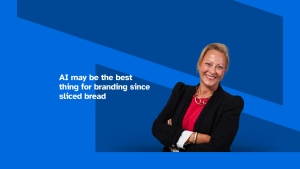
Jamie Irving, SVP of Media, Insight and Effectiveness at Pentland Brands,the global group behind labels including Speedo, Berghaus and Ellesse, sat down with New Digital Age to discuss the company’s evolving approach to data, retail media and the fast-changing search landscape. The conversation ranged from a major platform migration to the implications of large language models for how brands need to think about content and product information.
Moving to a customer data platform
Pentland Brands recently completed a migration to the Ometria platform, bringing its customer data and communications in-house after previously managing these functions externally through THG. The move covers seven brands across multiple markets and has shifted the organisation’s focus firmly towards lifecycle marketing and first-party data.
The results have been tangible. “We’ve really started to realise the power of first-party data,” says Irving, pointing to stronger open rates and conversion performance after pushing customer data into platforms such as Google and Meta. Revenue from automated emails and dynamic segmentation has increased significantly, and the platform has unlocked something that was previously out of reach.
“Personalisation at scale was just not available to us before,” he says, describing it as a major driver of improved conversion rates, even through relatively straightforward actions such as recommending adjacent products.
The fragmentation of retail media
Retail media has expanded dramatically, with a growing number of retailers opening their own advertising offerings. For brands like Pentland, this creates both opportunity and complexity. Irving describes “a really fragmented market where you’ve got lots of disparate companies with different data sets and different inventory,” making the landscape increasingly difficult to navigate.
The Amazon model, balancing profitability with paid advertising while effectively owning the consumer relationship, is now being replicated by others. Frasers Group’s Elevate proposition is one example of this trend.
“Everyone is trying to find additional revenue streams by leveraging their space and their data,” Irving said, and as more retailers move in this direction, the question for brands is how to manage investment across an ever-wider set of partners.
The case for aggregation and better measurement
Irving is clear that the retail media space needs a centralised technological solution to aggregate networks and, critically, to improve measurement. “If you could measure across multiple retail partners through one platform, using their actual sales data, and get an aggregated report, that could substantially change the marketplace,” he says.
While agency groups could in theory manage this aggregation, Irving argues that a technology-led approach would be more cost-effective, an important consideration given the tight margins in retail.
The ideal solution would go further than existing tools, providing richer reporting data and closing the gap between advertising activity, sales performance and product availability. “Even with Amazon, it is really hard to connect your marketing activity through to sales and product availability,” he says.
A persistent challenge is that most retailers outside of Amazon are still using retail media tactically, activating campaigns around key moments rather than maintaining a consistent presence.
“The key unlock for retail media, outside of Amazon, is for those smaller players to be able to plan their investment line by line over a year and treat them like a normal marketing channel,” Irving says. The barriers to achieving this, he argues, remain measurement and accessibility.
Programmatic and the pursuit of guaranteed outcomes
On programmatic advertising, Irving describes a long-standing desire for a model in which ad technology providers share the risk with advertisers.
“What we really want is a true guarantee of scale, the opportunity to grow our business with a guaranteed CPA or ROI,” he says. This is particularly relevant for growing direct-to-consumer brands that currently rely heavily on affiliate networks for lower-funnel activity but lack the tools to build mid-to-upper funnel awareness efficiently.
“Affiliate is great for lower-funnel activity, but it doesn’t build the mid-to-upper funnel,” Irving explains. He sees the industry moving in the right direction, with agencies becoming more innovative and using AI to develop their own products, potentially allowing brands to scale existing channels without taking on disproportionate financial risk.
AI, LLMs and the evolution of search
The conversation turned to what Irving describes as an evolution rather than a revolution in search.
“The core function of search, which is finding answers to questions, is not fundamentally changing,” he says, but large language models are meaningfully shifting how people interact with it. “People are asking longer, more detailed questions, which increases the importance of relevancy,” he adds, pointing to the integration of tools such as Gemini within search as an opportunity rather than a threat.
Paid search will continue to play a role, including through emerging CPC-based formats on platforms such as ChatGPT, which Irving describes as “paid search on steroids.”
But the real shift is in how brands need to think about content and product data. “Content and product data become more important than ever for LLMs to understand the product, its naming and its benefits,” he says.
Product data as the foundation
To be visible within LLM-driven search, brands need strong technical SEO, unique on-site material and high-quality product data. Irving describes LLMs as acting like a salesperson for a brand’s storefront. “LLMs are forcing brands to set up better and focus on their storefronts,” he says, “and the LLM acts as the salesperson for that.”
A theme running through the entire conversation is the interconnectedness of all these channels. Better product data improves SEO performance, which in turn benefits retail media by increasing searchability and the effectiveness of sponsored placements.
“Better product data benefits SEO and consequently retail media,” Irving says, before drawing the thread together. “Product and consumer are the foundational elements powering everything,” and in an era where LLMs give consumers ever greater power to demand clarity and specificity from brands, getting those foundations right has never mattered more.