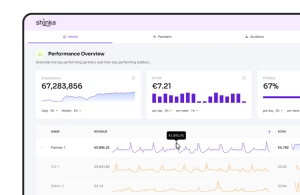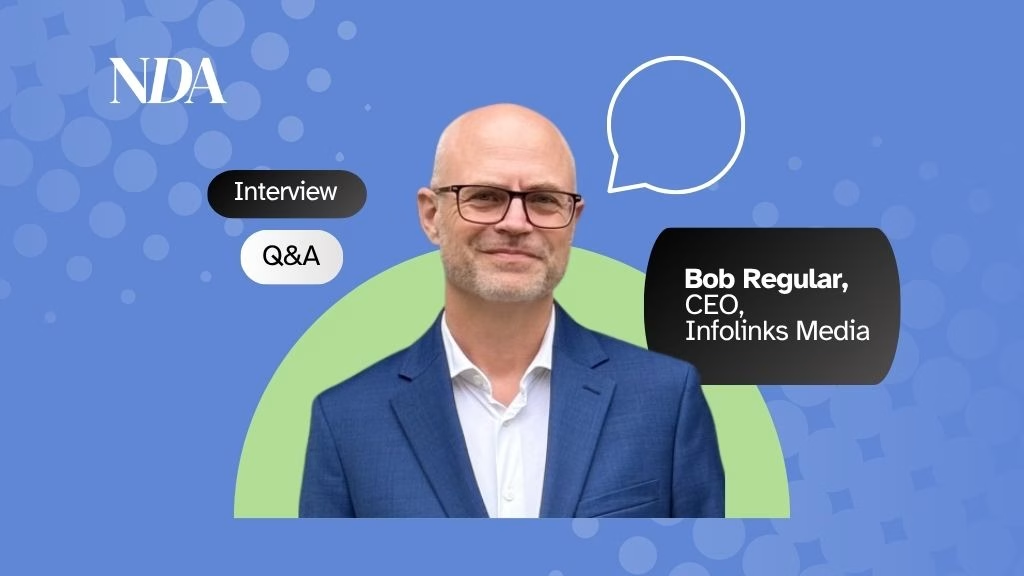
Advertising marketplace Infolinks Media recently announced a direct integration with Basis, an intelligent operating system for autonomous advertising. The integration brings Infolinks’ Premium Proprietary Placement media inventory into the Basis platform, enabling advertisers to access high-impact display, native, and video inventory across thousands of direct publisher relationships.
New Digital Age spoke with Bob Regular, CEO at Infolinks, to find out more…
What was the motivation behind Infolinks’ new partnership with Basis?
Infolinks is a proprietary supply-side ad marketplace, and we’ve worked very hard over the years to scale our inventory by working directly with publishers. As we’ve grown, we’ve reached a point where we’re focused on expanding our direct relationships on the demand side as well.
You could almost call it a reverse supply path optimisation strategy. We want to maximise our relationships with advertisers, agencies and the broader demand-side ecosystem.
What I really like about these direct relationships is the communication. You have the ability to experiment, to explore, and to work together to help advertisers find unique outcomes and successful opportunities. It’s much more intimate than operating behind an anonymous platform where you’re simply looking at bid requests and wondering what’s actually happening through the process.
When you integrate with a partner as sophisticated and experienced as Basis, it allows you to work directly with them and create that advertiser intimacy. That helps drive quality, drive performance and create better outcomes for everyone involved.
Basis recently went live with us and the results have been very positive so far. Personally, I’m really enjoying the return to human connectivity in these partnerships. It’s less about looking at raw data in isolation and more about taking the data and sitting down with people to ask: how is it working for you, and how do we make it better?
What are advertisers asking for most from partners right now?
I think advertisers are reacting to the moment.
The economic environment remains volatile. At a macro level things may look relatively healthy, particularly in the US, but there are a lot of nuances underneath that. Making campaigns successful today requires more sophistication than ever.
The good news is that advertisers are becoming increasingly thoughtful. They’re more thoughtful about measurement, more thoughtful about outcomes and definitely more thoughtful about efficiency. They’re looking closely at performance pathways, supply pathways and every aspect of how their budgets are being spent.
What I’m enjoying is that this thoughtfulness aligns perfectly with who we are as a business. Advertisers and agencies have always been sophisticated, but right now they’re extra attentive to the efficiency of spending money, the quality of response and the removal of inefficiencies and poor performers.
Because we own and control our media, we can engage directly with them on those priorities. The reality is that achieving performance isn’t as easy as it was a few years ago. Brands have to work harder for every result, and that has created much deeper conversations about quality and effectiveness.
How do you view the industry’s current obsession with AI?
AI is probably the most overused term in the industry right now.
Every conversation starts with, “How are you using AI?” or “What is AI doing for your business?” But if we take a step back, what we’re really talking about is another major innovation cycle.
Digital media has already gone through an incredible period of innovation over the last two decades. We’ve watched digital become the dominant media channel. We’ve seen the rise of mobile, video, streaming, machine learning, big data and increasingly sophisticated measurement.
For a while, it felt like the industry was primarily focused on optimising what already existed. We were refining efficiencies, improving attribution and squeezing more performance from established systems.
AI changes the conversation because it creates an opportunity to rethink everything. Suddenly the architecture of media, attribution, measurement, workflow, planning and creative execution are all open for reconsideration. Everyone is experimenting. Nobody is entirely sure where it’s all going to land, but every time people explore what’s possible, the reaction is usually the same: “Holy cow, this is incredible.”
At the same time, it’s still early. If I’ve learned anything from living through virtually every major shift in digital media, it’s that many of our early assumptions turn out to be wrong. We experiment, we fail, we learn and eventually we discover what actually works.
I think AI will be another ten-year gold rush of innovation, experimentation and failure. There will be incredible breakthroughs, but there will also be a lot of lessons learned along the way.
What will the media look like after the AI evolution takes place?
If I put my futurist hat on, I think we’ll see amazing advancements in targeting, attribution and optimisation. That’s inevitable. But I also believe there will be a growing craving for authenticity.
People will increasingly value emotional connection and authenticity in media experiences. In fact, I think authenticity is going to become one of the most important currencies in media.
As AI-generated content becomes more common, authentic communication will become more valuable. The ability to create genuine connections with consumers won’t disappear—it will become even more important.
What are Infolinks’ key priorities over the next 12 to 18 months?
I’m leading with that authenticity theme. As AI continues to reshape the web, we’re doubling down on authentic relationships on both the supply side and the demand side.
On the publisher side, we’re investing heavily in direct relationships. We want to work more closely with publishers, create more value for their media and help ensure they continue to thrive in a changing digital ecosystem.
At the same time, we’re making significant investments in our sales, account management and optimisation teams. We want more direct relationships with advertisers and agencies. We want fewer layers between us and the people we’re ultimately serving.
There was a period where much of the industry became comfortable being platform-like. Money moved through systems, but there was less communication and less accountability around whether things were actually working for all parties involved.
We’re intentionally swinging that pendulum back the other way. We’re investing in customer service, optimisation, publisher relationships and direct engagement because I believe authenticity and directness are becoming increasingly important.
From a product perspective, we’re also preparing to launch what I believe is one of the most pioneering AI products we’ve developed. What’s interesting is that it isn’t focused on workflow automation or traditional media optimisation.
Instead, we’re incorporating large language model capabilities directly into advertising experiences. The goal is to leverage the power of AI while preserving the intimacy, persuasion and authenticity that make media effective.
We don’t want to create another generic AI experience. We want to create something that feels genuinely valuable for consumers and brands alike.
Is there anything else you’re seeing in the industry that deserves more attention?
One thing I’ve noticed is the explosion of industry events. There are more conferences, summits and trade shows than ever before. Every week there seems to be another opportunity to network, present, learn and connect.
That’s positive, but I think it highlights a growing need. The industry is thirsty for authentic conversations. People want honest discussions about what’s really happening in their businesses and their segments of the market. They want substance. They want insight. They want to learn something meaningful.
Too often, people leave events talking about the lack of substance rather than the quality of what they learned. The reality is that people are looking for environments where they can collaborate not only around success and positivity, but also around challenges and difficulties. Those conversations are just as valuable.
If everyone already recognises that there’s a lack of substance in certain forums, then we shouldn’t hide from that reality. We should address it directly. I think the industry would be far more enriched by more authentic, sincere and practical conversations about where we’re headed and what we’re collectively trying to solve.