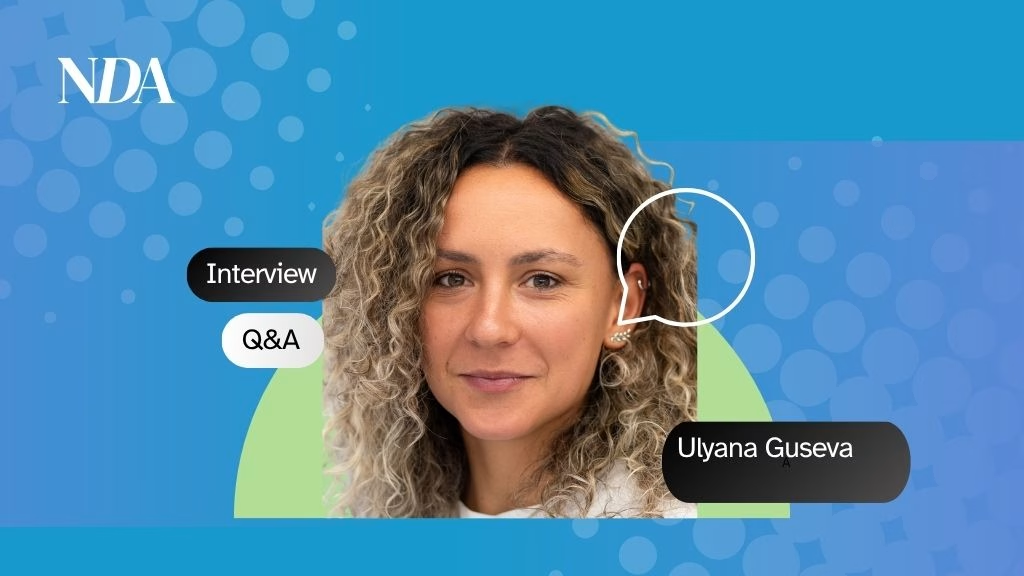
New Digital Age speaks to Ulyana Guseva, Head of Sales and Partnerships at Citymapper Ads, about the growing role of mobility media, contextual advertising, and how brands can tap into real-world intent. With a background spanning Google and Waze, Guseva brings expertise in location-based platforms and their evolution.
Can you tell me a bit about your background and your role?
I’ve spent most of my career in media, starting at Google where I worked with small and medium businesses across Ukraine, Belarus and Kazakhstan. I then moved to Waze, focusing on the UK market and spending five years working across different roles, finishing as a senior industry manager.
I joined Citymapper about two and a half years ago, and now lead sales and partnerships. My role spans working with agencies and direct clients on campaigns, managing auction and reseller partnerships, and overseeing the overall ad monetisation side of the business.
You sit at the intersection of mobility and real world behaviour. What makes Citymapper unique compared to other location-based platforms?
There are a few things. First is the audience, our users are typically based in major cities, they are tech savvy and highly engaged. There’s also a strong level of trust in the platform, which we value highly, reflected in our app ratings.
Secondly, it’s about intent. We understand not just where users are, but what mindset they are in. For example, during a morning commute, someone might be open to grabbing a coffee.
In the evening, they might be thinking about dinner or entertainment. That combination of audience quality and real time intent creates a powerful opportunity for brands.
Where does Citymapper fit within the omnichannel journey?
It depends on the campaign. We can operate across the funnel. At the top, we can deliver high reach and strong engagement for brand campaigns. Lower down the funnel, products like local ads help drive footfall by influencing decisions in the moment.
We often play a last mile role, especially when it comes to proximity and location based messaging. But equally, we can support broader brand objectives depending on how advertisers use the platform.
How has advertiser demand changed in recent years?
Commuting habits have changed since the pandemic, but the desire to reach people at key moments in their day has not. What has evolved is how we understand those moments, fewer people commuting five days a week, different timings, different patterns.
Advertisers increasingly want to tap into those contextual moments. There is also a growing emphasis on brand safe environments. Platforms like Citymapper offer a controlled ecosystem where brands can stand out and feel confident about where their messaging appears.
How do you balance commercial objectives with maintaining a clean user experience?
The user is always at the centre of everything we do. That mindset actually benefits advertising. When ads are relevant and respectful, they enhance the experience rather than disrupt it.
For example, with local ads, we carefully considered where to place them. Instead of showing locations mid journey where they are not useful, we focus on the walking parts of a journey, either at the start or the end, where a user could realistically act on the information.
Similarly, with video ads, we place them at moments when users are more relaxed, for example when they are already on a bus and checking their progress. In more hectic moments, we give users control, using tap to play rather than autoplay. This approach leads to stronger engagement and better outcomes for advertisers.
How do contextual and real time signals shape what you can offer brands?
They are central. We focus on where users are, where they are going, and the time of day. These signals help us understand mindset.
The most effective campaigns combine targeting with creative that reflects that context. For example, messaging around proximity or travel time works particularly well when it aligns
Do you work alongside other channels such as out of home?
Yes, it’s reinforcing messaging when users are in proximity to billboards or travelling towards those locations.
It adds another layer of engagement and makes the campaign more memorable, particularly as users can interact with the ad in a way they can’t with traditional formats.
How has your relationship with agencies evolved?
It’s changed quite a bit over the past few years. Initially, Citymapper was seen as more of an innovation play, something new and different.
As our proposition has matured, it has become more of an always-on channel for many brands, particularly for driving location awareness and consideration.
We have strong relationships with major UK agencies and beyond, and as expectations grow, so does the need to demonstrate effectiveness. That has pushed us to evolve our measurement capabilities and provide more robust metrics.
Looking ahead, what are your priorities for the rest of the year?
We’re focusing on two key areas. The first is targeting, developing more nuanced ways to adapt messaging based on different journey types and moments, such as commuting to work, travelling home or navigating disruptions.
The second is measurement.
We want to go further in demonstrating incrementality, particularly around footfall, and continue building partnerships that help us prove the value of our platform to advertisers.
Finally, what are the biggest challenges you face?
Education is a big one. We’ve evolved quickly, but the market is large and we need to ensure agencies and brands fully understand what we offer and how to use it effectively.
Another challenge is that our formats are quite different from standard digital advertising. For example, local ads behave more like out of home than traditional mobile display, so we need to guide brands on how to approach creative and messaging.
There’s also the balance between contextual targeting and more traditional demographic approaches. Some advertisers still think in terms of age and gender targeting, whereas we focus on journey and mindset. Helping brands shift that perspective is an ongoing process.