Repeats triumphed this Christmas with five of the top ten performing TV spots reusing previous ads, as revealed by new consumer testing by Kantar.
Cadbury’s Secret Santa was the most effective ad overall followed by Coca-Cola’s Holidays are coming, with both advertisers rerunning previous content. Just as Coca-Cola’s famous campaign has become synonymous with the festive season, Cadbury has begun to establish its own Christmas ritual built around its Quaker roots. The two ads sit in the upper 100th percentile of Kantar’s advertising database for powerful branding.
Other strong performers included Aldi, which continued the adventures of Kevin the Carrot and M&S Food, which brought back its Fairy character. Asda was the only brand to break into the top 10 with an entirely new idea in its Grinchmas TV ad, borrowing fame from the popular children’s tale and proving that even the hardest of hearts can be melted with the right spark of inspiration.
Now in its 11th year, Kantar’s annual Christmas TV ad research unwraps the secrets behind what makes festive ads memorable for consumers and successful for advertisers. Using its LINK+ creative development tool via Kantar Marketplace, Kantar asked 4,050 UK consumers what they thought about 27 of this year’s Christmas ads and compared the results to the world’s largest advertising database. Partnering with Affectiva, Kantar also used facial coding to determine the power of the ad to provoke an emotional reaction, and the nature of that emotion moment by moment as people experience the ad.
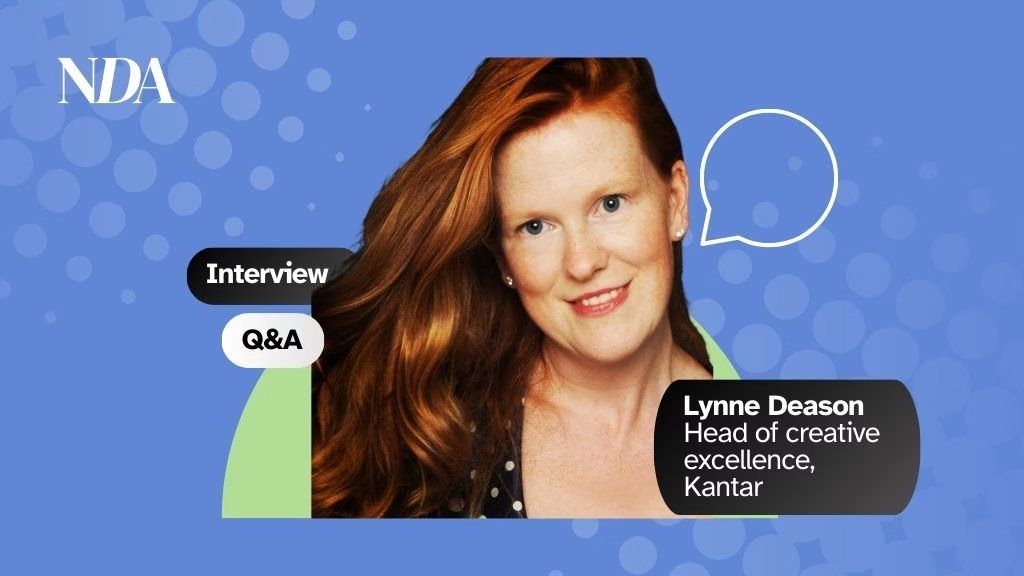
New Digital Age recently spoke with Lynne Deason, head of creative excellence, Kantar, to find out more…
Tell me about your role.
I’ve been working in the industry for over 25 years, across lots of different roles, industries and geographies. I’ve led global accounts at Kantar, worked in CX and innovation, but creative excellence in advertising has always been my real passion.
Today, in my current role, that means looking after our Creative team’s thought leadership, and making sure our tools and solutions are fit for purpose to help our clients address whatever situation they’re facing.
What were the key takeaways from this year’s Christmas research?
Christmas is a real cultural moment. People actively look forward to seeing ads at this time of year, primarily on TV, but increasingly across other channels as well. One in four consumers said they were looking forward to watching ads on YouTube and 18% on TikTok, with John Lewis the most talked about ad on the latter platform. The press is having a renaissance too as its advertising cut through for grocery brands has doubled in the past three years.
What we consistently see is that ads built on a strong, consistent creative platform massively outperform brand-new ideas. Cadbury, Coca-Cola, Aldi, Argos, Amazon: this year, these brands stuck with ideas that work, and those ads were more enjoyable, more expressive, and more strongly linked to the brand. It’s not that these ads ‘wear in’ and become better over time. They were great from the outset.
Researching ads early is critical, because confusion kills effectiveness. Understanding directly affects how good an ad makes people feel, how well they know which brand it’s for, and whether the intended message lands.
What can we learn from the most successful ads?
The best-performing ads get the fundamentals right. They use brilliant music to guide how people interpret the story. They tell stories well. Many of them use humour brilliantly. Those things are timeless drivers of effectiveness, and they’re lessons we can apply all year round, not just at Christmas. At Kantar, we talk about the ‘Three Cs’.
The first C is Clarity. That means knowing exactly what your brand stands for, what it is and what it’s not, and making sure that’s completely unambiguous across the business.
The second is Connecting with your audience, whether that’s through culture or human insight. When an adresonates, it earns attention and creates memories. It’s also about tailoring content so it feels right in every context, be it TikTok, out-of-home, or in-store. Content needs to be designed to win where it appears.
The final C is Committing consistently. Once you have a strong idea, bring it to life everywhere. Our data shows that being present across five or more media points can deliver three times the return, but only if there’s real cohesion.
When you get all of this right, brands become more vibrant in culture, more meaningfully different, and more likely to come to mind when people need them.
Were there any surprising insights?
Ahead of Christmas, we saw evidence that people were more open to gifting second-hand items, shopping on platforms like Vinted or eBay, or buying from charity shops. That signals a gradual societal shift, but we didn’t see many brands fully tapping into that insight in their communications.
What it tells us is that brands need to be present in the right places, not just communicating, but showing up where people are actually making purchasing decisions.
People often say they wish ads were as good all year round as they are at Christmas. In reality, there’s no reason why they shouldn’t be. Yes, Christmas brings its own emotional context, but great storytelling, music, humour and cohesion work in any category, at any time of year.
Brands also need to stay in tune with society. We’ve seen a rise in more traditional portrayals recently, and brands have to be mindful of how that aligns with how people are actually living their lives.
You studied Coca-Cola’s ad in detail. What did that reveal?
We looked at two versions of Coca-Cola’s Christmas ad: the people-led version shown in the UK, and the animal-led version used elsewhere.
Both performed very strongly, but the animal version was more emotive. Using facial coding and AI, we can see exactly how people emotionally respond as an ad unfolds, whether humour lands, whether tension works, and how powerful the emotional peaks are.
With animals, you have more creative licence. We don’t know what a surprised hedgehog ‘should’ look like, so there’s greater freedom to create emotional expression and that drives stronger emotional responses.
What this shows is that even when using AI, the fundamentals still matter most: great storytelling, strong insight, and clear brand centricity. If you’re depicting people, expressions have to feel right. And that’s why testing and research are so important. You need to make sure ads are landing as intended.
What are the key talking points among marketers for the year ahead?
AI will undoubtedly remain a hot topic, in all of its guises. That includes how it can help personal productivity, but also how it can be used wisely to develop and deploy more effective content.
Creators and influencers will also continue to be a major focus. It’s about how you brief them, how you measure their impact, and how you get the most out of them as a genuine source of growth.
At Kantar, we feel a real responsibility to help the industry learn from what’s working, so we can inspire people to create content that delivers for brands, but also that the public genuinely enjoys. That’s how you build trust, both in brands and in the ad industry as a whole.
The key message is that, with so much change and uncertainty in the world, brands need real clarity around who they are, what they stand for, and how they bring that to life consistently across every channel.