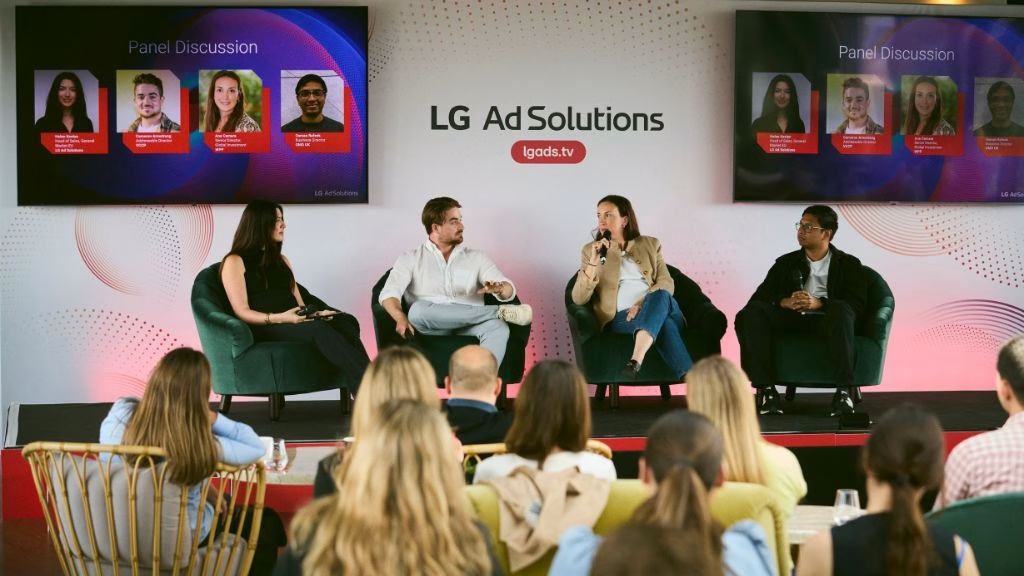
At the LG Ad Solutions Thought Leadership Breakfast, a panel of media experts gathered to discuss how trusted environments are reshaping the way brands build credibility, capture attention and deliver results. The session, moderated by Helen Keelan, Head of Sales for the General Market Europe at LG Ad Solutions, brought together Ana Camara, Senior Director of Global Investment at WPP Media, Cameron Armstrong, Addressable Director at VCCP, and Osman Rafeek, Business Director at OMD UK.
The evolution of the premium value exchange
The conversation opened with a look back at the roots of media credibility. Television has occupied a central place in domestic life for seven decades, fostering a unique psychological relationship with viewers that continues to shape how audiences experience advertising.
“It’s not only about trust, it’s about perception,” explained Ana Camara. “How the user is when they are in front of that TV screen. That emotional state is invaluable, and there is no other media at the moment that can compete with that from that emotional perspective.”
The discussion then turned to how different media environments shape the relationship between content, advertising and the audience.
“We’ve created this broken value exchange,” observed Cameron Armstrong. “Back in the day, TV used to be a fair exchange, and still is. You see the TV in exchange for great quality content, you see a few ads, and the ads used to be quite good.”
According to Osman Rafeek, trust in media has been improving in recent years, with traditional linear channels leading the way. In digital video, he said, efforts such as supply‑chain and inventory curation are part of a wider push to create more trusted environments.
Rafeek added, “Previously, these traditional channels were seen as reach machines, but while they can still do that role, they also have a credibility angle.”
Mapping the trust ecosystem
While each channel serves a specific purpose within a holistic media plan, the panel agreed that different platforms cannot be evaluated equally in terms of brand safety and credibility.
Search, for instance, operates in a high-trust environment but largely captures existing intent rather than generating new demand. Social media offers immense reach and targeted community engagement through micro-influencers, yet it continually grapples with misinformation.
To illustrate why television commands a premium, Armstrong introduced a striking biological metaphor. “It’s the peacock analogy to a certain extent,” he suggested. “There’s a certain peacock element to it when you’re a big brand showing up on TV, showing up on the big billboards out of home. It gives you an element of trust. You need to be at least a little bit trusted, at least a little bit serious as a company to show up there.”
This signalling effect has substantial commercial value, helping brands build long-term equity and supporting stronger pricing power over time.
Rafeek pointed to industry data, such as IPA effectiveness studies, to highlight how long-term consistency creates a powerful compounding effect.
“The benefit of trust is that it’s also a compounding effect, so if you continue that, it actually makes your media cheaper, because you don’t need to reach people as often,” Rafeek explained. He added that iconic brands can trigger consumer attention with nothing more than a distinct audio asset, like the snap of a KitKat or the McDonald’s whistle, because of “years and years of long-term strategy building.”
Camara agreed, saying, “Where did all these brands start? Television.”
The metrics that matter
Quantifying an abstract concept like trust requires moving away from individual digital metrics. The panel questioned the value of metrics like completed views as a reliable proxy for true engagement, saying that a fully played ad does not guarantee an attentive audience.
To tackle this, agencies are developing sophisticated, data-led algorithms. Armstrong shared VCCP’s approach, which focuses on a custom metric called “memorability.” This framework balances three distinct pillars: attention, contextual quality (such as the time spent on a premium publisher site versus a clickbait aggregator), and creative relevance.
“That’s longer term, how we try to quantify trust as not just something we talk about, but something we can actually show with data points,” Armstrong said.
Rafeek echoed the need for multi-layered measurement frameworks that combine attention data, incrementality, econometrics, and brand lift studies.
“I personally like the use of attention, the only thing is attention can be quite tricky, because even if that’s not perfect, you can be noticed for the wrong things.”
Defining the boundaries of television
The liveliest debate of the morning centred on what actually constitutes “television” in a fragmented, internet-connected era. Does the label apply to the physical device in the living room, or does it belong exclusively to professionally-produced content?
Armstrong confessed a preference for watching independent travel vloggers via YouTube on his living room TV screen, viewing it as a deliberate, high-attention ritual. “I think it’s just anything on the big screen,” he argued, pointing out that even vertical platforms like Instagram are making inroads into connected TV (CTV) environments.
Camara, however, drew a firm line in the sand.
“I fundamentally disagree,” she countered. “To me, television is professionally produced content, regardless of where you watch it. In my opinion, watching Love Island on YouTube on your phone, that’s television.”
She warned against treating user-generated content and broadcaster inventory identically in media planning, stating, “Watching people play Minecraft on a large screen is an experience that needs to be planned in a different way to linear or on-demand TV.”
Ultimately, whether an agency favours the strict definitions of traditional broadcasting or embraces the fluidity of hardware-centric viewing, the overarching conclusion of the panel remained clear: the big screen is an unmatched engine for growth. By pairing creative consistency with the premium, lean-back environment of CTV, brands can build the deep-seated consumer trust that secures long-term commercial success.
While the panel differed on where television begins and ends in today’s connected world, there was broad agreement on one point: context matters. Whether through professionally produced content, premium viewing environments or long-term creative consistency, the environments in which brands appear continue to influence how advertising is experienced – and ultimately, how trust is built.