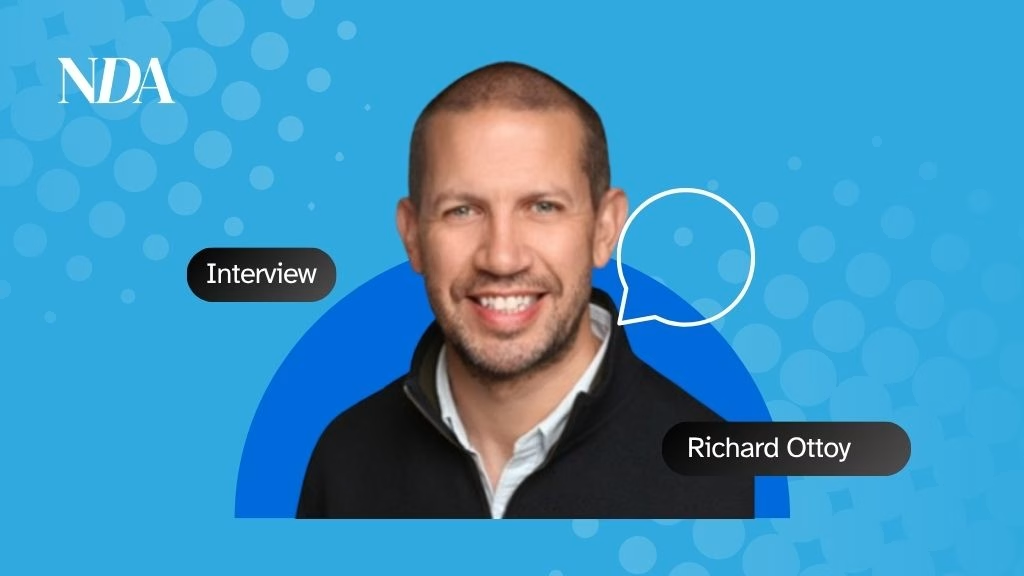
Picnic,an adtech company specialising in independent Inventory Intelligence with the PIQ data platform, has recently welcomed industry veteran Richard Ottoy as its new VP of Sales. With a focus on bringing PIQ to more brands and agencies looking to define and apply their own standards of inventory quality, we sat down with him to discuss his goals, the evolution of Picnic’s offering, and the challenges and opportunities ahead.
Tell me about your new role and what you want to achieve.
I’ve joined Picnic to lead our London sales team at an exciting time for the business. With Matt Goldhill, our CEO and founder, now focused on driving partnerships and US growth from New York, it’s the perfect moment to bring in a dedicated sales leader to accelerate our ambitions in the UK and Europe.
My overarching goal is to scale the business in two ways.
First, by growing revenue from our existing sales activity with brands and agencies, particularly around our proprietary PIQ product, which powers our media business. Second, by expanding partnerships, both with third parties who can use our PIQ data directly and with agencies and brands who want to activate that data themselves through DSPs.
For those who don’t know, can you explain how Picnic’s offering has evolved?
Picnic started eight years ago as a high-impact format provider, initially focused on social extension formats within Google AMP environments. The pitch was simple – high quality formats in high quality environments deliver better advertiser outcomes.
When publishers began moving away from AMP, the team needed a new way to identify quality environments. That’s when we developed PIQ, our proprietary inventory intelligence platform. It uses a crawler to assess thousands of sites on dozens of attributes, from ad load and content ratios to refresh rates and page speed, to determine quality from an ad experience perspective.
In recent years, we’ve started making PIQ available for partners to use independently. The vision is for PIQ’s quality signals to become an industry currency for planning and optimising campaigns.
How are you working with brands and agencies now?
The process is straightforward, we speak to brands and agencies about their campaign objectives, then use PIQ to curate a premium, high quality site list. We package that into a deal ID that can be used in any DSP, so clients can buy that inventory directly.
The results speak for themselves. When advertisers buy high quality environments, the post-click engagement is far stronger than in low quality environments, where accidental clicks and high bounce rates are common. Whether the goal is sa or deeper brand engagement, quality environments consistently deliver better outcomes.
How does revenue currently break down between direct sales and partnerships?
Today, the bulk of our revenue still comes from our media business, curating deals for brands and agencies.
But we’re on the verge of announcing major data partnerships where others will use our PIQ signals directly. We’ve tested this over recent months and the results have been very positive. Over the next 12 months, I expect these partnerships to become a much more significant revenue stream.
What are the biggest challenges ahead?
There are two main challenges. First, with so many data companies and signal providers in market, advertisers risk layering on too many costs, which can push CPMs up and hurt performance. We need to work closely with clients to be complementary to what they’re already using.
Second, there’s an education challenge. Buying high quality inventory may not dramatically change media metrics like CTR or viewability, which can make traders in DSPs default to cheaper inventory.
But the post-click outcomes, especially brand lift sales, applications, downloads, engagement, time spent on site, are far better in quality environments. We have to show the proof points through case studies and post-campaign analysis to shift ingrained behaviours.
Is anyone else doing something similar?
The closest business to ours, Sincera, was acquired by The Trade Desk earlier this year. That, along with other acquisitions like Greenbids, has raised the profile of quality and sustainability signals in programmatic buying.
There’s a lot of energy around how these data points can help brands, agencies, and adtech companies make more informed supply decisions.
What’s your personal goal for the next few months?
I love building businesses, and with Picnic we have a fantastic product and huge potential. My immediate goal is to scale up, growing both the media and data sides of the business. At the same time, I want to raise Picnic’s profile, particularly as we pivot more towards a data proposition.
Education will be key for this, both in the UK and internationally, to ensure the industry understands the real value of quality environments in driving outcomes.