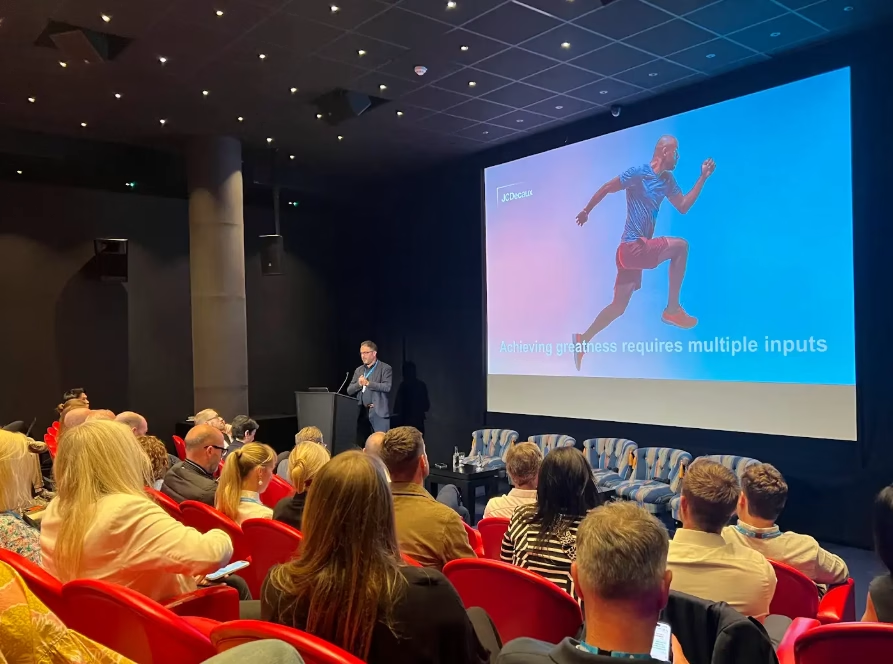
Two decades ago, outdoor advertising was still dominated by paper posters, with manual bookings and faxed insertion orders forming the backbone of the buying process. As Jon Mundy of JCDecaux explained at NDA’s Foresight event, the first significant shift came with digitisation around 15 years ago.
Today, the vast majority of JCDecaux’s revenue is digital-first, though only a small proportion of that is currently bought programmatically.
The wider advertising industry has experienced a similar transformation. Programmatic began as an experiment in automation, removing inefficient manual processes and enabling ads to be bought and sold in milliseconds. What started as a tool for efficiency has grown into the backbone of media buying, shaping the way campaigns are planned, optimised, and measured.
The rise of data and precision
The second major wave of programmatic’s evolution came with the arrival of data. First-party data, cookies, and audience targeting created a step-change in how media was planned. Advertisers no longer focused solely on context, such as aligning ads with specific content or publications, but instead zeroed in on individuals and their behaviour.
While this precision helped drive performance, it also came with unintended consequences. As Mundy noted, audience-based buying often undermined quality content. Blogs and publishers that once thrived by selling against context found themselves sidelined as buyers prioritised data-driven targeting.
“They didn’t care what they were looking at on the page,” Mundy reflected, highlighting how performance metrics overtook considerations of content quality.
Standards, accountability, and transparency
As programmatic matured, standardisation became critical. Industry-wide definitions of viewability and measurement frameworks brought a level of consistency that had been lacking in the chaotic early years. At the same time, advertisers demanded more accountability and control.
Transparency dashboards, brand safety tools, and more sophisticated attribution models emerged, enabling advertisers to understand exactly where their ads were running. Yet these developments also raised difficult questions about privacy, ethics, and advertiser-funded content. The debates that dominated the late 2000s and early 2010s helped lay the foundations for today’s more measured, responsible approach.
From chaos to adaptability
Mundy argued that the industry has now moved beyond the early chaos of automation and unchecked targeting. Programmatic today is about adaptability, with advertisers seeking solutions that cut across multiple channels rather than operating in silos. Audio, connected TV, and digital out of home have all joined the programmatic ecosystem, creating an omnichannel reality where campaigns are planned holistically.
“We’ve moved on from clicks to attention, from direct response to brand building, and from isolated channels to unified planning,” Mundy said. This shift reflects the growing maturity of programmatic, not just as a technology but as a strategic driver of advertising effectiveness.
Omnichannel, not multichannel
One of the most important distinctions Mundy drew was between multichannel and omnichannel. Multichannel simply means being present across different platforms, while omnichannel involves tying those platforms together to deliver greater impact.
This approach requires both the back-end systems and the strategic mindset to unify campaigns across out of home, CTV, retail media, mobile, and beyond. Programmatic becomes the connective tissue that binds these channels, ensuring campaigns are not just fragmented presences but integrated experiences.
Out of home as a powerful partner
For JCDecaux, digital out of home is central to this omnichannel future. Mundy shared examples of how programmatic out of home can combine with mobile to deliver powerful results.
A study with Lumen demonstrated that bus shelters generate strong attention scores, particularly from people waiting at stops. When those audiences are later retargeted on mobile, campaigns can follow them through their journey in a seamless way.
“It’s the ultimate brand builder,” Mundy explained, describing out of home as a powerful primer that works best when paired with other channels. The ability to connect those channels programmatically is what turns awareness into action.
Looking ahead
For all its progress, Mundy acknowledged that programmatic still has challenges to overcome. Buying models in out of home need to adapt to programmatic realities, particularly when most inventory is still sold in two-week slots. Agencies also need to shift away from treating out of home as a silo and instead embrace it as part of wider programmatic planning.
Looking forward, JCDecaux sees itself becoming a programmatic-first, ad tech-driven business. “In ten years’ time, JCDecaux will be a programmatic-first company and an ad tech company,” Mundy predicted, pointing to the company’s SSP and DSP capabilities as proof of its ambition.
More voices, less echo chambers
Perhaps Mundy’s most important message was the need for diversity of thought. Warning against the dangers of ad tech echo chambers, he argued that the future of programmatic lies in bringing different voices, platforms, and channels together. Collaboration across the ecosystem will ensure programmatic continues to evolve into a smarter, more responsible, and more impactful way of connecting with audiences.
As Mundy concluded, “If you take one thing away, it’s that we all need to get more voices in the room and not end up in a weird ad tech echo chamber.”