The landscape of retail media is evolving at a breakneck pace, with data collaboration emerging as a key driver of innovation, efficiency, and growth.
During a recent panel discussion, four industry experts shared their perspectives on what makes successful partnerships, the importance of responsible data usage, and the challenges that lie ahead.
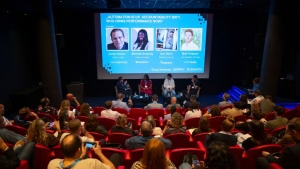
The discussion took place at an event held on Valentine’s Day at London’s The Ivy Club, featuring a select audience of senior marketers, dedicated to exploring data collaboration. The event was part of NDA and LiveRamp’s Meet the Revolutionaries initiative, which interviews and brings together marketers at the forefront of data-driven marketing.
The panel featured Lena Arbery, Director of Destinations, Travel and Growth, EMEA at Tripadvisor; Hugh Stevens, UK MD at LiveRamp; Paul Wright, Head of International, Uber Advertising; and Ollie Shayer, Omnichannel Director at Boots. Together, they dissected the intricacies of data collaboration and provided actionable insights on how brands can harness the power of partnerships to drive business success.
The foundations of effective collaboration
Kicking off the discussion, Hugh Stevens emphasised that collaboration is about “finding a place where mutual value can be achieved.” Whether it involves a publisher with valuable data, a unique consumer travel moment, or a product meant for a specific audience, effective partnerships hinge on identifying and unlocking shared opportunities.
Paul Wright of Uber Advertising echoed this sentiment but also stressed the importance of responsible data handling. He provided an example of Uber’s decision not to utilise certain sensitive data points, such as trips to hospitals and clinics, to ensure ethical data use.
“There’s always an element of responsible data in collaboration, and for us, that’s critical,” he stated.
For Ollie Shayer at Boots, two fundamental qualities underpin successful collaboration: positive intention and patience.
“What you may wish to achieve initially may not be where you end up,” he noted, highlighting the iterative nature of partnerships.
Lena Arbery added that data collaborations are “journeys of discovery, often leading to unexpected but valuable insights.”
The challenges of building retail media networks
As retail media continues to grow, brands must navigate a complex landscape of barriers and opportunities. The panelists identified patience, tenacity, and technological investment as key factors in setting up and scaling a retail media network.
Hugh Stevens outlined three critical “T’s” for success: “tenacity, talent, and technology.”
“There’s a lot of competition out there, so brands need to determine their unique selling points and respect their consumers’ data,” he explained.
Ollie Shayer emphasised that “every retail media network must be tailored to the retailer’s specific needs rather than simply replicating existing models.Start with who you are and what you want to be, rather than just mirroring what’s already available in the market,” he advised.
Lena Arbery reinforced the importance of aligning collaboration efforts with real consumer insights, while Paul Wright noted that “securing buy-in across all levels of an organisation is essential for long-term success.”
“Without alignment from the CEO to every team within the company, you risk making decisions based solely on revenue rather than consumer needs,” he warned.
Unlocking value through insights and measurement
One of the most pressing topics was the growing demand for better measurement and attribution in retail media. Brands increasingly seek not just activation opportunities but also deeper insights into consumer behavior and the effectiveness of their marketing investments.
“Retail media is an evolution of what’s been happening for years,” Stevens said. “But what’s different now is the realisation that a retailer’s assets extend far beyond their own store or website.”
Shayer highlighted Boots’ work in linking online ad exposure to in-store sales, demonstrating the power of cross-channel insights. “Understanding how retail media impacts transactions beyond digital environments is crucial,” he said.
Paul Wright provided an example from Uber’s advertising strategy, illustrating how simple data points can drive personalisation at scale.
“We knew who was traveling to Taylor Swift concerts via Uber, so we partnered with Pinterest to target that audience for future events,” he explained. “Personalisation doesn’t require vast amounts of data—just the right data.”
The role of technology in collaboration
As data collaboration becomes more sophisticated, the technology infrastructure supporting these partnerships must also evolve.
Boots, for example, focused on creating a single technological backbone that integrates its core business with Boots Media Group, accelerating learning and operational efficiency.
“Agreeing on the right tech infrastructure at the outset saves time and ensures seamless collaboration across privacy, legal, and marketing teams,” Shayer stated.
For Uber, balancing in-house development with strategic third-party partnerships has been key. “Where we can build, we do,” Wright said. “But we also work with partners like LiveRamp and Criteo where it makes sense.”
Hugh Stevens underscored the importance of data clean rooms in ensuring privacy-safe data collaboration, citing a recent initiative between Boots, LiveRamp, and Criteo that measured the in-store impact of digital ads.
“This collaboration is about closing the measurement gap and proving incremental value,” he said.
The future of data collaboration
Looking ahead, the panelists agreed that retail media and data collaboration will continue to evolve, but structural challenges remain. Measurement was identified as the industry’s biggest hurdle.
“Everyone keeps asking, ‘Who’s going to solve measurement?’ and the truth is, it will require a collective effort,” Stevens said.
Wright argued that “the retail media industry must develop its own measurement frameworks rather than relying solely on legacy models.
“We shouldn’t just fit into what’s come before—we need measurement that reflects the uniqueness of retail media,” he said.
Additionally, regulatory and privacy considerations play a crucial role in shaping future collaborations.
Shayer pointed out that “legal and compliance teams need greater education on the potential and risks of data partnerships to facilitate smoother execution.”
Collaboration as the key to growth
Throughout the discussion, a clear theme emerged: collaboration, when executed thoughtfully, has the power to unlock immense value for brands, retailers, and consumers alike.
From personalisation to measurement and technology, the retail media industry is rapidly evolving. By fostering partnerships based on trust, transparency, and shared insights, businesses can drive sustainable growth while maintaining consumer trust.
As retail media continues to gain traction, the key takeaway from this panel was that collaboration must be strategic, consumer-first, and rooted in a deep understanding of what makes each partner uniquely valuable. As the industry works to refine measurement standards and overcome technological and regulatory hurdles, one thing is certain: those who embrace data-driven partnerships will be best positioned for success in the future of marketing..
Videos from the event can be viewed here.