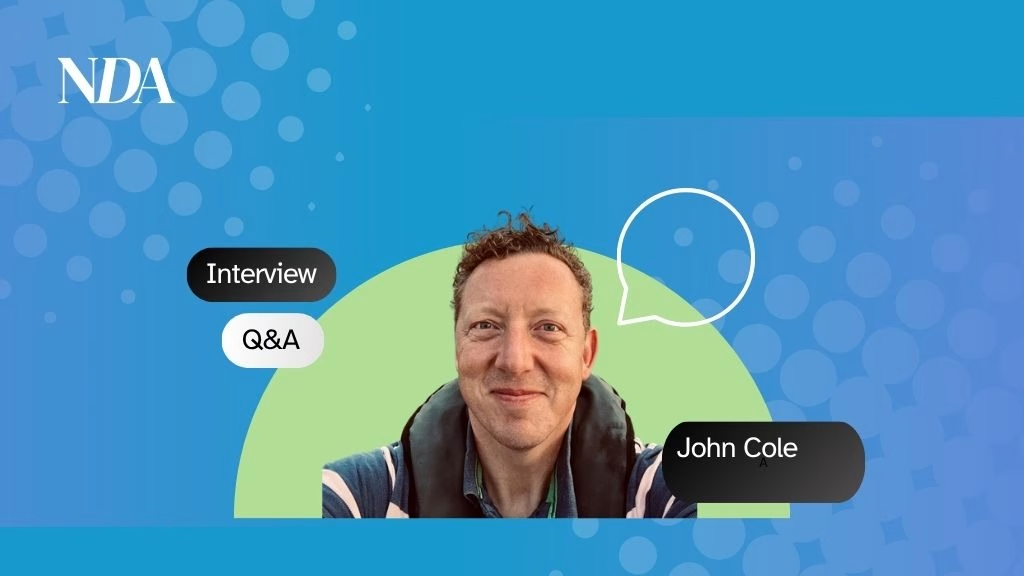
Fifteen years is a long time in digital advertising. Long enough to watch the same structural problems persist, the same power imbalances entrench, and the same publishers get squeezed by a supply chain that was never really built in their favour. John Cole, Chief Customer Officer at Ezoic, has had a front-row seat to all of it, and he is cautiously optimistic that things are finally starting to shift.
Ezoic began life as a multivariate testing platform helping publishers improve user experience and revenue simultaneously. It became the first North American partner for Google AdSense in 2014, and is now a Premier Google Certified Publishing Partner, one of only a handful globally.
With approximately 10,000 publishers running through its system and around 800 million visits a month flowing through its platform, it has scale. But the business it runs today looks quite different from the one it was building just a few years ago.
A deliberate move up the market
A few weeks before this conversation, Ezoic announced it would no longer take on publishers with fewer than 250,000 visits a month. It was a significant strategic signal, placing the company firmly in the mid-market tier and away from the long tail of smaller sites that had defined much of its earlier growth.
The reasoning is clear enough. Smaller publishers, despite being served well technically, would sometimes earn four dollars where they expected five, leave a negative review, and move on. The reputational noise made it hard to tell the fuller story.
Alongside that decision, Ezoic has also been quietly reducing its exposure to Google organic search traffic, which Cole says now accounts for a much reduced percentage of total traffic compared to three years ago. The driver is well understood.
“More than 75% of all searches now stay on Google due to AI overviews,” Cole explains. “Users are going less and less to the internet.” To compensate, the business expanded into non-content destination sites, like newsletter sites, web apps, online directories and email service providers as well as destination sites, where users arrive with a purpose that does not depend on a Google ranking. And it’s working, Cole mentions steady 25% YOY growth with the new approach.
The structural problem that never went away
Cole is candid about what has not changed. The fundamental asymmetry between publishers and the rest of the advertising ecosystem remains largely intact.
Publishers sit at the end of a long chain, with agencies, sales houses, SSPs, ad servers and assorted intermediaries all taking a slice before revenue reaches them. “One side knows more about the value of your users than the other,” he says, “and so they can pick it up more cheaply than they should. We aim to help fix that.”
The Google antitrust situation, where the DOJ found the company guilty of anticompetitive practices such as leveraging its ad exchange market position to lock publishers into its ad server, still looms large over the industry. Cole expects the appeal to be hard fought.
In the meantime, the auction dynamics that govern how publisher inventory is bought and sold have become, in his words, extraordinarily complicated. He references the Trade Desk’s Jeff Green, who has spoken publicly about obfuscation and misinformation in the auction process.
Cole has seen it himself. “For example, there are seller duplication techniques (not adopted by us) where a single ad request is replicated tens of times,” he says, “to try and get one of the higher bids.”
When he refers to a set of notes from a recent publisher meeting, the pain points are familiar: poor revenue transparency – how much one ad provider dilutes another, private marketplace deals arriving with poor tracking, ads.txt bloat – filled with resellers, and data fragmented across too many systems and partners. He observes that there is just too much adtech in the ecosystem. What publishers want is clarity,” Cole says. “They have high-quality traffic and they could get paid much more – if they leverage better technology to untangle all the inputs.”
Where AI is making a practical difference
The shift Cole is most energised about is not strategic but operational. LLM-driven development has allowed Ezoic to build and ship features at a pace that was not previously possible for any company of its size, enabling it to pitch mainstream newspapers and mid-tier publications with genuinely bespoke solutions rather than a one-size-fits-all offering.
“Software can become more bespoke now for publishers,” he says. “They don’t have to be the same as everyone else.”
Internally, AI agents are already embedded in day-to-day operations. Publisher success teams can write natural language queries against a database and receive instant answers. Cole and his publishers get agentic daily reports covering earnings, identity revenue, video versus display splits, and bid floor trend lines, all generated automatically by Ezoic’s AI Agents.
On the revenue side, Ezoic has developed a rewarded advertising format it believes offers a more sustainable alternative to hard paywalls. Modelled on mechanics familiar from mobile gaming, it invites users to watch a short video in exchange for access to an article, generating ad revenue while keeping the audience engaged rather being blocked or forced to sign up for a trial subscription.
“Publishers are in a conundrum,” Cole acknowledges, “Google’s latest advice is to add value with content or services that are unique, to avoid commoditised content; they have to add value outside of easily found, general information.”
After 15 years, the industry’s structural problems are stubbornly familiar. But Cole’s argument is that the tools to finally address them, properly, at speed and at scale, are only now arriving.