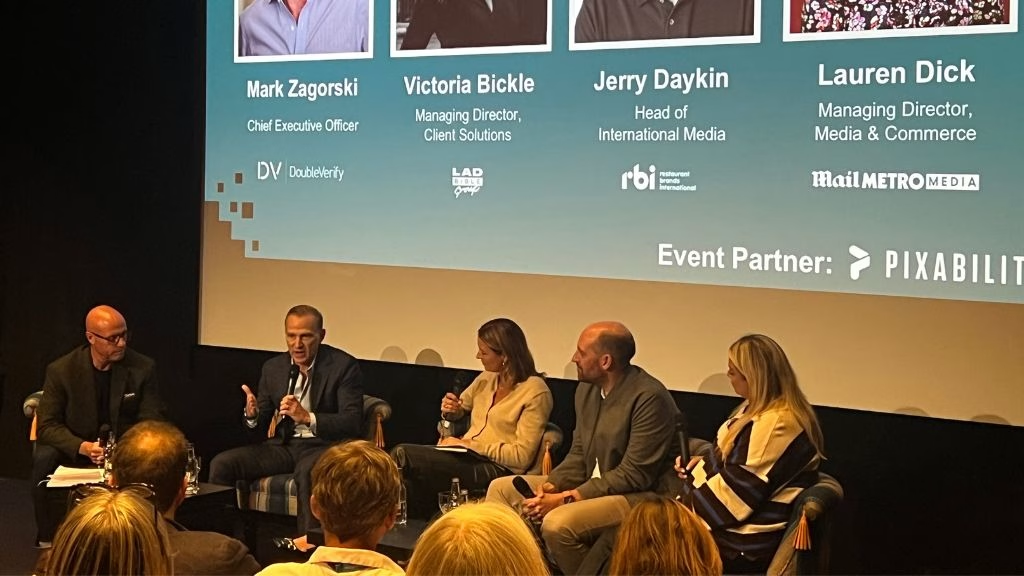
At New Digital Age’s recent Foresight event, a panel gathered to discuss the evolving role and value of premium publishers in today’s digital landscape.
The panel included Mark Zagorski, CEO of DoubleVerify, Lauren Dick, MD Media & Commerce at Mail Metro Media, Victoria Bickle, MD at LADbible Group, and Jerry Daykin, Global Head of Media at Restaurant Brands International/Burger King. Moderator NDA Publisher Andy Oakes set the tone by highlighting Claire Enders’ assertion in her opening talk at Foresight that premium publishers are experiencing a significant resurgence.
A new era for premium publishers
Lauren Dick observed, “We’re definitely seeing a surge in certain areas, and obviously a decline in others. The big step change has been in the last 18 months to two years; how do we completely change our business so that we’re focused on areas that deliver growth long term?”
Her view was echoed by Victoria Bickle, who said, “It’s looking really different. Brands are investing in long-form content and branded partnerships like never before. So it’s exciting.”
Both reflect a renewed optimism after years of industry uncertainty.
Mark Zagorski added a tech perspective, commenting, “What sets leading publishers apart is their ability to present a distinct perspective, a unique POV. Publishers were the original influencers, changing minds and building audience loyalty through differentiated content.”
For Zagorski, maintaining and amplifying that editorial voice remains a vital task in an age increasingly shaped by AI and automation, where undifferentiated data is readily available anywhere.
Advertisers value context and engagement
From the brand angle, Jerry Daykin noted that advertisers have matured beyond the hype of programmatic technology: “We lived through phases where programmatic was transformational. But ‘right place’ often just meant ‘any place’. There’s more to it than eyeballs; metrics like ‘attention’ matter and are stronger on premium publishers, added to intangible factors like trust.”
Daykin stressed that context is irreplaceable, bringing in the analogy of selling luxury goods in an inappropriate setting, it’s not just the right person, but also the right environment.
“If you’re selling a luxury handbag, you may know that someone visiting Westfield is in the market for one, but you wouldn’t try and sell them one in the toilet.”
Victoria Bickle described how LADbible’s positioning has shifted: “A couple of years ago, we wouldn’t have been considered a premium publisher. Now, it’s about trust, not just look and feel. We’re experts in youth culture, tapping into their emotions, mixing fun memes with serious conversations.” This approach resonates with audiences, forming the backbone of their commercial strategy.
Lauren Dick likewise argued that trust is the “red thread” running through Mail Metro Media’s content, but that premium publishing now requires communication across generational divides: “Teams report on The Budget one way for print readers, another way for students via online video. If they trust your brand, you have the authority but you need to deliver the content in a form they want to use.”
Performance pressure and the walled gardens conundrum
Despite recognition of premium publishers’ value, Mark Zagorski pointed out their biggest challenge.
“Advertisers have been trained by platforms to believe everything’s trackable and can be matched to a sale. Publishers must create connectivity, from exposure to outcome, and prove effectiveness.”
He argued that although budgets often flow to walled gardens for ease of measurement, news offers a compelling performance opportunity thanks to engaged audiences that help drive strong campaign outcomes.
Lauren Dick candidly reflected on the industry’s past focus on measurable outcomes, admitting, “We made a rod for our own back saying everything’s measurable. The entire industry surged that way. The walled gardens benefited due to their unified ecosystems’s ability to track spend.”
She now urges a broader planning approach, balancing performance metrics with brand uplift and engagement in premium bethe.
Victoria Bickle introduced the concept of “Lad 360”, a blended model that brings together strategy, creative, data and production expertise. It gives every corner of the industry access to our services – whether briefs come from media agencies, creative shops, PR firms, or directly from clients.”
“Brands are willing to pay more if you give them more than just a buy. Bespoke solutions help us focus on clients’ business challenges and expand beyond standard placements,” she explained, illustrating the added value premium publishers offer.
Measurement models and creativity’s evolving role
Measurement remains a hotly debated topic. Mark Zagorski said, “Things like media mix modeling and MTA work when advertisers see results that match the measurement. There’s an opportunity to scale measurement across platforms with a single currency.”
He warned against over-reliance on proxy metrics without a clear connection to real outcomes.
Victoria Bickle stressed engagement with hard-to-reach audiences as the key metric for LADbible, noting, “Brand metrics and the ability to prove true engagement are becoming more important. Our own channels and client measurement studies help optimise campaigns in real-time.”
While short-term results matter, the long-term brand lift is critical for sustained growth.
Lauren Dick added, “Sometimes we need to take risks and test new creative messages, rather than relying solely on what measurement models spit out. Leaning too far into data can kill creativity, which is why balanced insight is needed.”
Future formats and the AI opportunity
As the panel drew to a close, Victoria Bickle highlighted the importance of evolving formats: “We’ve launched a FAST channel on Samsung TV, branded podcasts, and expanded meme-based content for new audiences. Growth depends on delivering content across platforms where audiences spend time.”
Lauren Dick described Mail Metro Media’s approach as “meeting users where they are,” reflecting the need for publishers to adapt offerings for different demographics, platforms, and levels of brand compliance.
The discussion ended with a spotlight on AI. Mark Zagorski emphasised, “We have to define what true engagement means in the AI age. We’ll need new standards for agent interaction.”
Jerry Daykin offered a practical illustration, saying, “Brands like Apple and LVMH are putting more text on their websites to be AI-friendly. But ultimately, publishers who create valued content will win.”
The panel closed on the consensus that premium publishers, through trust building, data-driven creativity, and consultative partnerships, are uniquely positioned for success in a rapidly evolving media landscape – but only if they continue to adapt and prove their worth to marketers.