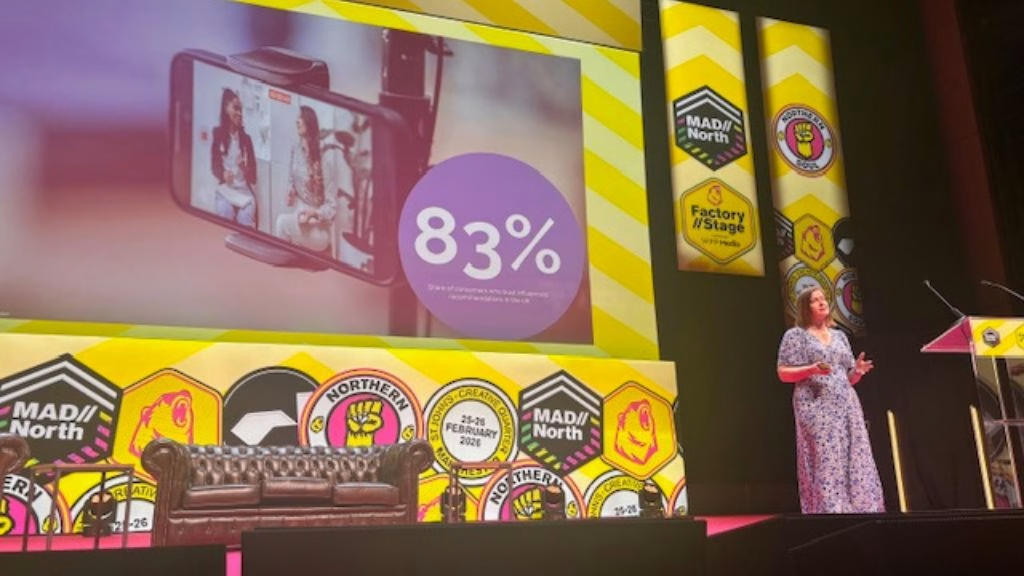
The rise of the influencer has been meteoric, yet for many brands, the channel remains a “black box” of unpredictability. At Madfest North, Ffion Turner, WPP Media Analytics, shared the findings of a landmark study conducted in partnership with the IPA, Thinkbox, and several industry competitors.
By pooling real-world data to create the first scaled databank of influencer marketing effectiveness, the project aims to move the conversation from guesswork to certainty.
Bridging the data gap
Turner noted that while the industry is currently rich in ROI studies, significant “black spots” remain, most notably around influencers. This led to a bold, collaborative initiative.
“We had quite a bold idea and with the support of the IPA, we worked with what would normally be deemed our competitors to come together to deliver a first of its kind scaled study of influencers,” Turner explained.
The necessity for such data is underscored by the channel’s explosive growth. Turner highlighted that global ad spend grew by 6% between 2024 and 2025, but influencer spend surged by 36%. “This money isn’t incremental into the market, brands are making a conscious choice to move money into influencers,” she noted, adding that 83% of UK consumers now trust recommendations from creators.
Short term performance and the sector split
When examining the short term, defined as up to three months post activity, the study found that influencers perform “mid pack”. With an average ROI index of 99 against a brand average of 100, the channel contributes approximately 4.5% of the total sales effect. Turner observed that influencers show a “similar ROI to TV, but the volume more in line with online video, specifically YouTube”.
However, these “average” figures hide significant sector-specific success stories. While most categories are in line with the mean, Telecommunications is a standout performer.
“Telco performs really, really well, but the spend is small,” Turner said. “It’s probably the smallest spend of all the sectors but a phenomenal result for influencers”. Geographically, she noted that “Italy are really good at this,” suggesting brands look to Italian counterparts for best practices.
The long term multiplier effect
The true power of influencer marketing is revealed in the long term, measuring lasting effects up to two years post activity. “This is where influencers really come into their own,” Turner argued. In this timeframe, the channel moves into the top three for ROI, with an average index of 151.
Turner attributed this to the unique nature of creator content. “Influencers are disproportionately impactful in the long term,” she explained. “This really reflects the trust element of this channel, so you’re using trusted voices to deliver the longer term”. This creates a significant “multiplier” effect that outperforms performance-led channels like paid social in the long run.
Navigating the death or glory distribution
The study’s most striking finding is the sheer variability of results, which Turner described as the “Wild West”. Unlike TV, where ROI tends to be normally distributed and close to the average, influencer performance is highly volatile. “It is very much death or glory in this channel,” Turner stated. “Not many people are actually getting that average ROI”.
This volatility makes traditional media planning difficult. Turner revealed that her team searched for “golden rules” but found that “all the usual media rules of thumb just didn’t apply”. “Sometimes you spend more and it’s okay, other times it’s not,” she observed, noting that there was no consistent relationship between ROI and spend levels, active weeks, or CPM.
The importance of synergy
The message for brands is that influencer marketing cannot be treated as a simple commodity. Success depends on intangible factors that data alone cannot always capture.
“It isn’t just about doing influencers,” Turner concluded. “Like partnerships and sponsorships, they work so much better when there’s a clear synergy between the channel and the brand”.