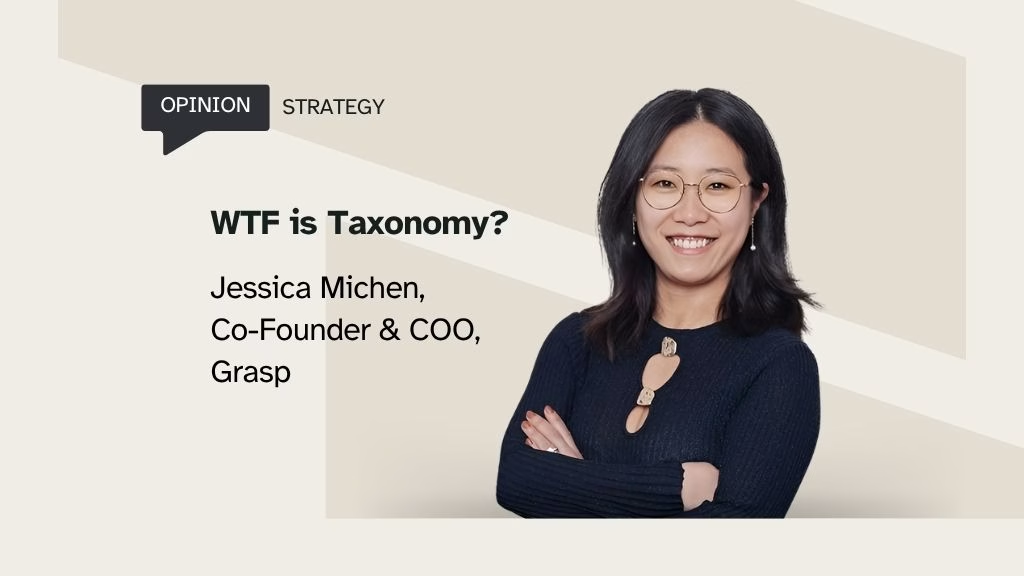
By Jessica Michen, Co-Founder & COO at Grasp
Taxonomy is the system used to name, organise and structure campaign data so it can be understood and used consistently. At a basic level, it’s the agreed format for items such as campaign names, ad sets, audiences, markets and channels.
Taxonomy may not sound exciting. But in modern media buying, it decides whether campaign data can be measured clearly, compared properly and trusted later.
In short, it creates a common language used across teams, platforms and markets to identify and track specific campaigns. In practice, this connects the planning stage to execution, and all the way through to reporting.
That matters because media buying is no longer neat or contained. Campaigns now run across multiple platforms, markets, agencies and formats, often at the same time. In that environment, taxonomy is no longer just housekeeping. It is what keeps campaign data connected as activity scales.
Why poor taxonomy costs money
Right now, marketing teams are feeling the pressure. Whether it’s from the top down to deliver better measurement and targeting, or the need to keep up with the pace of consumer demand, the expectation is clear: do more, move faster, and prove what worked.
Yet many of the issues that affect performance start before optimisation, before reporting, and before a campaign even goes live.
For many brands and agencies, how campaigns are set up in the first place is where challenges arise. Most of the time, setting up campaigns on marketing platforms is handled manually by junior team members working across multiple platforms and managing a high volume of campaigns. Even for more experienced teams, the complexity can quickly become overwhelming, and human error inevitably creeps in.
Modern media buying runs on data, but that data is only useful if it is structured correctly from the start. Grasp analysis suggests that up to 80% of media data can be lost or compromised at the source when taxonomy is inconsistent or incomplete.
The scale of that risk becomes clearer during major global moments. Take the FIFA World Cup, for example. With campaigns running across dozens of markets, platforms and teams, Grasp analysis suggests that up to $3.9 billion of ad spend could be affected by compromised campaign data due to inconsistent taxonomy.
That is not just a reporting inconvenience. It creates a blind spot in media performance, where teams are making decisions on data they cannot fully trust and, in some cases, wasting significant ad spend.
The issue is that poor taxonomy affects far more than campaign names. It can influence the data feeding media mix modelling, optimisation, AI-driven buying, budget allocation and performance analysis. If the campaign data is wrong at the source, every system built on top of it is working from a flawed picture.
Put bad data into the system and you do not get smarter marketing. You get faster, bigger mistakes.
What this looks like in practice, and how brands are fixing it
A typical global campaign might run across multiple platforms (think Google Ads, Meta, TikTok and Amazon DSP) across dozens of markets, often managed by different teams or agencies.
To keep that activity consistent, a taxonomy might require every campaign name to follow a specific structure. For example:
UK_Meta_Prospecting_NewCustomers_Q2
Using this, any team or system looking at the data can immediately understand what the campaign is, how it was set up, and how it should be grouped in reporting.
However, in reality, this is where things can start to unravel. If one team writes “UK” while another writes “United Kingdom”, or if a field is missing or formatted slightly differently, the data no longer aligns. Even something as small as an extra space can break reporting.
Individually, these look like minor inconsistencies. Collectively, they are where the boring bit becomes expensive. One extra space, one local variation, one missing field, and suddenly the campaign data that should be helping teams optimise performance is creating confusion instead.
This is why agencies and brands are moving towards prevention. Rather than finding the problem after a campaign has launched, they are embedding taxonomy tools directly into workflows at the point of setup, so errors can be stopped before they enter the system.
Grasp’s Taxo, for example, sits inside media buying platforms and guides or enforces how campaigns are named and structured as they are being created in real time.
This shifts the burden away from individuals having to be perfect under pressure and onto systems that make consistency the default. By the time a campaign is live, the budget has already moved, reporting has already been affected, and teams are left trying to reverse-engineer what went wrong. Ultimately, prevention means fewer mistakes reaching that stage in the first place.
So yes, taxonomy may sound ‘dull’, but in modern media buying, it is impossible to ignore. As campaigns become more complex and teams rely more heavily on automation, the brands that get the basics right at the start will be the ones with data they can actually use at the end.