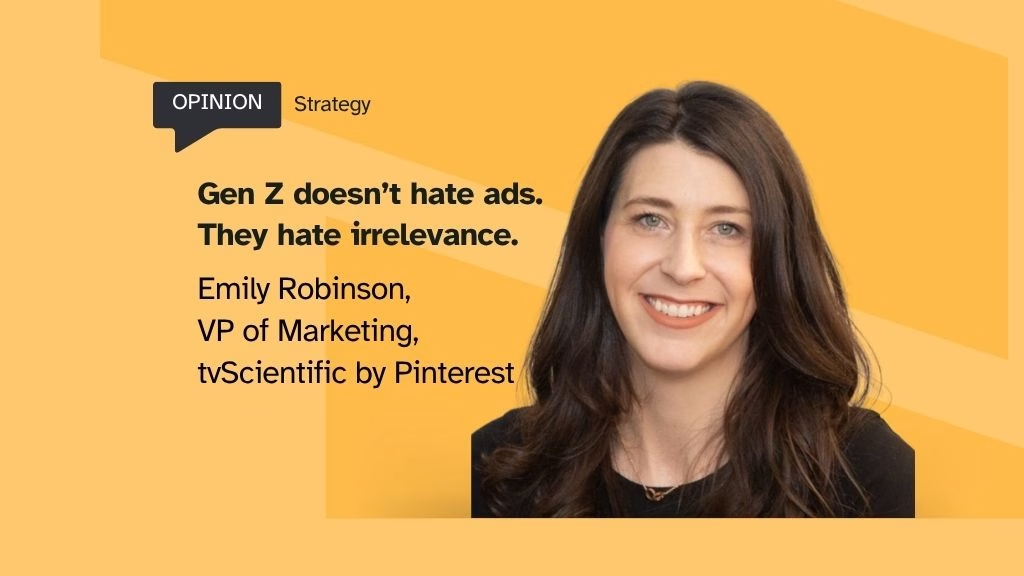
By Emily Robinson, VP of Marketing, tvScientific by Pinterest
It seems like every generation has a different relationship to advertising.
Some grew up with appointment viewing and accepted ads as part of the experience. Others learned to scroll past them. And now, Gen Z is often described as the generation that avoids ads altogether — so much so that they’re willing to pay more for ad-free subscriptions.
On the surface, the data seems to support that narrative. A 2026 Consumer Trends Report shows that 74% of Baby Boomers have ad-supported tiers in their streaming TV mix, compared to just 43% of Gen Z.1
But that stat doesn’t tell the whole story.
Gen Z doesn’t reject advertising outright. They reject advertising that feels irrelevant, repetitive, or disconnected from their experience. When ads don’t meet their expectations, they opt out. But when they do, Gen Z actually leans in.
How Gen Z got its reputation
It’s easy to see how Gen Z earned the label of “ad-averse.”
They have more control over their media environment than any generation before them. They can skip, scroll, mute, or pay to remove ads entirely. And often, they do.
The natural conclusion to draw from that behavior is that the younger generation rejects brands or marketing. But a closer look at how Gen Z relates to advertising reveals it’s actually a rejection of clutter and irrelevance.
If the majority of ads someone sees feel generic or poorly targeted, opting out becomes a rational decision, especially when that person is used to personalization. In fact, Gen Z is more willing than any other generation to pay for ad-free viewing, with only 43% choosing ad-supported tiers.1
When viewed through that lens, Gen Z’s lower adoption of ad-supported TV tiers reflects a higher standard for relevance, not a rejection of advertising itself.
Gen Z expects personalization and utility
That higher standard shows up clearly in what Gen Zers actually say they want.
More than half (53%) of Gen Zers want ads that are personalized to their recent searches or purchases, compared to just 20% of Baby Boomers.1
Gen Z has grown up in environments shaped by personalization. Their media experiences are tailored to them in real time, making Gen Z accustomed to systems that adapt to them. Advertising, in comparison, often lags behind.
When ads feel disconnected from what they care about, they stand out in a bad way.
But when ads are relevant and useful, the response is very different. Forty-five percent of Gen Zers say they’re interested in shoppable pause ads, compared to just 11% of Baby Boomers.1
This reveals that Gen Z is open to advertising formats that feel integrated into the experience and provide immediate value. If an ad helps them discover, evaluate, or purchase something more efficiently, it’s not an interruption at all. On the contrary, it’s an appreciated part of the journey.
This aligns with broader behavioral patterns. Gen Z is highly accustomed to AI-driven, adaptive experiences across platforms. They expect systems to learn from their behavior and respond accordingly. Advertising is no exception.
Creators shape what relevance looks like
Relevance for Gen Z is about trust as much as it’s about personalization.
This generation places significant weight on who is delivering the message. That’s where creators play an outsized role.
Forty-three percent of Gen Zers discover new products on social media, making it their primary discovery channel. And 40% rank creator-led TV ads as their top advertising format, compared to 29% of consumers overall.1
But the influence of creators extends beyond advertising formats.
Creators shape trends, preferences, and intent before a consumer ever sees an ad. They influence what Gen Zers search for, save, and plan around. In that sense, they act as an upstream signal of relevance. For Gen Z, a product that shows up in their feed, their searches, and their planning journey already feels familiar by the time it appears in an ad.
This doesn’t mean polished brand storytelling is obsolete, but it does mean the definition of relevance has evolved. Ads that align with what consumers are already exploring carry more weight for the generation.
A more useful way to think about Gen Z and advertising
The narrative that Gen Z “hates ads” misses a very important point. What they are really responding to is a mismatch between expectations and execution.
They expect personalization that reflects their behavior, formats that integrate seamlessly into content, and messaging that feels authentic and credible. When those elements are missing, they disengage. When they’re present, Gen Zers behave like any other generation; they discover, consider, and buy.
For marketers, this signals a meaningful opportunity. The tools now exist to deliver more relevant, adaptive, and measurable advertising experiences, particularly in environments where personalization, creative, and performance can work together.
Gen Z is raising the bar on advertising. The brands that adapt to that expectation will be better positioned to earn attention and loyalty.
Sources: tvScientific, 2026 Consumer Trends Report, United States, April 2026, Gen Z = 18-27.