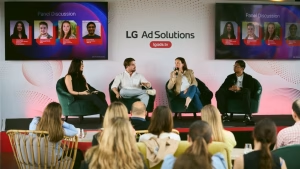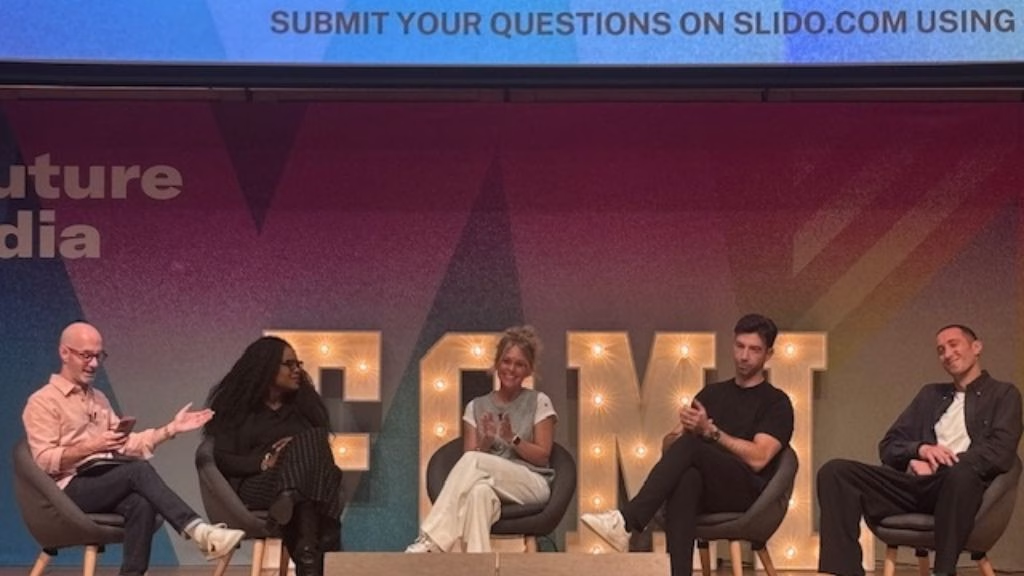
At The Future of Media conference, a panel of industry leaders discussed how artificial intelligence is reshaping marketing, creativity and work itself.
AI has long been a buzzword in the marketing industry, but as Lauren Ogúndèkó, Global and EMEA Chief Activation Officer at IPG Mediabrands Kinesso, explained, it is now firmly embedded in daily workflows.
“Every single platform we use has some level of AI,” she said, “whether it’s entrenched in the platform or in multiple features, it’s everywhere. We also operate within a system that has agentic workflows across all our modules and even our own AI console connected to multiple LLMs like Gemini and Claude.”
Ogúndèkó noted that AI’s integration has fundamentally changed how her teams respond to briefs and deliver plans. “Because we have client data within a closed environment, we can respond faster and create plans more efficiently,” she said. “It’s about augmenting how we work, not replacing people. AI hallucinates like crazy, so we still need human intervention.”
At BT Group, Maddie Armitage, Chief Product Officer for Digital Data and AI Products, shared similar experiences. For her, the biggest practical shift has come from AI-driven productivity tools.
“The use of Copilot has been huge,” she said. “It saves time and effort in meetings by capturing notes and actions automatically.” Beyond that, she highlighted the role of generative AI in customer operations. “We’re using it to summarise calls, categorise data and tag information correctly, improving data lineage and governance. It’s all about making better decisions through clean, well-structured data.”
Armitage added that BT’s AI strategy focuses on the interplay between data and automation. “Data is the fuel,” she said. “We’re ensuring access controls, governance and taxonomy are in place so AI can truly accelerate insight generation and improve service outcomes.”
Finding balance in the AI sandwich
At independent agency Charlie Oscar, James Connelly, Founder and CEO, said his team thinks about AI through what he calls the “AI sandwich”.
“The bottom layer is automation, the mundane administrative tasks that machines can easily do,” he explained. “The top layer is strategic planning, using LLMs for quick insights. But the middle layer, automated intelligence, is where the opportunity lies.”
Connelly said this middle layer involves turning strategic thinking into automated execution. “That’s the hard bit,” he admitted. “We’ve had successes and failures. For example, using AI to identify influencers works brilliantly, but trying to use it for relationship-building doesn’t. People still want to talk to humans.”
He added that knowing which tasks to automate, augment or innovate is critical. “It’s about
understanding where AI adds value and where it doesn’t,” he said.
The changing skillset of the industry
Alberto Ciot, Sales Director EMEA at Quantcast, described his company’s approach as being “the middle of the sandwich”, using AI to make complex advertising systems more intuitive.
“Agents make it easy to interact with what used to be a very complex structure,” he said. “My team uses them daily to extract information, prepare pitches and understand how to position campaigns.”
He believes automation will reshape roles in digital advertising. “Machines can now make autonomous decisions better than humans in some areas,” he said. “That might take away some jobs, especially those focused purely on toggling platforms, but it also creates opportunities for more strategic, creative and product-focused roles.”
For Ciot, critical thinking is the skill of the future. “Scale up your teams to interpret information,” he advised. “Teach them to analyse results and strategically use AI outputs. The opportunity isn’t in pushing buttons, it’s in understanding what the data means.
Staying ahead, not just keeping up
Looking forward, the panel agreed that businesses must be proactive, not reactive, in how they adapt to AI.
Connelly warned against building in-house AI tools too early.
“You’re competing with companies that have far more capital and resources,” he said. “Instead, focus on training, smarter use of AI. The real advantage comes from proprietary data. Agencies sit on a wealth of data they can use to train models and deliver better outcomes for clients.”
Armitage echoed that sentiment, stressing the importance of balancing technical efficiency with creativity. “AI can improve productivity, but it also accelerates strategic thinking and ideation,” she said. “It’s not something to fear, it’s something to embrace.”
Ogúndèkó agreed, adding that organisations should be clear about how roles evolve alongside automation. “Look at every task you do,” she said. “Decide what 20 or 30 percent of it can realistically be handed over to AI, and then redefine your role. That’s how you prepare for the future.”
Avoiding “AI slop”
An audience question about “AI slop”, the flood of mediocre, machine-generated content, prompted a lively discussion.
Ciot said the key lies in measurement and experimentation. “You need a framework that enables teams to test within boundaries and measure outcomes,” he said. “That’s how you ensure you’re using AI purposefully.”
Ogúndèkó emphasised the human element. “We need to upweight strategic and planning skills,” she said. “Brilliant strategists and planners use deep critical thinking, that’s what keeps AI-driven work meaningful.”
Connelly concluded that too many people skip the thinking at both ends of the process. “You have to think before you use AI and think again once it gives you an output,” he said. “If you skip those steps, you end up with undifferentiated work. AI is a partner, not a replacement for thought.”
Learning more about AI
To close, the panel shared some of their favourite AI resources. Armitage recommended Sebastian Chelyth’s newsletter exploring AI, psychology and quantum theory, while Ciot cited The Rundown newsletter for insights into policy and market changes. Connelly suggested following Ethan Mollick, a Wharton professor and author of Co-Intelligence, on LinkedIn for practical business applications of AI.
As moderator Jules Love of Spark AI put it, “AI is woven into everything we do now. The challenge is not whether to use it, but how to use it wisely.”