Independent sell-side advertising company Magnite (NASDAQ:MGNI) has announced the launch of Magnite Orchestration, a coordination layer that enables buyers to connect their buyer agents to Magnite’s seller agent and build on the industry’s largest pool of premium inventory, supply-side intelligence, and automation. Magnite is also expanding its buyer agent and seller agent capabilities, and is testing with partners including dentsu and DIRECTV Advertising.
Magnite Orchestration connects agents within a shared environment, allowing AI-driven buying systems to discover, evaluate, and activate premium omnichannel inventory. Buyers, publishers, and data providers can also make proprietary audiences available to agents, allowing those audiences to be packaged directly alongside premium supply for a more interoperable ecosystem.
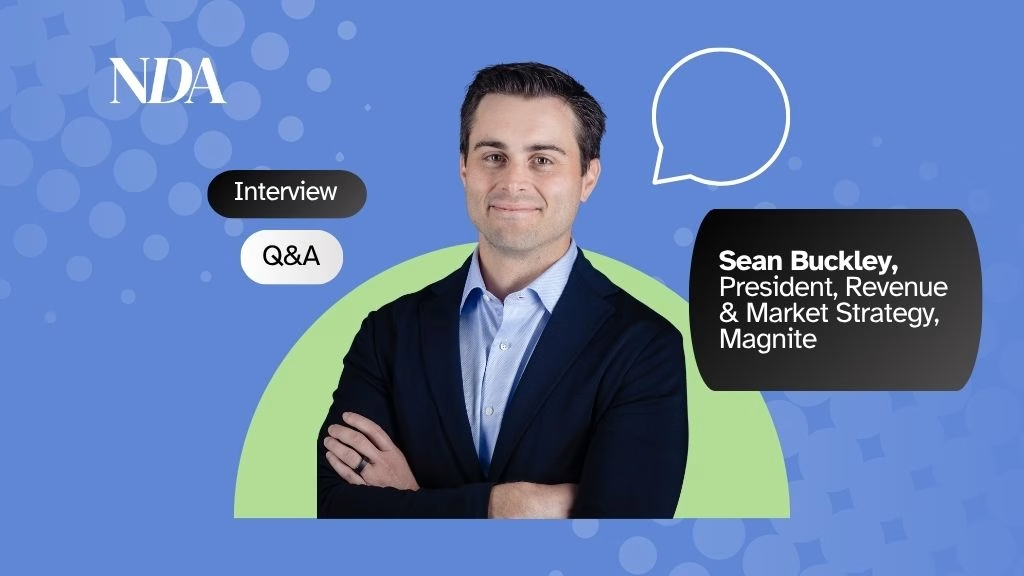
New Digital Age spoke with Sean Buckley, President, Revenue & Market Strategy at Magnite, to find out more…
Tell us a little about your role at Magnite.
I manage the commercial side of things at Magnite, so sales, account management, partnerships, our international businesses, marketing and corporate development.
Magnite recently announced its AI orchestration layer. What was the motivation behind it, and how does it strengthen your proposition for the market?
We made an announcement in April, which coincided with the POSSIBLE conference in Miami, and that was our first really big move into agentic capabilities. We announced our buyer and seller agents.
From a buyer agent standpoint, media buyers can now interact with our platform using natural language – very similar to what your experience with something like ChatGPT or Gemini looks like as a consumer. They can upload a brief or an RFI, tell the system what they’re trying to accomplish, the outcomes they’re looking to achieve, who they’re trying to reach or which media owners they want to work with.
On the flip side, we have seller agents, where media owners and publishers can structure inventory packages and audiences that are then made available to the buy side. A publisher can come in and say, “I want my inventory packaged this way, I want this pricing, and I want these audiences made available.”
Those two components formed the basis of our April announcement.
Our most recent announcement – the Orchestration layer – is really a single place where buyers can either use our buyer agent or connect their own agentic tools. We make our system interoperable. Buyers can use our tools end to end, or they can bring their own tools and integrate them into the equation, which we’re seeing a lot of well-resourced buyers build in-house.
The Orchestration layer provides one place where buyers can access all the details around inventory and supply-side intelligence. That’s one of Magnite’s biggest differentiators. We work with virtually all of the major ad-supported media companies, certainly in the US and increasingly around the world, so we have the best repository of that information. We’re largely a one-stop shop for everything on the open internet.
Are many buyers choosing to integrate their own AI tools?
We’re seeing a lot of both. Some buyers are opting to use our tools, which we can also private-label, while others prefer to integrate tools they’re building in-house. We’re completely open to supporting either approach.
What’s also interesting is what we’ve seen from a transactional standpoint. Today, a lot of activity is still one-to-one, with a buyer working with a single media owner. Where we think it’s likely headed is ‘one-to-many’.
The orchestration layer is an important step towards that. A buyer can evaluate opportunities across multiple media owners and formats rather than assessing each one individually, allowing them to optimise outcomes on behalf of advertisers much more effectively.
How do you see AI changing measurement and campaign optimisation?
One of the biggest benefits of agentic transactions is the feedback loop, particularly around intelligence. If you’re a media owner working with our seller agent, you can ask for on-the-fly reporting based on whatever you’re looking for, and the system can construct that very quickly. But you can also ask questions like, “I made this change, but what would have happened if I’d done something different instead?”
The next step is proactive intelligence. The system understands the kinds of changes you’re making and starts surfacing recommendations on its own: “I see what you’re trying to do here, but if you also did this, here’s the likely outcome.”
That kind of proactive intelligence for media owners—and there are similar applications for buyers through the buyer agent—is one of the biggest advantages of this operating model.
What are customers looking for from Magnite today?
There are really two parts to it.
First, you have to innovate. You have to build compelling products that are on the cutting edge, that customers see value in and want to use. I think we’ve demonstrated that through our recent announcements. But that’s only part of the story.
We’re already deeply embedded with the major constituents on both sides of the marketplace, whether that’s the large agency groups or the major media owners. We already transact at very high volume with them, and we’re deeply integrated into their workflows.
That gives us a running start because we’re bringing new market-leading capabilities into relationships that are already well established. We’re not starting from scratch.
I think customers value that. They want innovation, but they also want to work with companies they already know and trust. That’s helped us move more quickly with many of these partners.
What are Magnite’s biggest priorities for the rest of this year and into next year?
Outside of our agentic capabilities, one major priority is supply-side decisioning – enabling audiences and decisioning on the supply side rather than where it’s traditionally happened.
A good example is our recent announcement with Walmart. They’ve shared their move towards enabling their audience data and measurement capabilities on the supply side through Magnite. That was a significant signal to the market that this trend, sometimes referred to as curation, is real, durable and being adopted by major players.
We’ve been working in this area for years with key TV OEMs, and now we’re seeing it extend much more broadly. We’ve also integrated with many of the major holding companies around their data assets to enable supply-side decisioning for them. It’s something we’ve been investing in for a long time.
The other major focus is live. As live events, particularly live sports, continue moving towards programmatic monetisation, the infrastructure requirements are very different from traditional digital advertising or even video-on-demand streaming.
With live events, everybody reaches the commercial break at the same time, creating enormous spikes in concurrency. You have to deliver a huge volume of advertising to a very large audience in a very short period. We’ve invested heavily in our infrastructure to support that.
A great recent example is our work in India around the Cricket World Cup. That’s an incredibly demanding environment given the scale of the audience, and it was a serious pressure test for our live capabilities. The partnership was a huge success and a great example of the areas we’re continuing to invest in.
Magnite is a client of Bluestripe Group, publisher of New Digital Age.