The Trade Desk recently announced a new partnership with Utiq, in a move that further expands its identity solutions portfolio across EMEA.
Utiq provides Telco-powered user-consented signals for publishers and advertisers on the premium open internet, working with telecommunications companies across Europe such as Deutsche Telekom AG, Orange SA, Telefónica S.A., and Vodafone Group plc.
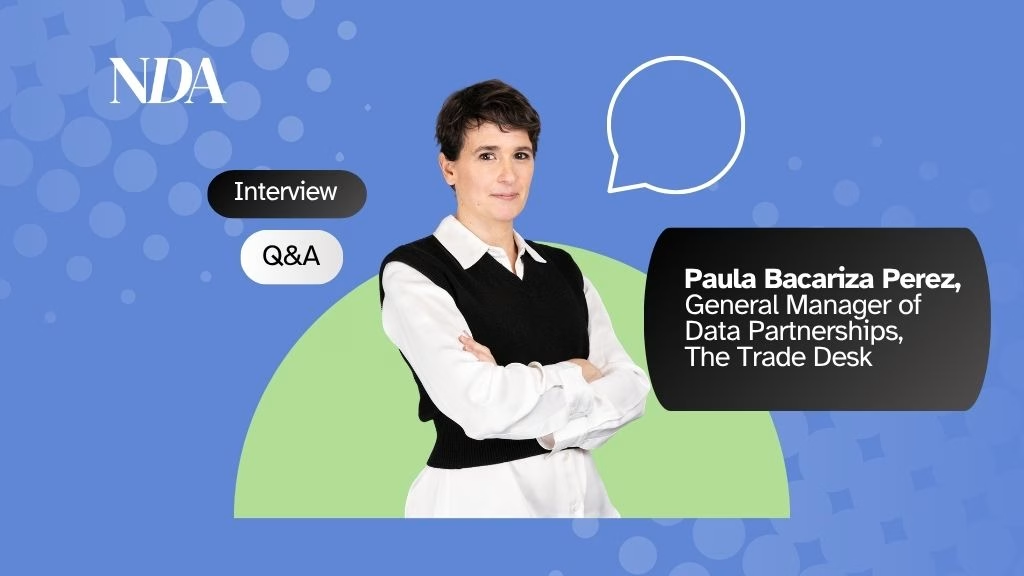
New Digital Age spoke with Paula Bacariza Perez, General Manager, Data Partnerships at The Trade Desk to find out about the recent alliance and more…
What were the motivations behind The Trade Desk’s new integration with Utiq?
The strategy has always been about connection. As long as technology companies share the same approach to privacy and ethics as The Trade Desk, our goal is to connect as many technologies as possible to create the strongest open ecosystem.
This latest integration is part of that broader strategy. Identity is a space where there isn’t a single solution that solves every challenge. We have customers at many different stages of their identity journey, and what we want to be is a platform that allows them to make their own choices and execute their preferred strategies.
We don’t want to create walls between our customers’ identity strategies and our technology. We want to provide the flexibility and openness that allows them to use the solutions that work best for them.
From a data perspective, what does this integration add to The Trade Desk’s proposition?
The Trade Desk already has a strong identity proposition. We have our own identifier, Unified ID 2.0, and we integrate with many other identity solutions. Whenever we develop our offering—whether in identity or any other area—we ask a simple question: which partners are going to bring the most benefit to our customers?
In this case, the integrated solution is a strong identifier. It’s deterministic, trusted and, importantly, it’s the preferred solution for some of our customers. By integrating it into our platform, we’re able to provide a better offering for those customers who consider it a top-priority identifier.
Ultimately, it just made sense to add it to our portfolio and expand the options available to our clients.
What kinds of support are advertisers looking for most at the moment?
In the world of identity, there’s a huge amount of variance. We see very different levels of maturity and customers at very different stages of their journey.
The common trend we’re seeing is that clients increasingly want a consultative relationship. They want advice and support because identity is a particularly fragmented area within an already fragmented industry. There are a lot of providers, a lot of solutions and a huge amount of information coming at them, and they need to make decisions that are incredibly important to their business.
A strong identity strategy is fundamental to a strong data strategy. What customers are looking for is a trusted, agnostic partner that can advise them without bias. They want someone who can help them navigate the landscape, introduce them to the right partners and provide guidance on how to move forward.
As a result, we’re having more and more conversations centred on identity strategy. Clients are asking us to help them continue their journey, expose them to the right opportunities and support their decision-making. Identity strategy has become a top priority for many organisations.
What are The Trade Desk’s key priorities for the remainder of the year?
Our top priority continues to be becoming the first choice for advertising spend and the premium alternative to the walled gardens. To achieve that, we’re focusing heavily on three key areas: advancing identity, deepening our retail media capabilities and continuing to improve measurement solutions.
Alongside those priorities, we’re investing significantly in AI-powered solutions that can help accelerate progress across all three categories.
What’s particularly exciting is the opportunity to do all of this through an objective and transparent approach that gives customers the power to make their own decisions and pursue their own strategies. We believe that if we continue to make progress in those three areas (identity, retail media and measurement) we’ll be well on our way to achieving that ambition.
Looking ahead, what trends are catching your attention in the market?
What we’re seeing is two major developments happening simultaneously.
On one side, there’s the explosion of AI, large language models and agent-based solutions. The pace of innovation is incredible, and these technologies are creating enormous opportunities for efficiency, speed and optimisation.
At the same time, we’re having more conversations than ever with brands about attention, brand building and differentiation. Advertisers are thinking carefully about how they maintain that premium relationship with their customers and continue to build meaningful connections.
For me, the most sophisticated organisations are focused on balancing these two priorities. It’s incredibly important that we embrace technologies that help us become faster, more efficient and more accurate. But we also can’t lose sight of brand building and the direct connection between brands and consumers.
What we’re seeing is a growing effort to combine both approaches. Brands want to understand how they can use AI and technology to drive efficiency while continuing to invest in the elements that create differentiation – strong brands, meaningful customer relationships and high-quality experiences.
I think there’s a tremendous opportunity for creativity, premium environments and attention-based strategies to complement the rapid pace of technological advancement. Getting that balance right is a key focus for many organisations right now, and I believe it will remain one of the defining challenges and opportunities for the industry moving forward.