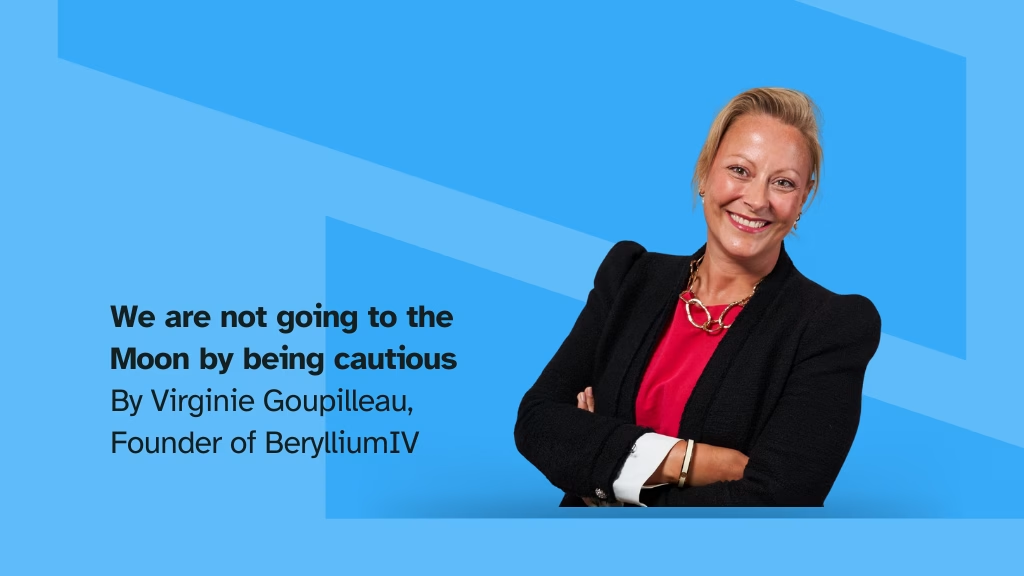
By Virginie Goupilleau, Founder of BerylliumIV, a boutique marketing transformation and AI integration consultancy. She has spent twenty years inside major advertising holding companies, leading large-scale operating model redesigns, business and technology integration programmes, and commercial growth strategies
In September 1962, John F. Kennedy stood at Rice University and told America it was going to the moon. Not because it was easy. Explicitly because it was hard. Because the hard things, the ones that demand new thinking, new tools, and the courage to abandon what used to work, are the ones worth doing.
The marketing and advertising industry is standing at its own version of that moment. AI is not a trend to be monitored from the sidelines. It is a structural reorganisation of how value is created, how businesses operate, and how talent is deployed. And like the space race, the organisations that will define the next decade are not the ones with the most resources. They are the ones that move with the most clarity.
The tension is real. So is the opportunity.
Two things are happening simultaneously, and arguably, they are two sides of the same coin.
On the brand side, AI is collapsing the barriers that previously made in-house impractical. According to the WFA and Observatory International’s most recent global survey, 66% of major multinationals now have an in-house agency – up 16 percentage points in three years – and a further 21% are actively considering establishing one. Data, technology, and creative capability that once required an agency ecosystem can now be built, owned, and operated internally at a fraction of the cost. Brands are taking control. The result is not just a shift in budget allocation. It is a fundamental renegotiation of the client-agency relationship. The question is now is how to bring more capability in-house without losing the differentiators the agency partnership was actually delivering.
On the agency side, the operating model is under pressure from every direction. Margins are being squeezed by procurement and investors, talent expectations have shifted post-pandemic, and generative AI is simultaneously threatening and enabling every service line. The agencies navigating this well are the ones rebuilding their value proposition around what AI genuinely cannot do: strategic judgment, creative courage, deep client relationships, and the institutional knowledge that comes from working across dozens of businesses at once.
These two pressures are not separate problems. They are a single structural shift, playing out on both sides of the same commercial relationship. And the organisations caught in the middle, trying to manage it with yesterday’s frameworks and last year’s operating model, are the ones losing ground fastest.
Here is the uncomfortable truth about how the industry has tried to respond to this moment. Strategy firms produce excellent diagnostics. The slide decks are sophisticated. The frameworks are defensible. And then they leave, handing over a transformation roadmap to an organisation that does not yet have the capability, the culture, or the commercial alignment to execute it.
Meanwhile, implementation partners and internal teams wait to be told what to build. They are excellent at building it. But if the strategic thinking is incomplete, or if the organisational change management has not been done, the technology lands in a business that has not actually changed. The tools get adopted (or not!) but the behaviours do not evolve. The ROI does not materialise.
Eighteen months later, someone commissions another piece of strategy work to work out why. The change fatigue settles and stifles innovation and goodwill.
This is the transformation gap. I have seen it from every angle in twenty years of working inside holding companies, leading operating model redesigns, and sitting in the rooms where these decisions get made. The gap is not a failure of intelligence or ambition. It is a failure of continuity. Someone needs to stay until the organisation has actually changed.
Why Beryllium. Why now.
Beryllium is the fourth element on the periodic table. Rare. Extraordinarily strong. Lightweight. It is the material that made space travel possible; the structural component inside the rockets and guidance systems that got us to the moon. You have never heard anyone lead with beryllium. But nothing gets off the ground without it.
That is the business I have created.
BerylliumIV is a boutique marketing transformation and AI integration consultancy. We work with brand-side C-suites and agency leaders who are navigating the AI frontier and need more than a roadmap. We build AI-native operating models, in-housing strategies, and advanced media capabilities. And crucially, we stay until it works. Not until the deck is delivered. Not until the platform is live. Until the organisation has changed: in its operating model, its technology, its culture, and its results.
Kennedy understood something that the industry needs to reckon with now. Going to the moon required more than ambition and engineering. It required new governance. New protocols. New ways of making decisions under conditions of radical uncertainty. The existing frameworks for space travel were insufficient for the task. They had to be built from scratch, in parallel with the mission itself.
AI in marketing is at the same inflection point. The technology is moving faster than the governance frameworks designed to manage it. Questions of data ownership, Agent responsibilities, security and ethical consideration in infrastructure and model building, AI-generated creative attribution, algorithmic transparency in media buying. These are live commercial and regulatory risks, and the industry is largely trying to navigate them with policies written for a pre-generative AI world.
The organisations that get this right will build the guardrails that make AI adoption sustainable. They will define what responsible AI integration looks like in practice, not in a code of conduct document, but in their operating procedures, their supplier contracts, and their reporting frameworks.
That is also part of what BerylliumIV does. We do not treat AI governance as a compliance exercise. We treat it as the foundation of your competitive advantage.
The hard thing is the right thing.
Kennedy did not promise the moon would be easy to reach. He promised it would be worth reaching. The industry needs the same honesty right now. AI transformation is not a six-week project. It is not a new job title and a prompt engineering workshop. It is a fundamental redesign of how a business creates and delivers value. Done well, it compounds. The organisations building AI-native operating models today will have structural advantages that are very difficult to replicate in two or three years’ time.
Done badly or not done at all, it is the opposite. The gap between organisations that have genuinely transformed and those that have performed transformation will become visible in margin reports and market share within eighteen months.
I have seen this pattern before. The holding company consolidation era looked the same, and so did the dot-com or programmatic revolution. The leaders who moved with clarity during those shifts defined the industry for a decade. The ones who waited for certainty found themselves playing catch-up in a game where the rules had already changed.
We are not going to the moon by being cautious.