As AI continues to transform how businesses operate, market and sell, competitive advantage will increasingly come from what technology cannot easily replicate: creativity, judgement, trust and genuine human connection.
For Not On The High Street, this question has particular resonance. The business combines sophisticated technology and data infrastructure with a marketplace built around more than 4,000 independent brands, makers and entrepreneurs, and is now deliberately putting the people behind those businesses back at the heart of its growth strategy.
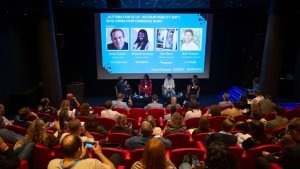
In this closing fireside interview with NDA Editor-in-Chief Justin Pearse at NDA’s Foresight event, Pascal Schuster, CEO of Not On The High Street, explored what it means to build a modern, technology-enabled business without losing the human qualities that make it distinctive.
We have spent much of today talking about what AI will enable. Let us flip that around: as technology becomes more capable, what do you think becomes more valuable about being human?
It comes down to authenticity and thoughtfulness. In an era of automated, mass-produced items and fast fulfillment, human connection becomes the ultimate differentiator.
When people buy a gift, they want to give something meaningful, something with a backstory. They want to know who made it, how it was crafted, and the care that went into it.
AI and automation can deliver speed, but they cannot deliver genuine human emotion or the joy of giving a gift that has real thought behind it. That human spark is what people value most, and it is something technology simply cannot fabricate.
Not On The High Street is a technology platform, but its proposition is fundamentally built around people, creativity and individual businesses. How do you use technology to scale that without inadvertently removing the thing that makes it special?
Technology should be invisible. It should serve as an enabler behind the scenes rather than getting in the way of the customer experience.
We use AI and tech infrastructure to optimise coding, streamline operations, and enhance search and discovery. But we deliberately avoid putting artificial barriers, like robotic chatbots or overly-intrusive automated curators, between the customer and the maker.
We tested automated curators that ask a series of rigid questions to guide gift selection, and customers simply did not want it. People want an experience that feels conversational and organic.
The role of technology is to help customers find the right thoughtful product seamlessly, while letting the human story and craft take center stage.
You have just announced the Founders Circle with Sara Davies and a renewed focus on the people behind your 4,000 independent brands. Why was putting the human entrepreneur back at the centre important now?
We are coming full circle back to brand building.
For a period, like many platforms, there was a heavy reliance on performance marketing and pay-per-click channels. But nobody wins in that cycle except the search engines.
We realised we needed to step back and focus on what truly makes us unique: our makers and entrepreneurs. Initiatives like the Founders Circle and our “Meet the Makers” campaign showcase the actual people crafting these products in the UK.
We actually reduced our overall SKU count from over 300,000 to focus on higher-quality, curated items from genuine creators, and our conversion rates went up. By putting the spotlight back on human craftsmanship, we build long-term brand equity and trust rather than just chasing single transactions.
If AI makes it easier for everybody to create content, products and customer experiences, does originality and human creativity actually become more valuable and harder to find?
Absolutely. When everyone has access to the same generative tools, the market risks being flooded with generic, mass-produced items and identical messaging.
We actively take steps to filter out drop-shipped, mass-manufactured, or AI-generated cheap goods from our platform. We do not want to compete with platforms like Amazon, Temu, or Shein on logistics or rock-bottom prices, we cannot win that game, and we do not want to.
As AI-generated content and products become ubiquitous, true originality, physical craft, and genuine human narrative become far rarer, and therefore far more valuable to consumers.
As a CEO looking towards the next five years, what would you tell marketing leaders to embrace about AI but, equally, what should they fiercely protect?
Embrace AI for efficiency and backend enablement, but fiercely protect your brand and your product.
AI can help optimise operations, generate insights, and refine workflows, but it should not replace the core proposition of what you sell or how you connect with people. If you rely solely on algorithms and performance marketing, you end up selling hot air in a crowded room.
Focus on building a trusted, recognisable brand anchored in real product quality. Ensure you maintain a strong, authentic voice that resonates on a human level, because that brand equity is what will survive no matter how fast the technology evolves.