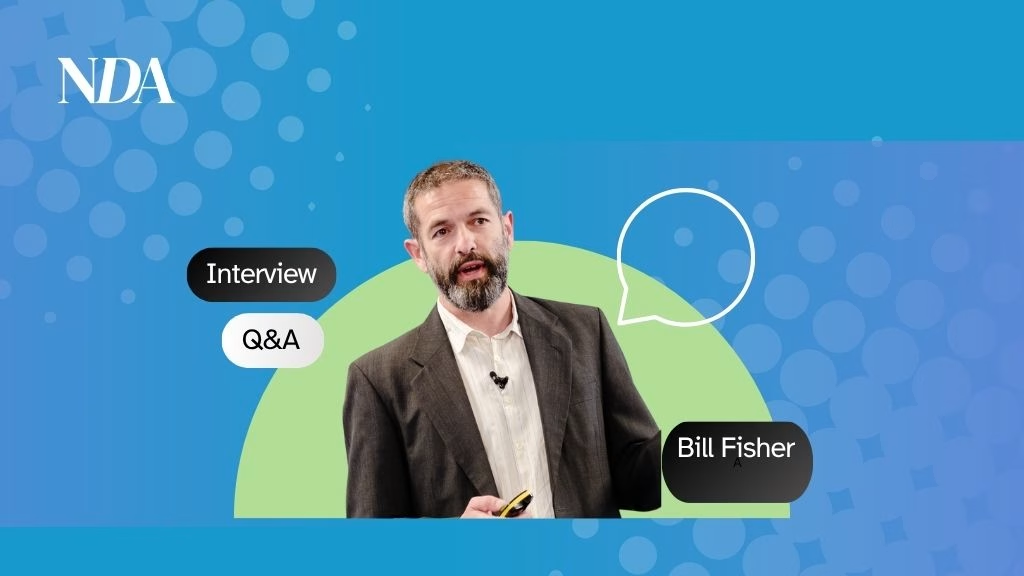
Ahead of his opening keynote at NDA’s Foresight conference, Bill Fisher, Principal Analyst at EMARKETER, discusses the structural shifts set to reshape advertising over the next three years, from AI and algorithmic discovery to the convergence of media, search and commerce, and the ongoing challenge of measuring advertising effectiveness.
Looking ahead three years, what is the single biggest structural change in advertising that you think businesses are underestimating?
Obviously, any answer has to include AI, but I actually think one of the biggest changes will be less about the structural changes that AI makes and more about the way businesses approach its use.
At the moment, every man and his dog is saying, “Let’s use AI for this and for that, and to optimise this.” I think we’re going to move quite quickly from businesses saying, “Where can we use AI?” to “Where should we use AI, and what are we actually trying to achieve?”
We know AI can make things dramatically faster and more efficient, but efficiency doesn’t necessarily mean effective.
If you’re automating processes that aren’t really creating much value, you’re just doing the wrong things faster.
So I think the businesses that get ahead over the next three years won’t necessarily be the ones that deploy AI most aggressively. They’ll be the ones that understand how to use it more effectively.
Perhaps the structural shift I’m most interested in is a transition from AI adoption to AI accountability. Businesses shouldn’t measure their progress by how much AI they’re using, but by the value that AI is creating for them.
What does the marketer of the future look like? What new skills will be needed?
I think we need to be a little bit careful with the premise that AI simply takes over the operational layer of marketing.
There will obviously be significant automation, but the important issue isn’t how much of the marketing process we can automate. It’s understanding what we should automate and to what end.
I think that’s where the marketer’s role progressively moves from executing towards providing judgement and direction that makes an activity valuable.
AI can optimise the bidding process. It can generate loads of variations on the creative side. It can look at huge amounts of audience data and allocate budgets.
But it becomes about knowing what objectives to set, what data to trust and what constraints to impose. That’s when human judgement needs to override the machine.
With media, search and commerce increasingly converging, how should marketers decide where to invest?
Historically, these things were very separate. Media created demand, search was about intent, and commerce was where you completed the transaction.
We’re increasingly seeing those functions exist inside the same environments.
Amazon is obviously the obvious example. It came from shopping first, but it’s increasingly added search. It’s also joined up the whole video aspect.
Then if you look at TikTok, that’s come from the other angle. It started as an entertainment medium, increasingly added search, and is now rolling in commerce with TikTok Shop.
Video is becoming increasingly important in all these areas.
Video can create mass reach and emotion like television can. It can demonstrate products, incorporate creator influence, be searched and answer questions, generate intent and increasingly lead to a transaction.
So I think the strategic question becomes less “Which channel should I invest in?” and more “Where is consumer influence actually happening, and what do I need to own versus rent in order to participate in that conversation?”
Discovery is increasingly happening in AI environments rather than traditional search. How should brands rethink awareness, consideration and demand?
I would actually start by challenging the idea that we are in a world of a fully algorithmic consumer.
Algorithms unquestionably have a much bigger influence on consumer behaviour. They’re embedded in almost every major media environment, and we’re seeing brands think seriously about their visibility within those environments.
We’ve created a new tool called the AI Visibility Index. It’s currently a US model, and what we do is interrogate multiple generative AI platforms with various search queries and look at how brands appear in AI-generated recommendations across categories.
But I would argue we’re still really early in this behavioural change from the consumer side.
There are big questions around trust with AI. Consumers just aren’t particularly trusting of it yet, and they’re not handing over major purchasing decisions to AI.
We write a lot about agentic commerce, but we’re a long way from it being a common thing. It’s still relatively small percentages of people who are really doing this.
And the influence of algorithms isn’t consistent across the consumer journey.
At the discovery end of the funnel, algorithmic influence is huge. Consumers are increasingly encountering products, brands and ideas because a recommendation system has put them in front of them.
But once they move closer to making an important decision, such as a purchase, that’s when they want to start reclaiming agency.
They start doing their own research and comparisons. They seek out their own reviews and trusted voices. They move between social and search, retail sites, brand websites and AI tools.
So I don’t think the future is simply one in which algorithms decide what we buy.
Measurement remains a major challenge for the industry. What needs to change?
Advertising continues to advance. It becomes more sophisticated and complex, and we can measure more. But we’re always asking the same questions.
No matter what the next advancement is, the same questions are asked: how effective is my advertising and how do I measure that effectiveness?
And we’ve never really solved that.
One thing that we always fall back on is that we measure the things that are easiest to measure, not necessarily the ones that create the most value.
An impression isn’t necessarily valuable. A click isn’t necessarily valuable. You could even argue that a conversion doesn’t necessarily prove that advertising created value, because a consumer might have been looking for that thing in the first place.
At the other end of the spectrum, some of advertising’s most valuable effects, such as creating memory around a product or changing perceptions about a product, are much harder to observe and attribute.
There’s a danger that we continue to confuse measurability with effectiveness. And I would argue that AI doesn’t necessarily solve that problem.
So what should marketers ultimately be trying to measure?
If we give increasingly sophisticated optimisation systems like AI narrow or imperfect measures of success, they’re going to be very good at maximising those measures.
That doesn’t mean they’re going to maximise the value of the advertising.
I don’t have an answer to this, but ultimately my question is, “Can I measure what happened after somebody saw an ad?”
That shouldn’t be the question.
It should be, “Did something valuable happen after somebody saw the ad?”
And I still don’t think the industry can confidently answer that question today. Even though we think we’re getting better at it, I would argue we’re still going to have the same question tomorrow that we had yesterday.
If you were sitting in the CMO chair three years from now, what would be the three big areas where you would put your money and attention?
The first thing is definitely to build the organisation to take advantage of AI rather than just ploughing loads of money into it and betting the house on it.
I’d invest in the foundations, getting the data right, understanding how that data talks to each other, and deciding what you’re going to allow AI to access in terms of that data.
I’d invest in people who understand what AI is good at as well.
The winners aren’t going to be those companies that just throw loads of money at AI. They’re going to be those that use it more purposefully.
The second thing would be investing in becoming discoverable in an algorithmic world.
I think that’s going to be really, really important. There was a whole industry around search and SEO. I think GEO and AI visibility are going to become increasingly important.
But don’t take your eyes off the other stuff, because people are still going to want agency when making decisions. Algorithms are going to be increasingly important in the discovery part of the equation, so you have to build for that.
And then the last thing I’d do, and this is kind of fundamental, is invest unapologetically in the brand.
It’s easy to get excited by the new shiny thing and invest loads of money in AI and all these other things, but you still need to invest unapologetically in the brand.
AI is going to make things easier, more abundant and cheaper. But distinctiveness is going to be harder because everything is going to look a bit the same.
In order to stand out, you need to invest in things like creativity and building experiences.
You can optimise until the cows come home, but that’s no good if nobody connects with or cares about your brand.
That’s still fundamentally what marketing has been about, and should still be about in this bright new AI future.