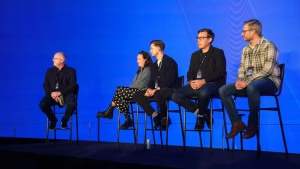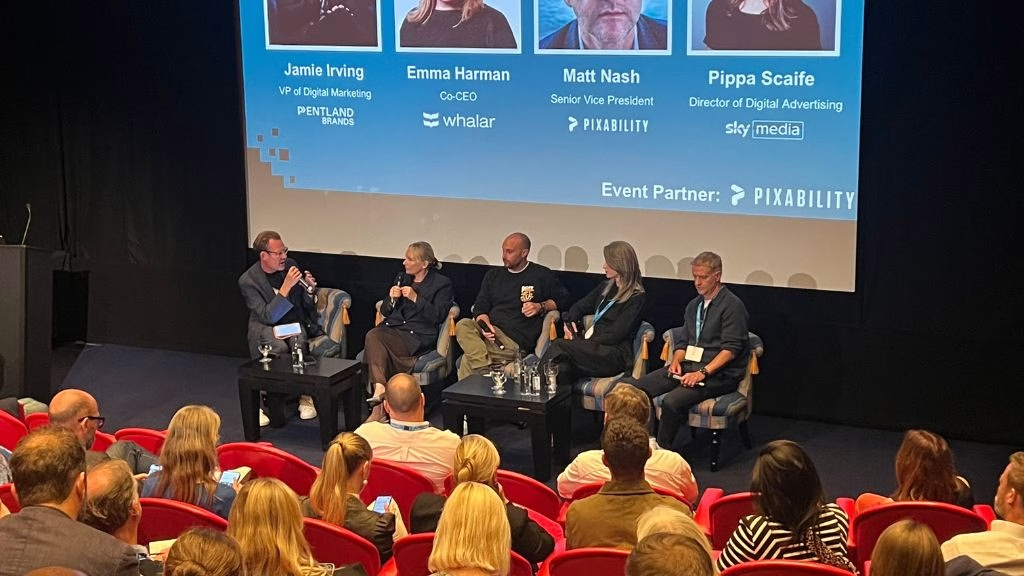
The creator economy is entering a period of rapid maturity as brands shift their focus from social as an afterthought to making it the heart of holistic marketing strategies. That was the central discussion point at New Digital Age’s recent Foresight event, where a panel explored how brands, creators, publishers and agencies are defining the next stage of growth in social advertising.
The session, chaired by Justin Pearse, NDA Editor-in-Chief, featured Emma Harman, Whalar, Jamie Irving, Pentland Brands, Matt Nash, Pixability, and Pippa Scaife, Director of Digital Advertising, Sky Media.
Across the discussion, each emphasised the need to balance creative ambition with strategic rigour, to ensure authenticity while maintaining brand control, and to embrace a new era where premium publishers and individual creators sit side by side.
Social moves upstream in brand planning
Opening the conversation, Pippa Scaife highlighted the transformation in how brands approach social as part of the planning cycle.
“Whereas historically our big TV investments went live first and social was often added on if budget remained, brands are now thinking about social much earlier in the process,” she explained. “It is a much more holistic approach, bringing TV and social together so that each channel sings in harmony and amplifies the other.”
Scaife pointed to Sky Sports’ social audience as a prime example of why marketers are making this shift. “Sky Sports alone reaches about 18 million de-duplicated users across our social channels, with 44% of that audience incremental to our linear and digital broadcast reach. That is a net new audience for brands,” she said.
She cited Uber Eats’ Premier League sponsorship as a current case study. Historically a linear TV partnership, this year’s campaign has extended across TikTok, YouTube and X.
“These are TV-level investments. None of it was an afterthought,” Scaife explained. “It was about building community around the sponsorship in a multi-channel 360 way.”
Social is the brand’s shop window
Emma Harman stressed that leading global advertisers are now operating “social first” and see social channels not as an add-on but as the most public-facing part of their brands.
“Social media is the window into your brand’s soul,” she said. “Your social feeds now are your billboards, that’s the real estate. That is where trust is built and engagement happens.”
She highlighted Unilever’s stated ambition to collaborate with 100,000 creators each month as a clear signal of market direction.
“The big brands we work with want to invest creatively in social, they want to collaborate in ways that drive cultural relevance. People are looking at which creators you work with and what communities you are embedded in. That is now central to growth,” Harman argued.
But she also noted that poor quality work still plagues social. “There is a huge cost to dull work. Brands don’t want social to be another cultural wasteland. They want creativity that cuts through.”
Good product is the foundation
For Jamie Irving of Pentland Brands, while social creativity is vital, it cannot compensate for weak products or poor fundamentals.
“The biggest killer of good social advertising is, more often than not, a crap product,” he stated bluntly. “Social is a tool to help sell products. If your product marketing and creative aren’t strong, social won’t work no matter what.”
He argued that the most effective campaigns start with solid features and benefits, then use social to elevate them. “If you’re just pumping out the same asset into social, it won’t cut through. Word of mouth has always been the hardest thing to drive, and that is still true in the creator economy,” he said.
Irving also raised concerns around TikTok’s rapid shift from creativity to QVC-style commerce. “That could put the creator economy in danger. It risks undermining trust and the sense of authenticity that underpins influencer recommendations.”
Scrutiny on measurement grows
From a technology and platform perspective, Matt Nash of Pixability said the sharp rise in spend on YouTube particularly is leading brands to demand far more accountability.
“Budgets are increasing year on year on YouTube, but with that comes scrutiny. Brands are asking, what exactly am I getting for my investment? Am I getting beyond vanity metrics?” he said.
Nash emphasised that brands want measurement that reassures not just marketing teams but also finance leaders. “We need tools and methods of measurement that give CFOs confidence that spend is being deployed effectively, otherwise budgets will come under pressure.”
He argued that brands must also revisit how they use their organic channels. “For too long, YouTube channels were a dumping ground for content. Now brands are investing in growing their audience organically. There is more focus than ever on serious use of owned channels alongside paid media.”
Choosing creators is like orchestrating
The panel turned to how brands make decisions about which creators to work with. For Harman, it requires a mix of big names and grassroots voices.
“It’s a bit of an orchestra,” she explained. “Top-tier creators give you talkability and PR coverage, while micro and nano creators provide trust and relevance. Together, amplified through media, you create a symbiotic strategy.”
She urged brands to avoid transactional relationships. “This is no longer about just sending someone a product. It is about truly strategising who you want to work with, why, and what role each creator plays in your broader marketing mix.”
Ambassadors and high churn activations
Irving agreed but stressed that careful segmentation is essential. “At a high level you may want a brand ambassador who can impact strategy for the next year, a bigger creative solution,” he said.
“At the other end you need a constantly-refreshing bank of micro-creators, who are more activational and can shift short-term sales. But you don’t want the same person pumping out reviews repetitively—it gets tiresome for the audience.”
He suggested that artificial intelligence may eventually help manage this complexity. “If you have influence at that scale, AI could be useful in creator discovery and ensuring cultural relevance, because without that it becomes more alienating than positive,” he noted.
Publishers as influencers in their own right
Scaife argued strongly that premium publishers must also be recognised within the creator economy. “Premium publishers are creating social content at scale and with distinctive perspectives. They shouldn’t be overlooked as part of this mix,” she said.
Sky Sports, for instance, produces around 3,000 social clips a week across different channels. “We treat our platforms like creators do, understanding the unique values of each audience. When brands activate with us, we carefully consider how that sits within content and alongside other influencers they’re working with,” she said.
She concluded: “Publishers can build the same trust and brand alignment as individual creators, if not more so, and should be considered a third slice of the pie.”
AI brings both risk and opportunity
The impact of artificial intelligence on the creator economy sparked lively debate. Nash described it as “both good and dangerous.”
“We’ll see huge positive outcomes, but also some horrific misuses, particularly for audiences that are less digitally savvy. Generationally, younger native users are better at spotting inauthenticity, but older groups may be more vulnerable to AI-driven misinformation,” he warned.
Irving echoed the risks but pointed to opportunities in trend analysis and media planning. “AI has huge potential particularly in discovery and planning. The idea of a synthetic consumer that helps power creativity and targeting is really interesting,” he said.
Harman cautioned against overhyping AI as a creative tool. “AI is not going to replace the human intimacy we have with creators. Many people have followed comedians, chefs and communities for 20 years. The relationship is real and human—AI can’t replicate that.”
The next phase: planning like gardening
Looking ahead, Harman suggested brands must embrace an “always-on” mindset. “Planning is shifting from big, isolated campaign moments to something more like gardening—nurturing, always-on, with constant activity that delights customers,” she said.
She cited examples of M&S and Chili’s as brands using humour, entertainment and social-first IP to reshape perceptions. “Brands increasingly need to create content that people actively want to watch and share. They must step into entertainment rather than simply disruption.”
Distinctiveness and authenticity must be preserved
A recurring theme was the tension between maintaining distinctive brand assets and giving creators freedom to be authentic. For Nash, collaboration is key: “Authenticity is important, but it should feel natural. The best results come when creators are aligned with brands they genuinely fit, rather than forced partnerships.”
Irving noted that campaigns at Pentland often achieve the best resonance when broad brand guidelines are set but creators are free to interpret. “We had far better engagement from female audiences in a waterproof jacket campaign when creators gave their own spin, compared to brand assets. It felt authentic.”
Scaife agreed, pointing out that brands must be deliberate about which talent to feature. “Audiences can tell very quickly if something feels unnatural. We are very careful with who appears on Sky’s social channels, because if the voice isn’t authentic, it doesn’t work.”
A new maturity for the creator economy
As the session closed, the panel acknowledged that the creator economy is reaching a new maturity. With bigger investments, brands demand accountability, coherency and cultural impact. Yet creativity, authenticity and distinctiveness remain non-negotiable.
“Social is no longer an afterthought,” Scaife summarised. “It is a strategic platform delivering new audiences and cultural relevance. Whether through creators or publishers, brands now need to think holistically if they want to cut through.”
For Harman, the opportunity is clear. “Creators should not be seen as transactors, but as long-term creative collaborators. The brands who get this right are going to see social truly drive growth.”