Meta and Google were recently found guilty of intentionally building addictive platforms, raising further questions about the ethics of online spaces being owned and monitored exclusively by walled gardens.
The Trade Desk, the largest independent advertising technology company in the world, believes the case should prompt advertisers to ask what kind of platforms they are unknowingly supporting with their ad spend.
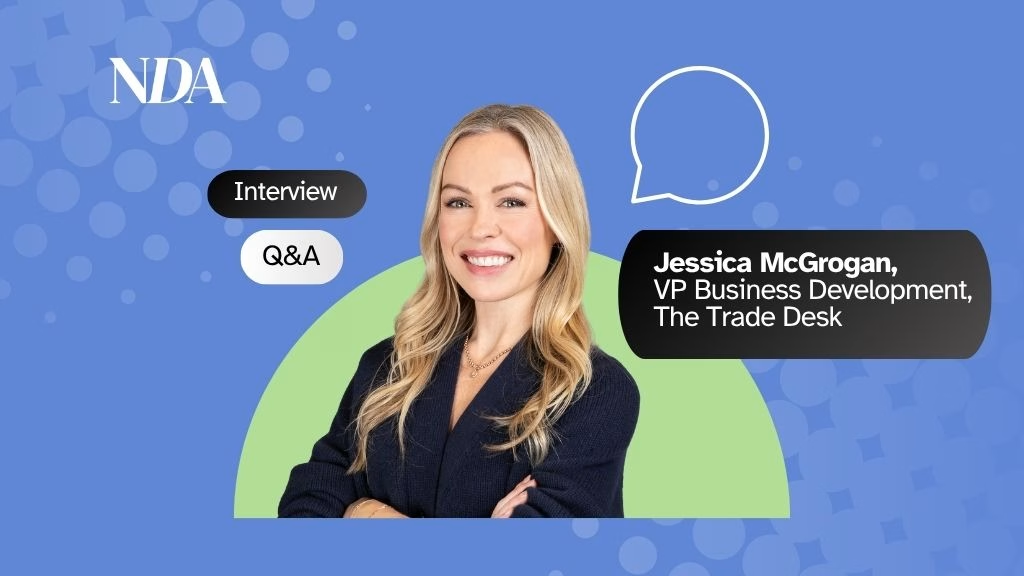
New Digital Age spoke with Jessica McGrogan, VP Business Development at The Trade Desk, to find out more….
From an advertiser’s perspective, what has traditionally made the big “walled garden” platforms so attractive?
I think with advertisers and the walled gardens, they’re really easy to understand. It’s easy to explain to a CMO that you’ve reached scale on YouTube, or that there’s a big audience on Facebook. They represent one publisher, one destination. That makes it very easy to explain where your media dollars are going.
Does that simplicity also help CMOs justify spend internally?
Yes, exactly. But this is where, without any interrogation, it can become problematic. By the same virtue, they’re saying, ‘Look, I’m running on YouTube. Here’s the performance, as YouTube has told me. Here’s the budget I spent in Facebook, and Facebook told me it works.’
The platforms own the data. They also own the measurement framework. So there’s no third-party verification layer that they’re allowing in. Essentially, they’re grading their own homework. Of course they’re going to tell you your campaign ‘worked’.
With recent legal rulings highlighting the addictive nature of some platforms, should advertisers care?
Yes, absolutely. This ruling has shone a light on a very big conversation that’s ongoing in our industry around brand safety. We’re now going beyond just saying it’s important for brands to show up next to safe content or avoid certain keywords; that was the traditonal way of thinking about it.
Now, though, we’re taking it a step further and really thinking about the effect these platforms are having on everyday people. So not just brand perception, which is important, but also the broader impact on consumers.
The question isn’t just, ‘Can you imagine this brand showing up next to unsafe content?’ It’s also, ‘Can you imagine our brand funding addictive platforms?’ That’s really the issue: it’s about what your media investment decisions are funding and the knock-on effect that has on ordinary people.
What viable alternatives do advertisers have today?
From our perspective, there’s never been more viable alternative options that are premium, high quality, and brand-safe across the open internet.
When we say ‘open internet,’ we’re talking about premium content on connected television, platforms like Netflix and Disney, where there’s beautiful, professionally produced content, not user-generated. It’s podcasts, music streaming like Spotify, digital out-of-home; there’s a tonne of incredible channels and formats for advertisers to explore.
They also come with the added benefit of being truly omnichannel, so advertisers can create more intelligent storytelling across touchpoints. Importantly, they also come with third-party verification and measurement as standard, so we’re not grading our own homework.
What we’ve noticed is that premium and performance really go hand-in-hand. The more premium the environment, the better the outcomes, whether that’s brand perception, affinity, or conversions. There’s never been better options than there are today.
Measurement has often been seen as more complex outside walled gardens. Is that changing?
I think there is simplicity in measuring lower-funnel metrics like reach, clicks, or engagements. But there’s a lot more work being done now around attention.
We’re constantly evolving how we think about signals: things like content genre, ad load on a page, how many ad spots are showing, how long someone was watching. These are all signals that help us determine how premium an environment is and what effect that has downstream.
Time and time again, we’re seeing that better environments drive better outcomes. So it’s about moving beyond those ‘vanity metrics’ and really understanding the quality of attention and its impact.
Beyond this ruling, what trends are you seeing in conversations with clients right now?
These topics are very top of mind for marketers today. Brand safety is a continuous conversation. I do think this ruling is an opportunity to think differently about brand safety. It’s something that’s been talked about for years, but now there’s a whole new lens on it focusing on the real impact these platforms are having on audiences.
It raises a bigger question for leaders: do they want to make a different decision about where their media spend is going, and what they’re ultimately funding? That’s something that’s going to continue to come up.
The other big one is AI and how companies are leveraging AI to make better, smarter decisions.
And then there’s full-funnel marketing. Brands are constantly asking how they can make their spend more efficient across both branding and performance, and how to break down those silos.