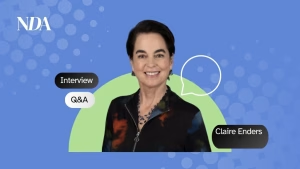
The media industry has rarely lacked confidence in its ability to reinvent itself, however, according to media analyst Claire Enders CBE, 2026 feels fundamentally different.
Speaking at New Digital Age’s Trinity Lunch keynote interview with publisher Andy Oakes, Enders painted a picture of an industry caught between technological acceleration, economic instability and a rapidly changing consumer landscape. Her diagnosis was blunt.
“My headline would be dire straits,” she said.
For Enders, the pressures shaping media and advertising are no longer simply cyclical downturns or another wave of platform disruption. Instead, she sees the industry operating against the backdrop of a much wider geopolitical and economic realignment.
Referencing the ongoing Iran conflict, inflationary pressures and political instability in the UK, she argued that businesses are entering one of the most difficult macroeconomic periods in decades.
“We have the worst outlook from a macro point of view that we’ve had in a very, very long time,” she said. “Certainly in my lifetime, probably since the mid-70s.”
The combination of stagnant growth and persistent inflation, she suggested, is creating sustained pressure across the media economy.
“When you think about borrowing costs close to 6% but 0% growth, you’re looking at a situation where people get poorer and poorer,” she said.
Yet despite the bleak economic backdrop, Enders does not believe media consumption itself will collapse. “Families exist,” she said. “We will just get through this in one way, shape or form.”
Instead, she argues that periods of instability often sharpen the value of creativity, originality and trusted relationships: “It’s also a time in which the best work always shines through.”
The overlooked consumer
One of the strongest themes running through Enders’ analysis is her belief that the industry continues to misunderstand the shape of the modern consumer market. For years, media and advertising have remained heavily focused on youth audiences and family-based demographics. Enders believes that model no longer reflects reality.
“The global demographic trend is no kids,” she said.
In particular, she highlighted the economic power of women aged between 30 and 80 who are financially independent and increasingly living outside traditional family structures. “The females in that group who are economically active are extremely powerful consumers,” she argued.
According to Enders, these consumers dominate spending across publishing, culture and lifestyle categories: “They buy 80% of books, they buy 80% of subscriptions to magazines, they buy 80% of all the tickets sold around London.”
Yet despite their spending power, she believes they remain systematically underrepresented in media planning, product development and advertising strategy. Instead, Enders sees a fragmented, highly individualised consumer economy emerging — one built around “singletons” rather than traditional households.
That shift, she argued, is reshaping not only consumer behaviour but also politics, culture and media consumption.
AI’s real impact
Enders dismissed the idea that AI adoption remains speculative: “Corporate adoption is ubiquitous and universal,” she said.
Across publishing, content creation and production workflows, she sees AI dramatically increasing speed and reducing costs. Enders pointed to areas such as virtual production, automated creative tools and creator-led content ecosystems as examples of where AI is already transforming workflows.
At the same time, Enders believes consumer-facing AI may prove more fragile than many technology companies initially assumed. “The consumer data that I’m seeing from the US shows that consumers are decreasing their engagement with personal agents,” she said.
“As soon as people hit a paywall, consumers are moving to other free alternatives”.
While AI competition remains intense, Enders believes the market is increasingly consolidating around a small number of dominant ecosystems. Among those players, she sees Google’s Gemini platform emerging as particularly influential within enterprise environments. “Gemini is definitely the dominant life form in the corporate space,” she said.
However, she also warned that increasing dependence on a small number of US technology platforms creates new vulnerabilities for UK media businesses.
Trust, safety and fragmentation
As AI-generated content proliferates, Enders believes trust is becoming more commercially valuable, not less.
“The consumer never changes,” she said. “The consumer never wants to be misinformed.”
Fears around misinformation, AI-generated “slop” and unsafe digital environments are increasing the value of curated media brands and trusted publishers. “Safety is a very, very strong component,” said Enders.
Established news brands including the BBC, The Guardian, the Financial Times and ITN continue to hold exceptionally strong trust positions among UK consumers. At the same time, she acknowledged that audiences themselves are becoming increasingly fragmented and tribal.
Enders pointed to YouTube’s growing role in shaping political discourse among younger demographics: “If you look at the usage by 16-to-35-year-olds of YouTube in the UK in the political area, 75% of consumption is of the Joe Rogans, the Tucker Carlsons and so on,” she said.
Yet she does not believe this signals the collapse of traditional publishing. Instead, she sees strong opportunities for specialist and highly focused brands capable of building loyal communities. That dynamic is particularly visible in B2B publishing, where highly defined audiences continue to support sustainable business models.
“Small can survive very well if it’s sharply focused,” said Enders.
Retail media and the return of proximity
Enders also sees retail media as part of a broader structural shift in advertising. While she rejected the idea that retail media itself is entirely new, she believes technological transformation has fundamentally changed its scale and durability.
“What has come about is the technology transformation of the experience,” she said.
Crucially, retail media gives brands closer proximity to consumers and more direct control over customer relationships. For Enders, that directness matters increasingly in an environment where advertisers are seeking greater accountability, first-party data access and measurable performance.
However, she cautioned against assuming any single channel or innovation will permanently dominate.
“There’s always room for another innovation,” she said.
Britain’s creative advantage
Despite the huge uncertainty surrounding the UK’s economy, Enders remains convinced the country retains a unique creative advantage. She argued that Britain’s long-term success still depends on originality, creativity and cultural distinctiveness. That originality, she suggested, becomes even more important in a world increasingly saturated with automated content and AI-generated sameness.
At the same time, she warned that the UK faces mounting structural pressures following Brexit, geopolitical instability and increasing dependence on US technology companies.
“We’re now a tiny little country bobbing off the supercontinent called Europe,” she said.
Her conclusion, however, was not entirely pessimistic.
For Enders, the companies and individuals most likely to succeed over the next decade will be those capable of combining new technologies with strong creative identity and genuine audience understanding.
“Go home thinking, how can I be more original? How can I be more British? How can I be more creative? How can I use all these tools to really stand out? Everyone who asks themselves those questions every single day is going to be in a strong position.”