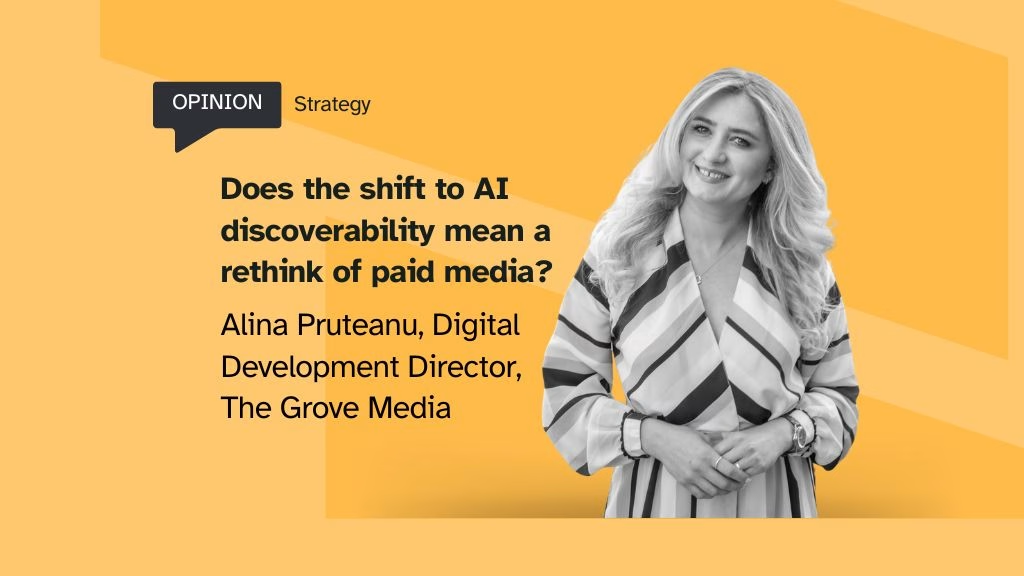
By Alina Pruteanu, Digital Development Director, The Grove Media
AI is having a huge impact on brand discoverability. When AI summaries appear, organic clickthrough rates drop by 60–65%. Not only that, but 60% of searches now end without a click and 37% of active AI users now start searches with AI tools.
Not surprisingly, all of this is shifting the focus from SEO to GEO, with brands seeking to influence AI agents as traditional ‘human’ search performance falls. And, importantly, it is leading to the suggestion that marketers now face a ‘two-audience problem’ — they must satisfy both humans and AI systems simultaneously.
Marketing theory rightly tells us that humans react to brands as mental shortcuts and are influenced by the likes of emotion, fame and distinctive creative. Machines, on the other hand, don’t ‘feel brands’ and work through pattern recognition, probability, structured knowledge and contextual associations.
Two clear audiences, with different but often overlapping needs. Faced with this prospect, should advertisers now move to a dual paid media strategy? One that persuades and influences machines as well as people?
Well, not quite – at least for now – but the role that paid media plays within a paid, earned and owned approach to AI-influenced brand discoverability will become increasingly important.
AI’s focus on earned and owned media
Up to 89% of AI citations come from earned media. Every editorial mention becomes part of a brand’s machine-readable reputation. So PR is no longer just top-of-funnel, it’s creating infrastructure for discoverability in AI.
A brand’s website is often where deep content lives, but only if it’s accessible to AI tools. And this is why optimising for both search and generative engines is now so crucial – it’s about directing both humans and AI to owned content while acting as a catalyst for earned.
GEO is fast becoming the accepted way to optimise content so AI tools can understand, summarise and cite it when generating answers for users. This is not so much about moving away from SEO, but more optimising for AI discovery. And, frankly, it’s exposing all the things marketers should have been focused on before AI reared its ugly/beautiful head: structured data, fresh content, brand trust, clear storytelling, user validation, demonstrable value and consistent authority.
The power of paid media to influence brand authority
Unlike earned and owned, paid media does not have a direct influence on AI discoverability and recommendations. AI agents are not trained on ads. They don’t rank answers based on adspend or ad performance.
But paid advertising drives awareness, searches, reviews, publisher coverage and social discussion. It’s not influencing the algorithm directly, but it is influencing the world the algorithm observes. Paid campaigns that drive traffic to well-structured and optimised content help build the authority and engagement signals AI systems recognise.
The new focus on ‘brand’ in paid media
In a world of AI discovery, where paid has an indirect influence on the algorithm, brand advertising has to step up. When AI assistants and agents can auto-compare every piece of available information in nano seconds, the brand becomes more important, not less. Once all the rational differences are normalised, the reputational differentiators grow in relative importance.
The algorithm relies on trust signals, which are heavily brand led. Traditional brand building is all about distinctive assets, emotional storytelling, cultural relevance, and of course the right media: placement, reach, frequency etc. Get this right and you are able to persuade people over time and build brand loyalty.
Brand campaigns delivering against AI goals
But this approach to brand building must now be developed to focus on AI goals, ie ‘ensure we’re brand the system is most likely to select’. This is where media can step up to ensure that brand advertising has the right presence, and is showing up consistently in places of authority and recognition.
Paid media brand campaigns will also have an increasing role in driving upstream visibility for AI through search, reviews and social chat. All of this ultimately feeds training data, retrieval systems and AI-generated answers.
And, paid media will have a key role in driving ‘signal generation at scale’. Beyond all the traditional media deliverables and metrics, paid media will become increasingly important for creating the signals that make a brand legible to AI. These signals include: volume of mentions, consistency of positioning, strength of category association, and cultural salience.
Paid search will play a role in the new world of AI discovery. Ads are a critical part of Google’s revenue, so they’re here to stay, even if traditional search is in decline. However, brands that have built up an effective paid strategy will need to rethink how they appear in the generative layers of search. Much is rightly being talked about ads being offered on ChatGPT, and we will no doubt see more ads appear in AI Mode and other generative engines. These types of ads could form an important layer of brand advertising within an elevated approach to paid media, but they won’t directly influence the AI agents on, or alongside, which they are placed.
While shifting a paid media strategy to support AI discovery would have seemed like science fiction only a year or so ago, in many respects it’s already a marketing reality. Brand building has always been part of a long term approach to successful media and advertising. And successful brand building has always embraced trust, authority and authenticity. So, it’s maybe somewhat ironic that it’s taken the new world of machines to show us what’s genuinely right for people.