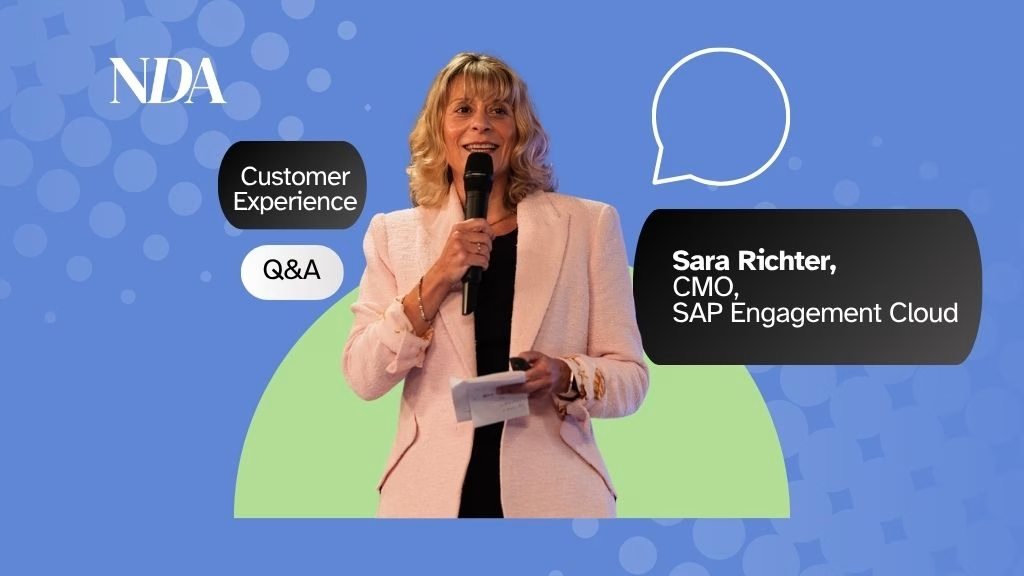
New research from SAP Engagement Cloud suggests that brands’ ability to deliver connected customer engagement at crucial moments has become a key challenge for marketers in 2026.
The survey findings show that as consumers increasingly rely on AI Agents to guide decisions, competitive advantage is being redefined. Despite this, however, many organisations still struggle to act on customer insight when it matters most.
According to the research, 21 percent of consumers already use AI Agents to support purchasing decisions, rising to 43 percent among Gen Z, while 74 percent say it helps them make faster, more informed choices. At the same time, 80 percent of marketers believe AI will be essential for acquiring and retaining customers in 2026 and beyond.
New Digital Age spoke with Sara Richter, CMO, SAP Engagement Cloud, to learn more…
Why did SAP commission this research?
We commissioned this research alongside the launch of SAP Engagement Cloud because we wanted to broaden the conversation around customer engagement. Too often, engagement is viewed through a very narrow lens. We wanted to look at it across the entire business and understand the gap between the connected experiences consumers expect and what businesses are actually delivering.
That naturally leads into conversations around loyalty, retention and long-term brand trust, because customer engagement isn’t about a single interaction. It’s about the entire customer journey and whether brands are consistently delivering the experiences consumers expect.
What stood out most from the findings?
The biggest finding was the distance between what customers need and expect in those critical moments that matter, and what brands are actually delivering.
More than half of UK consumers say their favourite brands provide connected experiences across channels, yet more than 80% are put off by disorganised interactions. At the same time, around 80% of UK businesses believe they’re already delivering a seamless experience. There’s a significant confidence gap there.
I don’t think businesses lack the desire to do the right thing. The challenge is that many simply don’t have access to the data and insights they need to activate meaningful customer experiences in the moments that matter.
Is successful AI adoption primarily a data challenge?
I think it’s less of a data issue than it is an activation issue, a coordination issue and an access issue.
Organisations have data, but they’re still trying to work out how to use AI at scale to make that data genuinely impactful. One of the biggest barriers is integrating new AI capabilities into existing systems. Some organisations are still running on-premise technology that simply isn’t designed to communicate in the agile way today’s AI applications require.
Even businesses that are technically capable are often held back by cybersecurity and privacy concerns. They want to be absolutely certain customer data is protected. But AI is only as effective as the quality of the data and context it has available. If AI isn’t making informed decisions, organisations won’t get the value they’re looking for or deliver the experiences customers expect.
How is AI changing consumer expectations?
Consumers are already using AI to make purchasing decisions. They’re using it to discover products, compare options and evaluate brands before they buy.
If consumers believe AI helps them make better decisions, they’ll naturally expect brands to be using AI in the same way to deliver better experiences. Those expectations are only going to increase.
What other trends should marketers be paying attention to?
One of the most significant findings was that only around 40% of businesses are sharing their data with a CRM or customer experience platform.
If you’re not connecting data across your channels, you can’t see the complete customer journey. And if you can’t understand everything your customer has done, how can you possibly act on it?
The other continuing issue is what we describe as ‘dark data’ — information that organisations have collected but can’t use or activate.
That’s not only holding businesses back operationally, it’s damaging customer trust. If a customer gives you personal information, that’s a value exchange. They expect to see value from that. If you never use that information to improve their experience, you’re beginning to erode the relationship between the customer and the brand.
Many organisations also have valuable customer data sitting in different parts of the business without even realising it exists. There’s a real pot of gold there if they can connect and activate it, but they’re also missing the impact that collecting data without using it has on the customer experience.
What are SAP’s priorities over the next 12 months?
Our focus is on making engagement a core enterprise capability.
More broadly, SAP’s vision is centred around the autonomous enterprise and moving AI beyond simply generating insights to actually driving action. The question is how AI can coordinate activity across different workflows so organisations can respond to customers more quickly and more precisely.
At the same time, the human element remains essential. The future isn’t about replacing people with AI. It’s about combining AI with human expertise so organisations can build stronger, longer-lasting customer relationships.