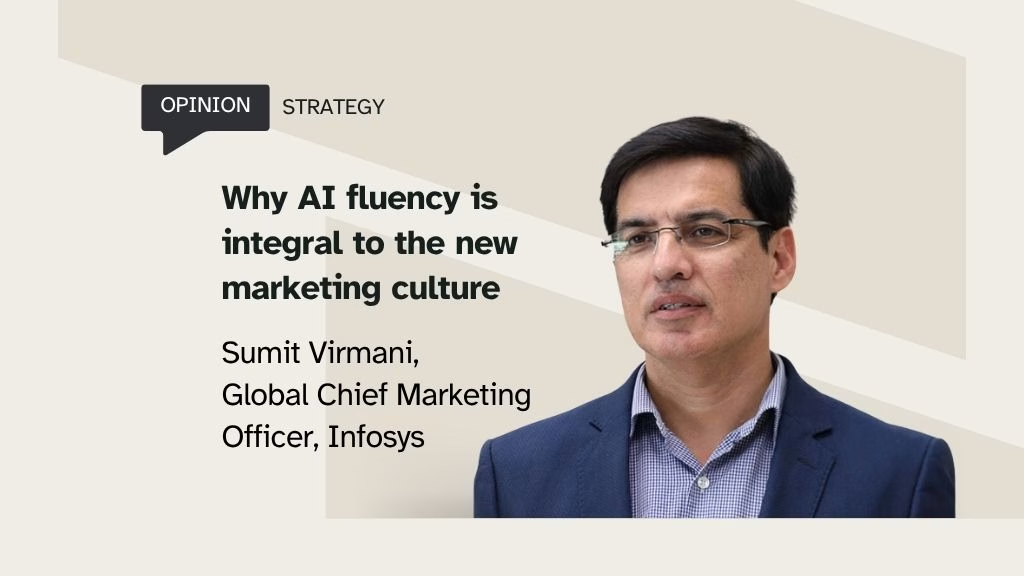
By Sumit Virmani, Global Chief Marketing Officer, Infosys
In marketing departments, across industries, a steady evolution is quickly gathering momentum. It’s all about getting AI-fluent. This is rapidly becoming essential currency for marketing teams determined to thrive in an increasingly intense and digital landscape. But this fluency isn’t merely about gathering desirable AI tools or skills. The challenge, most certainly, runs deeper than acquiring new software or scheduling training sessions. True transformation of marketing lies in cultivating a mindset that embraces AI as an essential partner rather than just an efficiency or productivity tool. And building that AI-fluent culture follows a strategic but predictable 4E – Enable-Empower-Encourage-Evaluate – pathway:
Enabling the team starts with furnishing them with the right knowledge and resources to experiment. Making solutions for creative generation, analytics, campaign management, personalization, and the like, accessible, along with structured training is, of course, foundational. Additionally, practical shared resources – like libraries of tried-and-tested prompts or AI hacks – serve to signal to the team that being AI-first is the way of the team. It’s also important to appreciate – as in any transformation – that adoption will likely not be homogenous. While there will be a minority that will jump in to innovate, and another minority that will be reticent, a big part of the team will wait, watch, learn and apply. Positioning the change leaders as ambassadors for the team to emulate and patiently nudging the rest can pay off rich dividends.
Empowering marketers to innovate starts with breaking down traditional silos. Content creators collaborate with data analysts, social media specialists partner with customer experience teams, and the creatives sit with the technical teams and testers to make sure new possibilities emerge. It’s at the cusps of the cross-functional learning that AI-powered creativity thrives and addresses real business needs rather than simply churning novelties. These collaborating teams don’t just solve for immediate challenges but build institutional knowledge and AI building blocks that become part of the marketing team’s DNA. For example, the creative team that built the Infosys ‘Rafa Forever’ campaign, powered by gen AI, worked with the Responsible AI office to make sure the application had a solid foundation with strong guardrails. This is essential for AI applications to filter out harmful or inappropriate content. The same gen AI foundation was later used by another creative team, with appropriate enhancements, to create personalized artistic renditions of the cover page of our annual report.
Encouraging scaled adoption means continuous and iterative prototyping, regular A/B testing, and multiplying early-stage beta campaigns that incorporate AI as a way of work for everyone in the team. Many times, the pursuit of perfection can hinder the pace of AI innovation and prevent many potential campaigns from seeing the light of day. Sometimes this manifests as vesting the task of AI Innovations with a separately appointed central team for AI experimentation while others persist in their tried and tested conventional ways. Experimenting with AI, in an AI-fluent team is everyone’s business. For example, when we started to explore ways to use AI and gen AI for marketing, we didn’t set up a CoE or designate specific teams to lead the charge; we simply started several experiments where everyone looked for relevant ways to apply AI to up the efficiency and efficacy of their campaign-build. As the experiments grew in impact on ROI, so did the learning and success of the AI-first new marketing tactics. When dealing with something as transformative as AI for marketing, unexpected and sometimes underwhelming outcomes are inevitable. Creating a space where the team feels comfortable trying new things, sometimes making those unavoidable mistakes, and knowing that if they are learning from these slipups and applying the learning to future tactics and campaigns – their efforts are lauded. Trusting their intent and rewarding failures too – that teach and pave the way forward for future successes – is vital to encourage.
Evaluating the journey is important as the journey itself. AI fluency isn’t a fixed state but a continuous journey of adaptation. Continuous evaluation is therefore necessary to ensure that the team’s AI fluency is making the necessary business impact. Periodic audits of multiple capability dimensions like —technology access, skill levels, current use cases, and the team’s enablement-levels to experiment and evolve – are key. Including applied AI proficiency as lens to measure and reward individual adoption of the AI-first way of marketing can unambiguously point to how the new marketing culture is evolving. After all, for most professionals – it only matters if its measured ( and potentially rewarded). It’s also important to evolve traditional marketing metrics, that are in most cases focused almost exclusively on elementary digital-world measurements. AI-fluent teams understand the value of embracing new KPIs that track campaign effectiveness now made possible by AI.
In the time of AI, marketing teams that embrace the habits of Enable-Empower-Encourage-Evaluate and build all round leaning into its operational rhythm—will successfully create the AI-forward culture that will serve them well as they look to move forward.