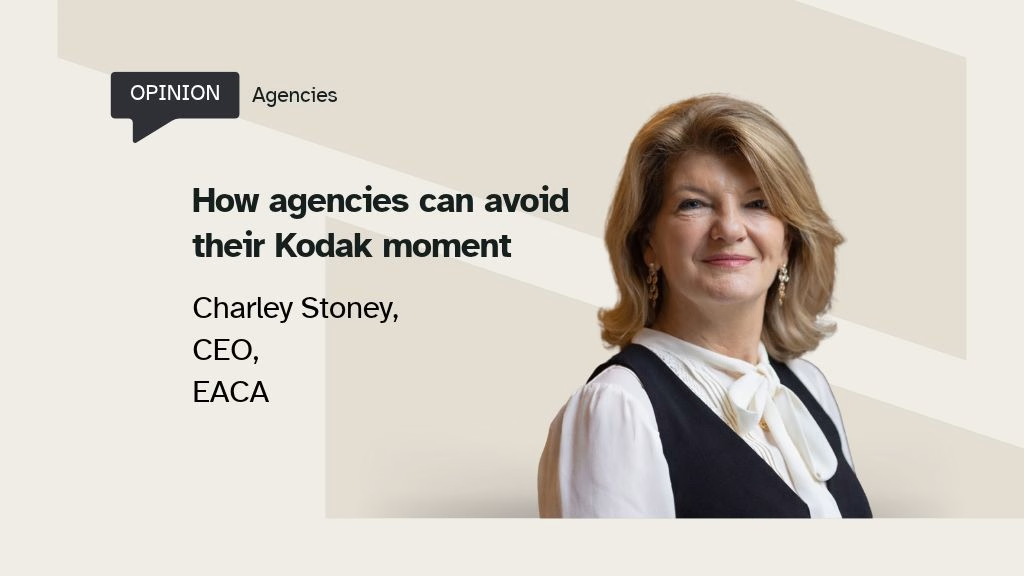
by Charley Stoney, CEO of EACA (the European Association of Communications Agencies)
I can remember when Kodak ruled the world. There were Kodak films (and cameras), Kodak moments (and even Kodak signs telling you where to take the best pictures from) as well as the branded physical prints that reminded us of the moments that matter.
Despite that emotional connection to some of the best days of our lives, however, Kodak went bankrupt as digital photography enhanced the medium. The company didn’t respond fast enough and rivals – including smartphones – took over.
The Kodak story should be a warning bell for agencies. Right now, we are on the same path. Fees are falling as time-based charging means lower income. Michael Farmer’s Scope of Work data, which tracks advertising pricing, found a 60% drop off over 20 years, through fees declining while scope expanded.
But unlike film and Kodak, nothing has replaced agencies. AI-powered tools provided by self-interested digital platforms simply aren’t even comparable to the thinking and insight provided by agencies.
We are still providing huge value for our clients, building the intangible assets that define company value. The strongest brands have outperformed the S&P 500 by more than 80% over 20 years, according to Kantar’s BrandZ and around the world the ad market is growing as more companies invest more in the power of marketing and advertising.
Struggles in every market
Despite this growth environment, however, agency finances are looking more fragile all the time. In Germany, revenues for GWA member agencies fell 2.7% in 2025, and 50.7% of member agencies recorded declines – according to their annual report.
Everii’s 2026 agency report for Germany, Switzerland and Austria saw 56% of 264 agencies describe their economic position as strained or very strained. While in Belgium, the latest annual sector report from IKAg revealed that median growth in the Belgian agency market fell from 14% to just over 1% between 2022 and 2024.
The fundamental reason agencies are losing revenue in a growing market is that our business model fails to secure a fair share of the value we create. AI tools are making agencies more efficient (and able to do more) but also reducing the amount clients have to pay for our services.
When we look at “Revenue per FTE” (full-time equivalent), at most agencies, the figure is roughly US$150,000. At most client companies, it’s often above $1 million. At Google, the revenue per FTE is $1.3 million. For Apple, its $2 million plus.
Most clients agree that agencies are underpaid. In fact, an IPA survey of 200 senior client-side marketers in the UK found that nearly two-thirds say what they are charged undervalues what their agency delivers.
Making the change
The fundamental switch that agencies need to make to avoid having a Kodak moment, is to disconnect results from staff, time from impact. The conversation needs to be reframed so that it’s not about selling services and capabilities, but rather solutions to business problems.
This can be done gradually and even in parallel to reassure clients. Agency leaders can focus on high-value areas that can be standardised, where they have a track record and can demonstrate outcomes. These solutions can then be turned into fixed price products that advertisers can buy with confidence, knowing exactly what they are getting in return.
That’s why I and EACA President Christian de La Villehuchet are so keen to have recently named Patou Nuytemans, the former EMEA CEO at Ogilvy, as our agency value ambassador, with a brief to evangelise the transformation we need as an industry.
With three decades of experience running and transforming some of the world’s biggest multidisciplinary agencies, she is perfectly positioned to convince agency leaders that the time-based model we have traditionally worked with has served its time.
EACA and VoxComm’s recent report Redesigning the Agency Value Model outlines a range of approaches including:
- Moving from staffing plans to modular solutions priced for impact;
- Turning expertise into repeatable AI-enabled solutions that scale; and
- Replacing projects with a subscription combining talent, technology, and outcomes.
Of course, there will have to be some delicate conversations, particularly with existing clients, but most will welcome the idea that compensation aligned with the outcomes that agencies help create should become a much more central part of the relationship.
For our industry to avoid its Kodak moment, the transformation needs to start today. We should not be content with falling profit margins, we’re better than that.