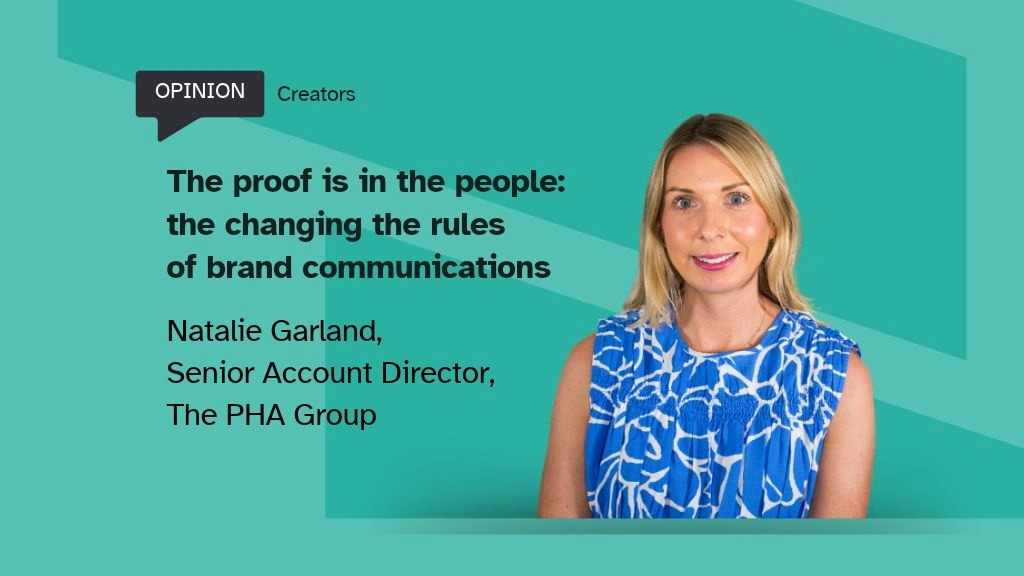
By Natalie Garland, Senior Account Director, Consumer at The PHA Group
For years, communications have provided an opportunity for brands to control their own narratives. From advertising campaigns to curated social content and strategic media placements, the objective has always been to tell consumers what makes a brand worth their attention, trust and money.
But the balance of influence is shifting. In an increasingly crowded and sceptical digital landscape, simply telling people why they should believe in a brand is no longer enough and consumers want to see the evidence for themselves. Welcome to the proof economy.
The rise of creator content, user-generated content (UGC), online reviews and peer recommendations reflects a fundamental change in how people now discover and, ultimately trust brands. Increasingly, audiences are looking beyond what brands say about themselves and turning to others’ experiences to inform their decisions.
However, this isn’t necessarily a rejection of traditional communications and marketing, but a need for something more tangible to sit alongside it.
Consumers have more access to information than ever before, but that has created its own challenge: knowing who and what to trust. With advertising messages competing for attention across every digital touchpoint, audiences have become more discerning about the claims brands make.
A campaign might capture attention, but a genuine customer review, product demonstration or creator recommendation can provide something advertising often struggles to deliver – reassurance. This is where the proof economy comes into play. Credibility is increasingly built through demonstration rather than declaration. Whether that’s a creator showing how a product performs in everyday life or sharing their genuine experiences, the emphasis is on evidence.
As a result, the most significant change is brands have had to let go of some control when it comes to consumer perceptions and instead distribute that influence.
Content creators have established their own communities, built on shared interests and perceived authenticity, so consumers regularly turn to them for reviews, social comments and peer recommendations before making purchasing decisions. Even seemingly ordinary social posts can shape perceptions and spark conversations that reach far beyond a brand’s own channels.
Crucially, influence is no longer exclusive to those with the largest audiences. A smaller creator with a highly engaged community, or a customer sharing an honest experience, can have just as much, or more, impact on how a brand is perceived.
So, what does this mean for brand communications today?
Firstly, rather than focusing solely on what a brand wants to say, communicators need to consider what will genuinely resonate with audiences and give them a reason to share it.
That means creating experiences worth documenting, developing products and services that deliver on promises, and building relationships with creators whose credibility extends beyond a commercial partnership. It also means being comfortable with a degree of unpredictability. Authentic advocacy cannot always be scripted, and credibility is difficult to manufacture.
Earned media, brand storytelling and strategic messaging still remain vital alongside this, however, their role is evolving. The strongest campaigns will bring together multiple forms of validation, allowing brand narratives to be supported by independent voices, real experiences and genuine consumer advocacy.
In a world where everyone has a platform and consumers have more power to shape brand reputations than ever before, the most persuasive brand message may not come from the brand at all. It may come from the people who have experienced it.
Ultimately, the proof economy represents a wider shift in the relationship between brands and consumers. Influence is no longer something brands can simply buy or dictate, it is something they have to earn.