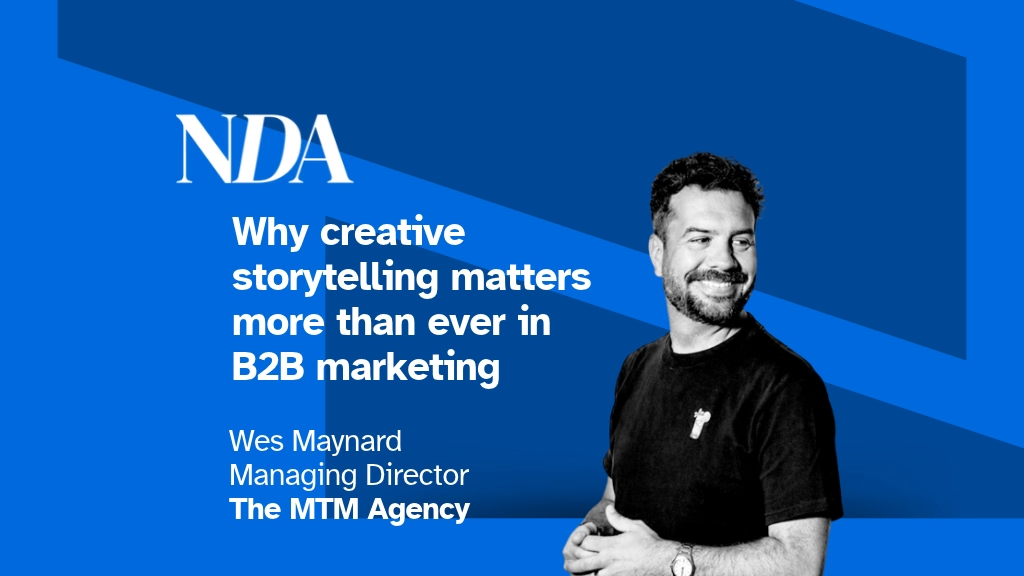
By Wes Maynard, Managing Director, The MTM Agency
If you run a B2B business, you’re probably very good at what you do. That can be part of the problem, however, when it comes to marketing.
Technical mastery is a powerful commercial advantage, but it’s a dull place to start a story within your strategy. Complex jargon might resonate with the people who already live and breathe your world, but for everyone else, it can be hard to digest, or worse, boring to read. In business, products get overtaken, competitors catch up and prices get undercut, but a strong story is one of the few things that can’t be copied overnight.
That’s why so many B2B brands are borrowing from the B2C playbook, where storytelling sits at the heart of the marketing. The aim isn’t to dilute the expertise that got you here; it’s to make sure more people, and crucially the people who need to be reached with your marketing, hear it.
B2B buying has entered complicated times
There’s no doubt that we’re living in complicated times: budgets are tighter, sales cycles are longer, and more stakeholders are getting a say, many of whom will never use the solution being offered. The people evaluating a product and its capabilities are rarely the only ones signing it off. Procurement teams, stakeholders, and senior decision-makers all want eyes on the transaction before pen goes to paper.
These are the “hidden decision-makers”, and they arrive with competing priorities; a highly technical proposition is unlikely to bridge those gaps and bring everyone onto the same page. The challenge is therefore to communicate expertise and demonstrate well without overwhelming – or boring – the audience.
In my opinion, there are three key methods through which marketers can make their tech know-how work harder: thought leadership can make it meaningful, creative formats can make it engaging, and creative consistency can make it memorable.
Method 1: Making expertise meaningful
Let’s talk about “thought leadership”, a phrase you can’t scroll through LinkedIn or trade press for five minutes without tripping over. Strip away the buzzword and the idea is simple: rather than competing solely on product functionality, a spokesperson with genuine expertise and insight can lift the conversation above features, specs and performance claims.
Research by Edelman and LinkedIn that surveyed close to 3,500 management-level professionals found that 60 per cent said high-quality thought leadership makes them more willing to pay a premium to work with an organisation, while 7 in 10 decision-makers are more likely to think positively of an organisation that consistently produces it. Strong research builds credibility, but personality makes that expertise memorable. A spokesperson with a distinctive voice and point of view gives buyers someone to connect with and remember.
That human voice is becoming even more important as the way B2B expertise is discovered changes. According to research by Meltwater that analysed 9.5 million AI citations, 75% of LinkedIn citations within AI-generated answers came from individual profiles rather than company pages, with more than half of those coming from people with fewer than 10,000 followers. It reinforces the value of making the people and expertise behind a business visible, helping to extend reach and build authority around the subjects a company wants to be known for.
Method 2: Making expertise engaging
Video is a prime example of how creativity can bring a technical message to life. It’s everywhere you look and is a highly engaged with medium for storytelling. LinkedIn Creative Labs found that corporate video which broke from the expected format, such as by leaning into cultural references or workplace humour, drove higher engagement and brand awareness.
That isn’t to say you should start sharing memes on your company LinkedIn page, but B2B videos do not have to be dry; they can be incisive, human, and tied to moments that resonate. The strongest examples are emotionally authentic, with credible experts speaking in a conversational style rather than in “corporate-speak”.
Method 3: Making expertise memorable
Thought leadership can give technical expertise meaning, and creative formats can make it easier to engage with, but neither creates lasting commercial value if audiences can’t connect those communications back to an organisation over time.
Product developments and technical breakthroughs create significant commercial moments, but that advantage is harder to realise if buyers don’t know who you are, understand why the development matters, or remember your organisation when the need arises.
This is where consistency closes the gap. When messaging, tone of voice and positioning stay aligned, they reinforce the same framework, making a brand easier to recognise, recall and trust.
Creativity can make true expertise travel
So, where do you start? Look at your last marketing campaign and ask who it was really written for. If the honest answer is the engineer who already believes you, you’ve spent your budget preaching to the converted.
My advice is to pick one piece of expertise your business wants to be known for and take it outside of the technical bubble. Ask who really needs to hear it. Will they care about it? What do you want them to remember once the technical detail has faded? From there, translate your expertise into a problem, opportunity or point of view that speaks to their priorities, and find a creative way to bring it to life, whether that’s through a strong spokesperson, thought leadership, video or another engaging format.
Creative storytelling is not about making B2B marketing less intelligent; it’s about making that intelligence travel further. After all, expertise only becomes influential when the people who matter understand its value.