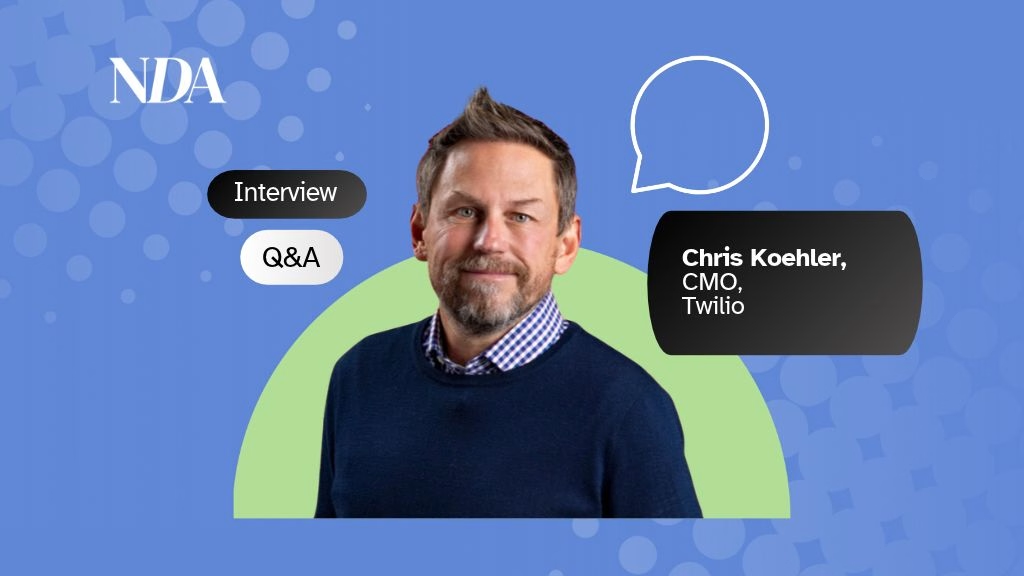
The specialisation of marketing tasks has created increasingly fragmented teams and workflows. Twilio CMO Chris Koehler believes that, as AI takes on more of the specialist tasks, marketers now have an opportunity to become more rounded, strategic and focused on driving business growth.
NDA spoke with Koehler to find out more…
What is Twilio, and what does your role as CMO involve?
Twilio is a communications platform. The way we talk about it is that we power communications around the globe. That could be a one-time password for your bank when you log into your account, a text message or an email, or the back-and-forth communication you have with a food delivery service or your car. We power communications around the world, and that’s accelerating in an AI era.
As CMO, I’m responsible for telling the Twilio story to the world and helping grow the business alongside my counterparts and the executive team.
You’ve suggested that marketing has become increasingly fragmented, with a growing number of specialisms. How do you see that changing?
If we think about marketing and the specialisation we’ve created over the last 20 or 30 years, as new disciplines arrive, we create specialisation around them. My hypothesis is that there was a world where that was necessary because the tools didn’t allow you to expand beyond your particular discipline.
But as a marketer, if I’m a product marketer, why can’t I create copy? Why can’t I drive some of the visual imagery and campaign aspects around that? Why can’t I make suggestions about where to deploy a campaign and the audience we should be reaching?
I think there’s a world where AI becomes more of the specialist. If AI can solve some of the biggest mathematical problems and proofs in the world, it can certainly help marketers drive more of the workflow. I’d argue that 95% of my marketing organisation is probably made up of specialists. What if you flipped that on its head and said: actually, as a marketer, I want to be able to do more of that workflow?
Think about solving a specific goal, such as engaging more CIOs through a field marketing programme. That’s a cross-disciplinary activity. Why can’t an individual or a small group of people go and solve that, rather than having every specialist in the marketing organisation contribute to it? I think that slows everything down.
The conversation becomes about how I can be a bit more of a generalist, while AI can be the specialist. That doesn’t mean you don’t need specialists. They will provide input and make sure that what you’ve created is accurate, correct and has the right level of taste. But I think there’s a shift towards being more generalist.
So AI could actually make the generalist marketer more relevant?
One hundred per cent. The idea is that we’re allowing technology to take on a lot of the activities that, quite frankly, none of us love doing – the tedious stuff and the steps that slow us down.
We’re becoming more like strategists and orchestrators of marketing, rather than having to do all the content creation ourselves. The role changes, but I think it becomes more satisfying because you can be more strategic, rather than spending your time on the day-to-day, boring stuff.
Does that also change the relationship between the CMO and the CFO, particularly around demonstrating return on investment?
I talk to a lot of my peers in the industry, and everyone is feeling pressure to drive more ROI. I hear a lot of conversations about how we’re driving efficiency with marketing. That’s one aspect of it, but I’d flip the question around and ask how we’re driving growth.
As a marketer, I can’t do all the things I want to do. I’ve got a laundry list of activities that I can’t get to because I don’t have the capacity in the team.
If you’re a good steward of the money you have, you can improve ROI. These capabilities should help us drive growth faster than we have before.The reality is that, yes, you may drive efficiency, but that efficiency should serve growth. It shouldn’t simply be about cutting costs.
As the marketing remit evolves, what should remain under the central control of the CMO to safeguard the customer experience?
In our marketing organisation, the first thing is that we should own the story. How are we telling the story to the market? That could be to industry analysts, financial audiences, employees, customers or prospects. We should own how we’re telling that story for the company.
The second part is driving growth. We’re a B2B company, so that’s done in partnership with our chief revenue or operations officer and our sales organisation. Marketing shouldn’t be a cost centre; it should be a growth driver for the business.
The third element is making our platform easier to use, easier to understand, easier to sell and easier to adopt. We don’t do the technology itself, but we have to explain it and make sure people understand our value proposition and can get ROI and value from it.
The final pillar is about being bold. In a world where there’s a lot of sameness, I’d argue that B2B is quite conservative in how we approach storytelling and campaigns. I’m pushing the team to be bold, rethink things and reimagine everything we do in this new era.
Looking ahead, what would constitute a successful 2027 for Twilio?
I’d love to see us continue to reaccelerate our growth while doing that efficiently.
We’re in an era where we can make our customers very successful. How do we capitalise on this AI boom? We’ve got a lot of AI-native companies building on top of our platform, which is really exciting.
One emerging area I find particularly interesting is the notion of consumer agents. As we all start adopting personalised consumer agents to make our lives better, where do we play a role in partnering with those companies? We’re already starting to do that.
It’s not just about the business side of agentic AI, but also the consumer side. I think it can free us up personally to do a lot of things that, quite frankly, we don’t particularly enjoy doing anyway, so we can spend more time on the things we actually enjoy.