With AI rapidly taking over many of the junior tasks that once helped young creatives learn their craft, a personalised AI platform – SCAFFOLD AI – has been developed to help the industry develop tomorrow’s creative leaders.
In a twist on the old school media apprenticeship, young creatives can have their ideas challenged by AI partners built around the thinking of some of Britain’s best creative minds. A collective of the UK’s top copywriters and creatives are supporting the new platform, in a bid to pass on their knowledge and protect the next generation against the negative effects of LLMs.
Patrick Collister, who worked on Guinness and Heinz, Graham Fink who worked on PlayStation and British Airways, Simon Richings, who worked on Adidas, Marmite and Volkswagen are all supporting the initiative, which is also being financially backed by Lord Karan Bilimoria, Chairman of International Chamber of Commerce, UK.
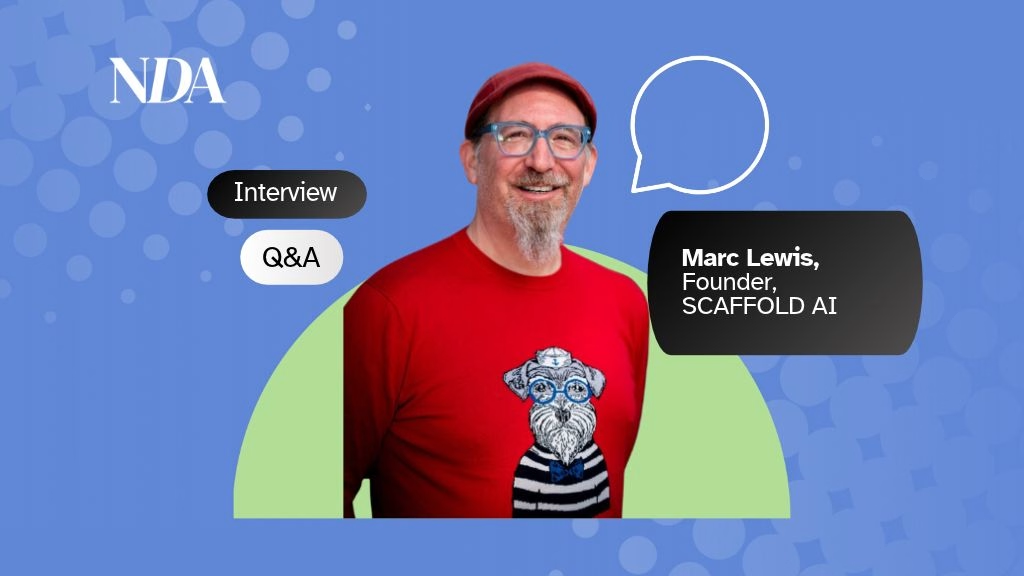
The platform has been developed by Marc Lewis, the Dean at the School of Communication Arts (SCA), who has spent more than a decade training creative talent, leading the school to win more prizes than any other institution.
Lewis designed SCAFFOLD AI for freelance creatives, in-house teams and agencies. Through a structured conversation with MarcAI, an AI model trained on Lewis’s coaching method, the system maps a user’s thinking, tastes, preferences and working habits into what it calls a Blueprint.
That Blueprint is then turned into an Exoskeleton, a personal AI partner intended to work alongside the user on live briefs. The agent can also work across the AI tools a user already relies on, rather than locking their work into a single platform.
NDA spoke with Lewis to learn more…
What was the original inspiration behind the SCAFFOLD AI project?
I’ve been running the School of Communication Arts for a long time, and I see my job as preparing students to fight tomorrow’s industry battles. I’m always trying to think four or five years ahead, asking our industry partners what’s keeping them up at night and what challenges they’re anticipating.
Coming out of COVID, what I was hearing increasingly was “AI.” Initially it was a whisper, but there was enough evidence to suggest it was going to be important, so we started thinking about how to introduce AI into what we do at the school.
At the same time, I was training to become an accredited coach and discovered a strand of psychology called Applied Cognitive Task Analysis (ACTA). It comes out of the military and is used in areas such as policing and firefighting. The premise is that, as we become good at something, we move through four stages: unconsciously incompetent, consciously incompetent, consciously competent and, eventually, unconsciously competent.
What I realised was that we could use that methodology to help people understand and articulate their own creative processes. The original thought was that students could use this to create a shadow of themselves, effectively becoming a creative partner.
Although students were the initial inspiration, Scaffold is ultimately aimed at capturing the expertise of experienced professionals. Why is that important?
One thing I’ve noticed post-COVID is that we spend much less time sitting next to the experts in our organisations. There’s a phrase I came across in my research for a book I’m writing: “sitting next to the Nellies”. The Nelly is the expert in the office, the person who knows everything, and you learn through osmosis simply by spending time with them.
We don’t do that as much anymore. At the same time, we’re approaching a generational change, with many experienced people starting to think about retirement and, at the same time, junior-level employment is already down between 25% and 50%.
I’ve been interviewing some phenomenal creative leaders and getting inside their heads to understand their processes. I call that their cognitive DNA. Once you’ve captured that knowledge, which might amount to 20 pages documenting how a leading creative thinks about a particular creative task, you can turn it into an agent.
A junior can then work alongside that agent and see how the creative leader thinks in particular situations.
Can you give an example of how that works in practice?
One creative director I interviewed described how, when looking at an idea, they ask themselves: “Is this idea cake or icing?”
If it’s just icing and there’s no cake, there’s no substance. If it’s cake but there’s no icing, that’s fantastic because you can decorate it.
That’s a really lovely way of articulating a judgement that a creative director makes when evaluating a junior’s idea. We can capture that thinking and build it into an agent, allowing the junior to test their ideas before taking them to the creative director.
Multiply that by hundreds of different decisions that senior people make and you start to see the potential. This tacit knowledge can be captured and shared with juniors to accelerate their learning.
But they have to want to learn. There’s research showing that if you use AI simply to give you answers, you’ll get some decent answers, but you won’t learn. If you use AI to help you work out good answers, you’ll get to even better answers and you will learn.
How does this go beyond traditional knowledge management?
Traditional knowledge management often resulted in intranets and wikis that nobody really updated. They became empty libraries containing processes and information, but without much judgement or empathy.
What’s different is how we capture the knowledge. We’re not simply asking people to write down their processes. Through structured interviews and cognitive task analysis, we’re looking for the cues, the judgement calls and those moments when an expert thinks, “Hang on, there’s something wrong here.”
When experts face a problem, they draw on experiences of similar situations in the past while simultaneously imagining how they might solve the problem in the future. That’s the important thinking we’re trying to capture.
Rather than creating a document nobody reads, we turn it into an agent that can work with the tools organisations are building into their workplaces. It can show you step by step how it’s thinking, talk to you in real time and ask for your input.
I like to say that the AI becomes the junior, the junior becomes the creative director, and the creative director becomes the coach.
There’s also an important question around ownership. My view is that this cognitive DNA belongs to the human. They make it available to their employer under licence. We have to protect the individual, and if someone retires, for example, they might agree to make their knowledge available to their former employer for a period of time, potentially generating passive income.
How does Scaffold work with organisations, and does it depend on any particular AI model?
We help organisations identify their bright minds, unlock and capture their tacit knowledge, document it and build agents that can be integrated into their workflows. We also show organisations how juniors can work alongside those agents as learning accelerators.
We’re not tied to a single large language model. Different organisations will have different approaches to AI, with some running models internally and others using providers such as OpenAI or Anthropic.
Once we’ve built the blueprint, Scaffold looks at the available models and determines which is the right one to use at each stage of the agent’s work. It can make decisions about the model, prompts and settings according to the task.
We’re also developing a marketplace that will allow organisations to access the expertise of senior people outside their own businesses.
Do you see this encouraging businesses to develop junior talent rather than simply replacing those roles with AI?
I don’t think it’s binary. We have to accept that the shape, size and structure of organisations will change quite significantly as a result of AI. They may need fewer people, and those people may have to learn faster.
But every business will still need new blood. I was talking to a group of consultancy partners recently and asked them: in this world of AI, if we’re not hiring juniors, who’s going to make partner in five years’ time?
That’s an existential question. Whether you’re in consulting, law, advertising or television, businesses rely on the next generation coming through. We’re always going to need fresh talent.
What would success look like for Scaffold over the next couple of years?
I’d like to see the idea of capturing tacit knowledge becoming mainstream, something that boards are discussing and incorporating into their governance.
I’d like us to be working securely inside a number of agencies, consultancies and brands, with leaders having built their own agents and juniors learning from them.
I’d also like to have a couple of dozen senior experts deployed through our marketplace, earning passive income from their knowledge while knowing that they’re helping the next generation develop.
Ultimately, I want to see a shift in how creative people feel about AI. There’s a lot of fear, particularly among creative leaders and juniors. I’d like to believe we can help turn that fear into ownership: leaders understanding how they can own their knowledge in the AI economy, and juniors discovering how they can learn from those leaders.