As viewing habits fragment across platforms, devices and social channels, the challenge for TV and streaming services is increasingly how to get the right content in front of the right viewer.
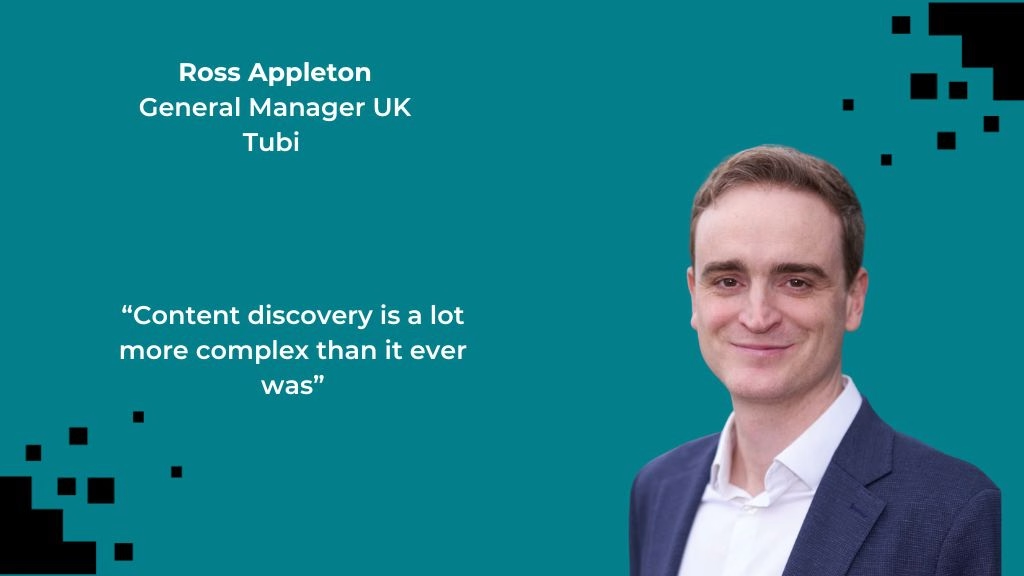
For Ross Appleton, General Manager, UK at Tubi, personalisation and machine learning are central to that challenge. Ahead of his appearance at NDA’s Foresight Conference, he discusses the changing nature of content discovery, the growth of ad-supported streaming, CTV advertising innovation and why fragmentation could ultimately create better opportunities for brands.
What are the biggest trends shaping the future of content discovery?
The overarching trend is that it is much more distributed than it ever has been. The days when you could put something on BBC or ITV at 9pm and people were going to watch it are gone.
Discovery now happens in so many different places. It happens within your own product, on TV operating systems, through partners, traditional search and social, where creators might be talking about or even producing content.
AI is obviously another, newer frontier. It is still early to say exactly how that will look, but I think it will be a combination of all these different channels. Media companies and publishers need to consider each of them. It is a lot more complex and there are a lot more routes into discovery than there ever were.
Where does personalisation fit into that?
Personalisation is hugely important for us because we have the largest content catalogue in the UK. When you have a catalogue that big, you really need to get personalisation right, otherwise you don’t let that catalogue shine.
We use machine learning to drive our personalisation engine and do lots of A/B testing around the blend between personalisation and editorial control. Nine times out of 10, the machine learning wins in terms of engagement.
The more you use Tubi, the more it gets to know you and the better-suited content it can give you. We see average viewing times increase and stickiness go up as a result.
Is the next step making recommendations more contextual?
Yes. I see three elements to personalisation. There is what’s popular, then there is “you watched this, so you might like this”, and the newer frontier is intent and context.
Instead of simply saying, “You liked this comedy, so we’ll give you another comedy”, it evolves to become more contextual. It could be something like, “What would me and my 13-year-old boy enjoy watching together on a Friday after school?”That is much more contextual than simply saying, “You watched this, therefore we’re going to serve you this.”
Does machine learning ultimately beat human curation?
For Tubi, there is real power in personalisation. We prioritize making recommendations and allowing fans to decide which rabbit hole they want to discover next. Given the size of our catalogue, it is impossible for a single person or team to determine what everyone in the country should be watching.
You might hit the median viewer, but you’re not going to hit everyone around the edges. We cater to all viewers, not just the median viewer.
We constantly A/B test manual curation against machine learning and see that personalisation wins in terms of engagement and average watch time.
There are obviously certain things you want to pin to the top of the homepage. Live sport is a good example. But for a catalogue service like Tubi, away from those big tentpole moments, I think there is a bigger place for personalisation than manual curation.
What does ad-supported streaming bring to content discovery?
The biggest thing is that it is free and, in Tubi’s case, really friction-free to access. We don’t enforce registration and there is no paywall or barrier between the viewer and the content.
That means whether you discover something through the Radio Times, a friend, Google, social media or a creator, you can get into it and play it very easily.
Social media also means old films and TV series can suddenly find a new life. A 20-year-old movie can become culturally relevant again because it has exploded on TikTok with a younger generation.
Tubi isn’t a catch-up service, so we aren’t constrained by a linear TV schedule. We can let the wider library shine, which makes content discovery even more important.
How is the relationship with advertisers evolving?
We’ve built some really strong relationships with key brands and agencies in the UK, even though we’ve only been here for two years.
What we offer that is different is a really young and diverse audience that is highly incremental versus many other streamers and places where advertisers can buy.
As audiences fragment, advertisers can’t get the reach they used to get from a small number of linear channels. Tubi helps them reach those younger and more diverse audiences in a premium TV environment.
At the same time, because viewers have purposefully selected what they are watching and our personalisation helps match them with relevant content, engagement is high. That is good for viewers, content partners and advertisers.
What advertising innovations are generating the most interest?
There is a big appetite for pause ads because they are easy for advertisers to understand and aren’t particularly intrusive.
But some of the more exciting opportunities are deeper packages, such as takeovers around particular genres or titles. In the US, we’ve worked with major studios on theatrical releases where a movie takes over the Tubi homepage, with animation around the title, followed by a relevant pre-roll experience.
It creates an immersive, 360-degree advertising experience and can be really effective for advertisers.
What is the biggest challenge for advertisers as TV fragments?
The overarching challenge is fragmentation. It is more difficult to run a campaign now because you need to reach people across more channels.
You used to be able to advertise on ITV and Channel 4 and reach a huge proportion of the population over a weekend. You can’t really do that anymore.
But I’m more glass half full. The upsides are much greater. Once you get over the complexity of reaching audiences across different platforms, those audiences are highly engaged, and you have a much deeper set of advertising tools at your disposal.
So I think it is a huge opportunity. It is just a more complex landscape than it used to be.