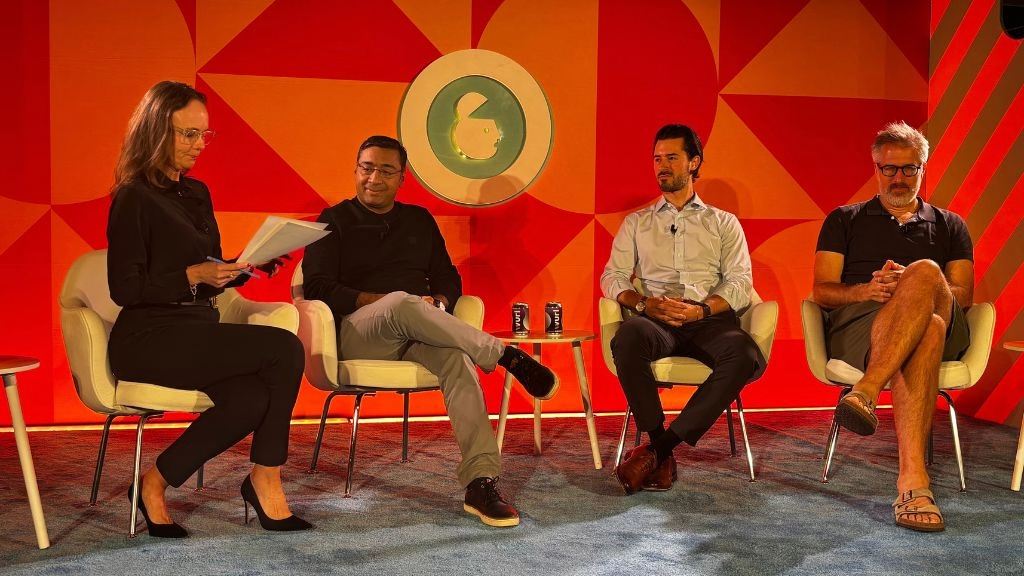
Advertising Week New York 2026 had one key message for the industry: lovely demo, now show us the money. Over four days at The Penn District, more than 500 sessions and 28 content tracks asked how AI, creators and commerce turn into actual business, rather than just a very confident slide deck.
AI cropped up in most of those sessions, but it seemed that the tone has shifted from “this changes everything” to “fine, but what does it actually do? ” Agentic AI, AI agents doing the shopping for their owners, and scaled AI creative production becoming normal for CMOs outside the billion-dollar brands all got airtime.
Not everyone was in the mood, though. Agency Mekanism’s “Give AI a Break” stunt gave attendees a parody chatbot that refused to take prompts until the week was over. A chatbot on holiday at one of the most AI-heavy events of the year is a neat trick.
By far the biggest focus of the week was on creators. Dhar Mann became Advertising Week’s first Chief Creator Officer, with a target of $100 million in new creator and brand business through pitches, meetings and creative collaborations. Creators were pitched as both creative partners and distribution channels. Around 1,000 came as delegates last year, and that number was expected to more than double according to the organising team.
This is a big shift and not everyone is enjoying it. One renowned trade journalist was very audible in his comparison of the relative paucity of the press room compared to the much more plush surroundings of The Creator Lounge.
The way deals get done is changing too. It seems that increasingly creators now pitch brands without an agency in the room, and pitch to AI answer engines rather than to algorithms. Agency execs were heard to laugh nervously at this point…
This wasn’t the only time senior agency types looked worried. An uncharacteristically grumpy Brian O’Kelley pointed to the massive talent gap and financial disparity between tech giants and traditional agency groups. He highlighted how difficult it is for agencies to recruit top-tier technical capability when competing against AI powerhouses.
“If you want to be great at technology these days, how can you compete when Meta is hiring people for $100 million a year,” O’Kelley pointed out. “You can’t compete with Meta. They’ll pay almost anything.”
He advised agencies to specialise deeply: “You have to be a specialist. It would be better to be the best at one little thing with agents that help you do it really well, than be a generalist.”
Advertising Week Global President Ruth Mortimer called 2026 a year of convergence, with streaming, creators and commerce media or social commerce overlapping more every month. Programming went much deeper into media and entertainment, gaming, health and wellness, and finance and investing than in previous years, making the event more useful and attracting a wider selection of delegates from vertical markets.
This was the first Advertising Week since owner Emerald was acquired by Apollo Global Management and merged with Questex to form Forge. Mortimer says she wants the event to create business rather than simply fill rooms, and next year it heads towards the Javits Centre and Hudson Yards, which means more space and hopefully much better wifi and aircon. The Penn District is frankly a pretty unloved venue, and the event will be better for the move.