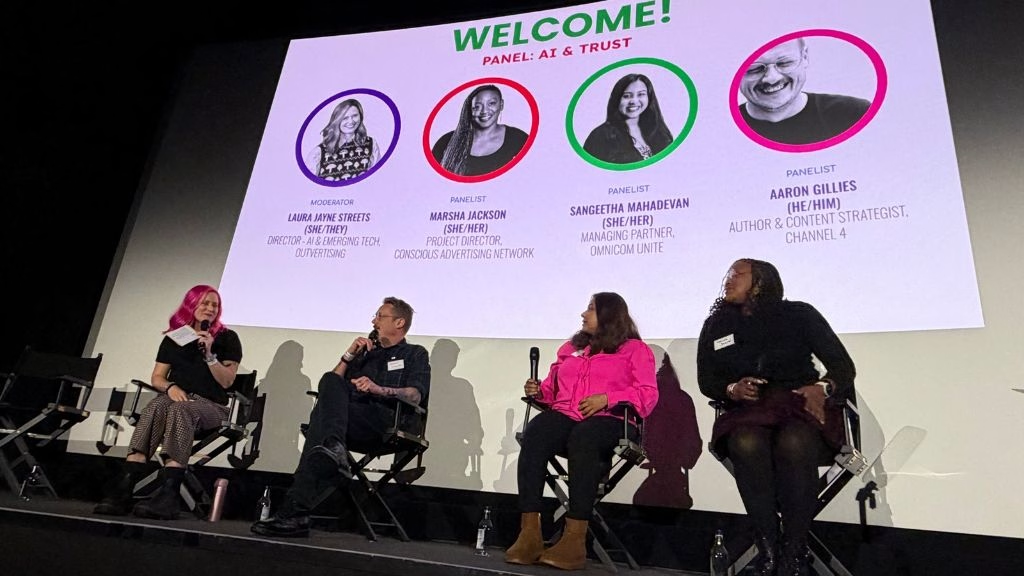
AI is rapidly transforming how brands target audiences and create content, yet its unchecked adoption threatens to erode consumer trust and marginalise vulnerable communities. Speaking on the AI and trust panel at Outvertising Live 2026, industry leaders examined the hidden harms of automated advertising systems and outlined practical steps for brands to act responsibly.
Moderated by Laura Jayne Streets, Director of AI and Emerging Tech at Outvertising, the session featured Marsha Jackson, Project Director at the Conscious Advertising Network, Sangeetha Mahadevan, Managing Partner at OMG Unite, and Aaron Gillies, author and Senior Content Strategist at Channel 4.
The commercial imperative of trust
Opening the discussion, Streets highlighted research showing that trust is the second most important factor in consumer decision-making, trailing only value for money. However, visible reliance on generative AI is actively undermining that confidence.
Referencing a recent Klaviyo survey, Streets explained that while 7% of consumers said AI-generated marketing content made them trust a brand more, 32% said it made them trust the brand less.
“If you are doing a bunch of work to build trust with your consumers on one side, and then you are using AI in a visible way on the other side, you are actually working against yourself,” Streets said.
For LGBTQ+ audiences, the stakes extend well beyond brand perception. Streets warned that AI accelerates existing adtech risks, including inferred identity targeting that can inadvertently out individuals, alongside cultural colonialisation where large language models scrape and regurgitate queer slang without context or permission.
To counter this, Streets urged organisations to map their values against their operational systems and scan for potential harms before deploying new tools.
Auditing the advertising ecosystem
Jackson explored how these issues feed into what the Conscious Advertising Network and the United Nations define as the global information crisis. Because advertisers fund the vast majority of digital platforms, Jackson argued that brands hold significant leverage to demand safer, more transparent ecosystems.
Traditional brand safety tools, however, often exacerbate exclusion by blocking keywords associated with marginalised groups rather than fostering genuine inclusion. Jackson called on agencies and brands to challenge technology vendors during procurement and prioritise transparency.
“Traditional tools do not help, they actually are more exclusive than they are inclusive,” Jackson said. “If you have a new tool coming into your organisation, make sure you challenge those on the set-up side of that tool. Is it bringing people in, does it include everybody rather than exclude?”
Moving beyond performative inclusion
Mahadevan examined how historical bias embedded in training data shapes AI outputs. Citing UNESCO research, Mahadevan pointed out that 70% of responses from Meta’s Llama model regarding gay individuals were negative, dropping only slightly to 60% in GPT-2.
When global brands deploy AI to scale campaigns rapidly, they risk automating stereotypes and exposing queer people to severe harm, particularly in the nearly 65% of countries where homosexuality remains criminalised.
Despite these risks, Mahadevan cautioned brands against retreating from LGBTQ+ engagement out of fear of appearing performative. Instead, she advocated for internal audits of hiring practices and customer experiences, alongside direct investment in queer-owned media and creators.
“The response to the fear of being performative is not to go silent or to go invisible,” Mahadevan said. “Investing in queer platforms and queer creators is an incredible way of supporting the community, because these platforms are not going to show up your brand in an inauthentic way.”
Keeping human connection at the centre
Closing the panel, Gillies addressed how content strategists can preserve authenticity as generative tools accelerate copywriting workflows. Because data models rely entirely on historical inputs, Gillies argued they are fundamentally backward-looking, whereas genuine creativity requires forward-looking human empathy.
Drawing on his past experience managing social media for the television channel Dave, Gillies recalled inadvertently sparking a viral moment with a joke about a potential October lockdown, which resonated deeply with the trans community. Leaning into the mistake with warmth and humility fostered a genuine two-way dialogue that automated systems simply cannot replicate.
“You do not get that really nice human error with AI, it is just forced and it is very mechanical, clinical and methodical,” Gillies said. “You want to be creating a dialogue, and that is where authenticity and lived experience is really true to that, and that is the only way that you can really have those conversations.”
Across the session, panellists agreed that AI should remain a supporting tool rather than a replacement for human judgment. By embedding lived experience into creative workflows and holding adtech partners to higher standards, advertisers can harness emerging technologies without sacrificing the trust of the communities they serve.