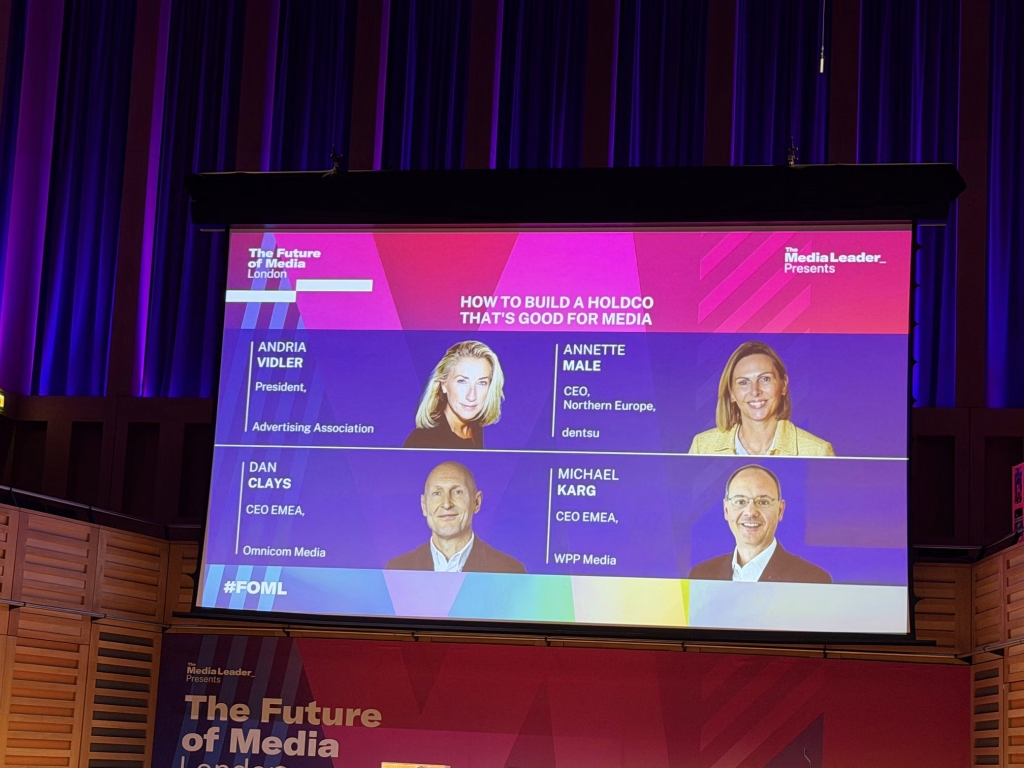
The Future of Media London 2026 conference launched today (3 November) at King’s Place, hosted by The Media Leader, with New Digital Age in attendance alongside more than 1,000 media owners, agencies, advertisers, and tech leaders.
The opening panel, “How to build a Holdco that’s good for media” was chaired by Andria Vidler, President, Advertising Association, and gathered together major agency holding group leaders including Annette Male, CEO, dentsu, Dan Clays, CEO EMEA, Omnicom Media Group, and Michael Karg, CEO, WPP Media.
The discussion centered on how these massive media networks are leveraging scale, automation, and connected ecosystems to reshape the agency landscape and deliver better business outcomes for brands.
Integration’s what you need
For Male, the changing role of media agencies is about helping clients make better business decisions, with media increasingly connected to content, data and technology.
“Media no longer sits in isolation. It’s about how we create a better connection between media and content, between data and tech, and how we focus that around solving clients’ problems,” she said.
While briefs may still begin with media, dentsu is increasingly looking for opportunities to connect capabilities around a wider business challenge, said Male: “It doesn’t mean clients want everything together, all the creative, all the media. From our perspective, it might start with a media relationship, and then it’s media plus CRM, or media plus content. Those connected solutions are where we’re seeing growth.”
Clays agreed that the scope of media has expanded, with agencies needing a broader range of capabilities.
“Clients are seeking to work with partners that can provide clarity and confidence around how to drive transformational growth. How do they prioritise investment across different channels? How do they structure for the future? How do they utilise AI? How are brands being discovered in different ways? How do they use and enrich their data?”
Michael Karg, meanwhile, cautioned against allowing the industry’s focus on integration to overshadow the work that media agencies continue to deliver every day.
“The vast majority of pitches are still media pitches. We have to be proud of the craft we’re doing. Media craft is super relevant and super important, and we need to cherish it a bit more because we have super talented people in our organisations.”
Buying is about value, not just price
The panel also explored the value of media buying, and the responsibility agencies have to balance clients’ commercial interests with the health of the wider media ecosystem.
Clays argued that buying is not simply a matter of securing the lowest price, but of understanding how media investment can deliver broader strategic value. He pointed to buyers’ understanding of audience behaviour, platform innovation and pricing as critical to ensuring that investment is working effectively.
“It’s very easy to get excited about some of the new innovation on platforms, but if the price is getting inflated, the buyers are the people who keep you on it. Buying is actually really critical to the transformation process.”
Karg highlighted the importance of choosing the right metrics, warning that media can appear efficient while failing to deliver the desired business outcome.
“We have to help clients look at outcomes more holistically and bring these conversations together. The ecosystem and the environment are super important, and so is the health of the publishing environment.”
Clays said agencies also have a responsibility to preserve the media environments that attract audiences and support advertisers: “We’ve got to get to the right pricing for our clients, but also in a way that’s enabling media owners to create the content that attracts the audience that we then need to attract the customers for our clients.”
He added that pitch processes should consider the quality of audiences and environments, rather than focusing solely on bottom-line price.
“We don’t want to be an industry that’s racing to the bottom. We’ve got to make sure we maintain a system that attracts audiences, creates high-quality environments that drive attention and deliver growth for our clients.”
Transformation, talent and AI
The discussion next turned to the challenge of making increasingly complex organisations easier for clients to work with.
Male explained that dentsu’s recent transformation had focused on connecting capabilities across the business: “The complexities of holding companies are things you don’t want clients to have to deal with. The main transformation we’ve done is breaking the silos down, having single P&Ls at a market level, and making sure capabilities across the whole business can connect. It just needs to be easier.”
The conversation also touched on talent, including the need to attract people into the industry and retain expertise across generations.
Male said she was concerned about the employment prospects of early-career talent, while also highlighting the need to support and retain experienced people.
“What’s really disappointing is seeing how it drops off post-50. What do we need to do to make sure we’re enabling talent, upskilling and retaining that expertise and experience within the business?”
For Clays, AI should be understood as a way to release capacity and allow people to focus on higher-value work, rather than simply as a means of removing roles: “The ability to enable our talent to have the tools, agents and applications that get there faster means they can spend more time adding strategic value to clients and having the kind of conversations our people want to have.”
Karg also saw AI as an opportunity to remove repetitive tasks and create more time for strategic advice: “The mundane work can disappear. We can use technology and AI to make sure all dull stuff that people spend hours and hours doing, whether that’s reports, dashboards or basic research, just goes away.”
So, what should clients ask agencies to prove as a demonstration of their value?
Karg’s answer was succinct: “Business impact. Growth.”
Male said agencies’ value should be measured not simply by reductions in media pricing, but by their contribution to clients’ businesses and consumers.
“I sometimes think of Jerry Maguire, which is ‘show me the money’,” said Male. “Not necessarily in terms of how much money you’re going to reduce on pricing, but show me the value you’re going to give back in terms of their business and for their own consumers.”
The panel agreed that scale and integration can offer agencies an advantage, but only when they make it easier to solve client problems, deliver effective media and demonstrate measurable business outcomes.