The Future of Media London 2026 event kicked off yesterday (November 3) and included a session examining how agentic AI is shifting how media is planned, bought and sold, and what it means for agency-owner relationships.
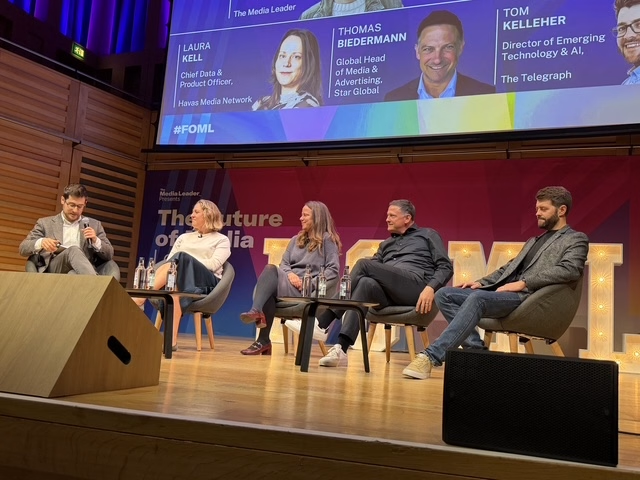
The session – “Agents of Change: Is Agentic AI Making Media Better… or Just Faster?” – was chaired by Jack Benjamin, Senior Reporter at The Media Leader, who was joined by Laura Kell, Chief Data & Product Officer at Havas Media Network; Lauren McGuire, VP, Media and Communications at Salesforce; Thomas Biedermann, Global Head of Media & Advertising at Star Global; and Tom Kelleher, Director of Emerging Technology & AI at The Telegraph.
The panel’s initial verdict was that agentic AI is already making media faster, and in some cases cheaper, but whether it is making it fundamentally better remains a more difficult question.
McGuire said AI was helping teams move more quickly through routine tasks and concentrate on work where they could add greater value. But she cautioned that this depended on the quality of the data underpinning the technology.
“The old saying ‘garbage in, garbage out’ applies to the world of agentic AI, and I don’t think that will ever change.”
Kell agreed that the efficiency gains were already evident, but argued that the industry needed clearer ways of measuring what agents were actually delivering. Much of the current activity, she suggested, was focused on doing existing tasks more quickly and cheaply, rather than changing the model itself.
“Definitely faster, definitely cheaper, and those things have all been proven. But in terms of better, I think we still need better and clearer measurement of what the agents are delivering. The next evolution will come when we start looking at how we can fundamentally improve the model, rather than just replicate what we’ve always done.”
There were, however, examples of AI improving the quality of media activity. Kell pointed to tests in which the use of agents had reduced the proportion of made-for-advertising (MFA) sites in a media buy to around 1%.
“If agents are improving the quality of what’s being bought and eliminating MFA, that’s good for everyone. Where ‘better’ falls down is in the metrics we’re measuring it against. Finding better becomes a measurement challenge.”
For Kelleher, the industry was still some way from a fundamental shift in how media was planned and traded. Much of what agents were doing amounted to automating existing processes, rather than creating a new approach.
“We’ve taken a lot of what people were doing – shuffling things around and clicking buttons – and machines are doing that much quicker. But I don’t think we’ve yet arrived at the paradigm where we’re doing things differently at all. We’re doing more of it, and it’s definitely happening faster, but I’m not sure it’s better in any meaningful way.”
Biedermann argued that the definition of better needed to start with the outcomes a business was trying to achieve, rather than the efficiency of the buying process. A system optimising towards the lowest CPM might be faster, he said, but that did not necessarily mean it was delivering greater value.
“In an ideal world, it’s about getting you to the business outcomes you agreed in the first place. That’s what better means. It starts and ends with agreeing what the outcome is, and whether that outcome is achieved.”
The costs of AI
The panel also questioned whether the apparent cost savings associated with agentic AI were being properly assessed. McGuire said the calculation needed to account for more than the immediate cost of using the technology.
“There’s obviously the token cost, the time cost and the sustainability cost. All of that has to go into the measurements. We need to look at the whole picture before we measure the impact.”
She also highlighted the importance of changing how people work with AI, rather than simply asking it to produce answers as quickly as possible. McGuire described a “20-60-20” approach: spending the first 20% of the time defining the problem and testing the hypothesis, allowing AI to undertake 60% of the work, and using the final 20% for human analysis.
“That’s where we need to get to, because it means spending time on true human thinking and using AI for its best capabilities.”
As the discussion moved on to the practicalities of agentic buying and selling, transparency emerged as a major concern. Kell warned that agents representing buyers and sellers could end up negotiating with each other in ways that made it harder to understand the costs and decisions behind a transaction.
“Maintaining the integrity and transparency of costs is going to be one of the most important things.”
Kelleher agreed, raising the question of how the industry would monitor the huge volume of decisions made by autonomous systems. Biedermann added that transparency between buyer and seller agents was essential if the technology was to deliver genuine benefits.
“When transparency comes into play between the seller and buyer agents, so we’re not talking about black boxes talking to each other, that’s where real transparency and real wins are born.”
For McGuire, the foundations for effective agentic systems lay in the quality of brands’ own data. Rather than concentrating investment on building agents, she argued that businesses should prioritise their data sets and the intelligence layer that supports them.
“If you’re not analysing the data before it goes into any type of agentic enterprise, it’s ultimately going to be garbage. Brands have no excuse for this. Making sure you’ve got your data set up so that agents can make the right actions is critical.”
Biedermann made a similar point, warning that reliance on generic audience data risked producing generic results. The real value, he said, came from combining a brand’s own customer information, purchasing behaviour and loyalty data within a transparent system.
“If everyone is using the same average data, you get average in, average out. The real value comes from the brand itself: its customers, their buying behaviours, loyalty and all the other information.”
Responsibility for mistakes
The question of who would be responsible when agents made mistakes also prompted concern. Kelleher warned that the risks increased when multiple agents were operating across different sides of a transaction, potentially making decisions and negotiating with one another without direct human involvement.
“These are probabilistic systems. You have to think about how the models are aligned, and how you set up your systems. One of the big guardrails is using your data to provide deterministic checkpoints, so that agents can’t make too much stuff up and have to be grounded in reality.”
He added that the question of who ultimately assumed the risk remained unresolved. Biedermann argued that responsibilities needed to be agreed at the outset of any partnership, including who owned the data and learnings generated through campaigns and interactions with agents.
The panel also considered the longer-term consequences for the industry, including the risk that businesses could reduce investment in junior talent if the anticipated returns from AI failed to materialise. Kell warned that this could leave the sector without the next generation of people equipped to oversee and challenge increasingly sophisticated systems.
“A huge risk, looking 20 years ahead, would be that we’ve got rid of the junior talent who are the next generation of custodians of these models. If we’re not training junior people to have the expertise and experience needed to marshal the models, we could be in a very bad situation.”
In the closing discussion, the panel was asked whether agentic AI would bring brands, agencies and media owners closer together or push them further apart.
McGuire was cautiously optimistic, arguing that the industry was learning how to work with the technology collectively, but that transparency would be essential to maintaining trust and human connection.
Kell suggested that agencies would continue to have an important role as intermediaries, bringing experience, expertise and an objective perspective across different platforms.
“This role of an agency being the connectivity between a brand and many different platforms is what will be needed in the future.”
Biedermann’s view was that the outcome would depend on the willingness of all parties to agree to common rules and operate transparently: “If agencies and brands agree to transparency, and agree to speak the same language, then they move much closer together. If there’s a lack of transparency, they’re pulled apart.”
Kelleher saw the possibility of brands and media owners finding more direct ways to work together through open standards, although he was less certain what that would mean for agencies.
The discussion ended without a definitive answer to whether agentic AI is making media better. The panel’s message, however, was clear: speed and efficiency are only part of the equation. Better outcomes will depend on data quality, meaningful measurement, transparency and the people responsible for making the technology work.