The tech-fuelled transformation of the media ecosystem dominated conversation at this year’s Cannes Lions International Festival of Creativity.
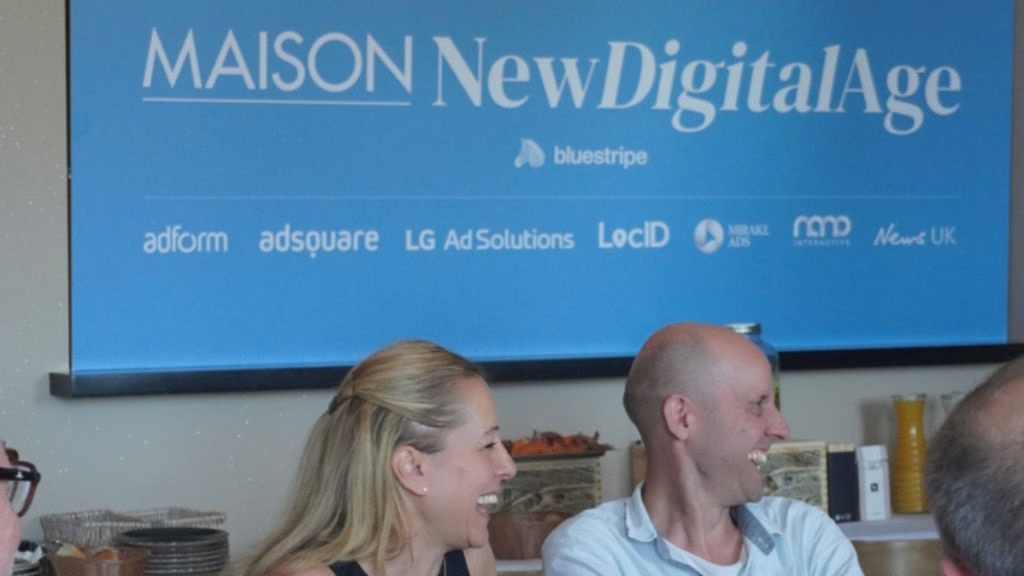
With the rapid adoption of AI and the emergence of agentic systems poised to reshape the structural foundations of digital advertising, New Digital Age hosted a roundtable in partnership with Adform and Adsquare, to explore this unprecedented shift in more detail.
Chaired by Justin Pearse, Editor-in-Chief, New Digital Age, participants included: Anna Campbell, Global MD, Carat; Anthony Katsur, CEO, IAB Tech LAB; Diana Erskine, Chief Operating Officer, IPG Mediabrands UK; Mike Murray, Head of Programmatic, OMD EMEA; Luc Benyon, Marketing Director, Adsquare; and Jochen Schlosser, CTO, Adform.
Defining the agentic framework
Agentic AI has become one of the industry’s biggest buzzwords. But behind the hype, is a much bigger question: what does agentic AI actually look like in modern marketing?
For agency operational leaders, the true value sits in foundational strength. They’re focused on refining back-office processes and addressing long-standing operational challenges to create efficiencies and a more seamless ecosystem.
For that to work, Anthony Katsur, CEO at IAB Tech Lab, believes that automated advertising needs a common language for AI.
“Without protocols like the Model Context Protocol, which Anthropic developed to dictate how artificial intelligence interacts with third-party environments, databases and DSPs, this technological shift remains fragmented,” said Katsur.
He added that true evolution lies in orchestration, where systems built by different enterprises can easily speak with one another.
The real opportunity isn’t replacing people – it’s unleashing a multitude of opportunities
For all the excitement around AI, the participants agreed that the biggest wins come from freeing teams up from repetitive manual tasks.
Jochen Schlosser, CTO at Adform, said that technical teams have been the quickest to adopt these frameworks, using automated code generation and system monitoring to accelerate engineering cycles. However, he believes that the most immediate commercial benefits for agencies are in plain sight: quality control.
“An AI agent can inspect an ad server or DSP setup in minutes and catch configuration errors quickly. Issues that once took hours to find can be stopped before they hit reporting, billing or reconciliation,” Schlosser explained.
It sounds minor, but it isn’t. One small mistake is frequently responsible for a multitude of problems, from errors in reporting to disruptions to billing and reconciliation. AI can fix these mistakes and prevent them from happening again with the proper guardrails in place.
Mike Murray, Head of Programmatic at OMD EMEA, argued that the media agency model has historically absorbed massive amounts of hidden administrative labour. Tasks such as financial reconciliation, compliance checking and manual platform configurations consume thousands of hours that could otherwise be spent on strategic development.
“Nobody enters the agency world hoping to spend their days manually reconciling campaign data across spreadsheets,” said Murray.
The procurement dilemma and commercial models
While the technology is moving fast, agency business models are struggling to keep pace.
Historically, agencies have billed clients based on time. More hours meant more revenue. But, what happens when an AI tool can compress weeks of data analysis or financial reconciliation into a few minutes?
Client procurement teams now frequently ask for explicit efficiency metrics during pitch processes. This presents an opportunity to bridge the gap between agencies and clients by positioning AI as a sophisticated, high-value corporate investment that delivers long-term business results.
But, Diana Erskine, Chief Operating Officer at IPG Mediabrands UK, argues procurement teams too often treat these technologies as standard agency utilities rather than the strategic tools they are.
She added that the industry needs to move toward value-based pricing models, where agencies are compensated for business outcomes and operational accuracy rather than the sheer volume of human hours logged against a campaign brief.
Luc Benyon, Marketing Director at Adsquare, pointed out that this commercial friction could fundamentally change how agencies differentiate themselves in a competitive marketplace: if automation takes care of basic execution, performance optimisation and data processing, the competitive edge shifts entirely back to strategic distinctiveness and creative excellence.
“Automation handles consistency, but it cannot deliver creative differentiation,” Benyon said.
Automation will win the execution race. But, it’s the humans behind it and the opportunities it creates, that will determine who wins the client.