A publishing industry defined purely by limitless display ad inventory and passive page impressions is fading. As audience habits evolve, the rapid disintermediation brought about by AI is driving media owners to redefine their purpose.
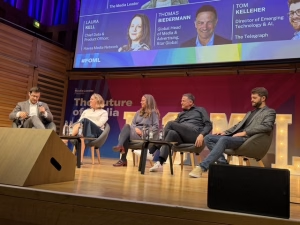
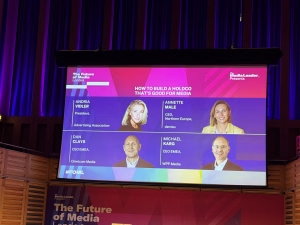
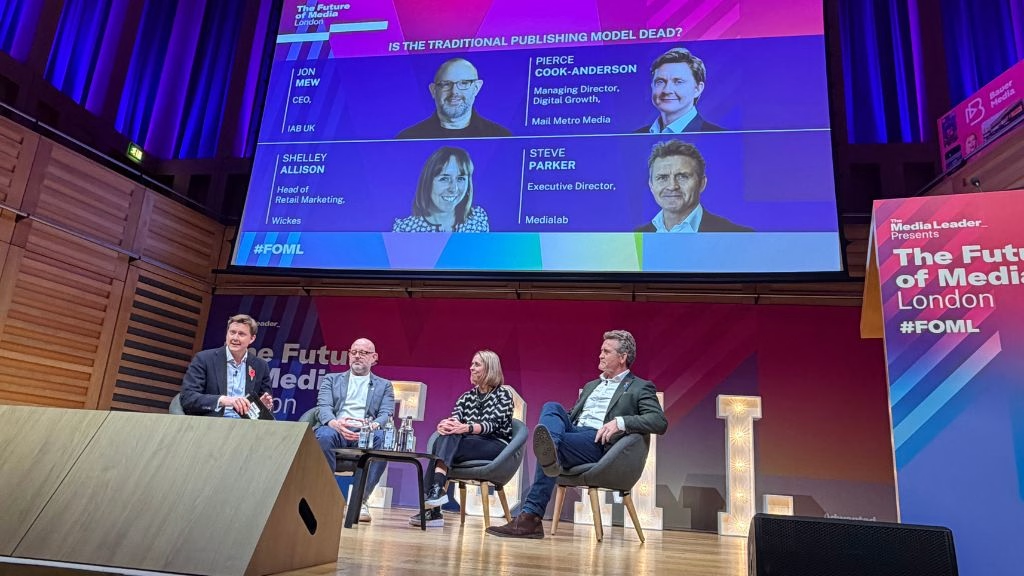
At the Future of Media London event, an industry panel gathered to tackle the fundamental question, is the traditional publishing model dead?
Chaired by Pierce Cook-Anderson, Managing Director of Digital Growth at Mail Metro Media, the discussion brought together Shelley Allison, Head of Retail Marketing at Wickes, Steve Parker, Executive Director at Medialab, and Jon Mew, CEO of IAB UK. What emerged was an argument for publishing’s reinvention around human storytelling, creator-led formats, and rigorous commercial effectiveness.
The shift from inventory to storytelling
For brand marketers, relevance can no longer be bought with scale alone. Shelley Allison, speaking from her brand perspective at Wickes, outlined the core challenge confronting marketing teams:
“When we think about this, I have to concentrate on three things: I have got to build trust, make sure marketing messages reach an audience at scale efficiently, and build an emotional connection with potential home improvers and customers,” Allison said.
While traditional publishers have historically provided reach and brand-safe environments, Allison explained that the sheer operational complexity of modern campaign plans demands deeper, multi-funnel integration.
“Publishing is quite unique in that it offers authenticity. Connecting brands with that authentic storytelling at the heart of publishing is something that can really help publishers remain relevant. We need flexibility and dynamism to support customer journeys.”
Later in the session, Allison emphasised that as direct consumer data becomes harder to track due to signal loss, publisher-led environments that facilitate genuine connection become vital:
“What publishers have at their very heart is the ability to tell stories authentically. People want recommendations and to make decisions based on trusted advice across different platforms. Publishers have a unique opportunity to help brands tell those stories and connect with creators.”
Moving past vanity metrics to business outcomes
A persistent issue for publishers seeking to prove their worth against automated platforms is the trap of short-term attribution. Steve Parker of Medialab emphasised that reach remains indispensable, but only when measured through transparent commercial frameworks:
“You can only undervalue publishing if you don’t measure it. If you don’t measure something, you can’t improve it or prove it. Any organisation has to be working on a unified measurement approach, whether that is attribution, experimentation and testing, or econometric modelling.”
Parker argued that brand building and performance can no longer be treated as isolated silos:
“I wouldn’t undervalue the power of reach. If businesses are trying to drive brand health, awareness and consideration, you must have scale and effective reach to change behaviour. Effectiveness is a team sport. We need everyone to contribute, and break through the silos, egos and barriers so everyone is transparent and pushing for the same business goals.”
Highlighting a recent Medialab study of 500 CMOs, Parker pointed out that while 95% understood the necessity of investing in long-term brand health, only 6% felt they had cracked attribution, and fewer than half had the data needed to secure board sign-off.
Overcoming that gap requires publishers and agency partners to co-create strategic solutions together rather than simply taking orders at the end of the media plan.
AI, convergence and the creator economy
The structural shifts across the landscape are also breaking down the boundaries between classic news brands, social platforms, and independent creator ecosystems. Jon Mew of IAB UK said that the response shows how much the media sector has evolved:
“Being a media company now means you have to communicate and broadcast where people are, whether that is across platforms, YouTube, or connected TV. The traditional norms have gone, and there is a lot of convergence.”
Addressing how the industry is adapting to current technological pressures, Mew said:
“In the early days of the internet, many publishers were quite slow to react, and the shift to mobile was similar. But with AI, I have been genuinely surprised by how much the big publishers are leaning into it and thinking about how their business models can change.
The work being done with creators is a great example of publishers using the assets, channels, and talent they already possess.”
Mew cautioned, however, that media owners still face an uphill battle against walled gardens that offer frictionless automated buying:
“If you are a marketer, there is a lot that is exciting right now in terms of targeting and measurement. But if you are a traditional media owner, you are in a very difficult place.
On a platform, you put your money in, it performs, and you do not have to worry too much about it. On the open internet, it is twice as hard to do that.”
The panel demonstrated that survival in publishing is no longer tied to defending legacy formats. As digital spaces become saturated with automated, commoditised content, the true value of publishing lies in human curation, editorial integrity, and the ability to unite creators and communities.
For publishers, the route forward appears to be to move upstream to solve broader commercial problems alongside agencies and advertisers. By pairing authenticated audiences and creator storytelling with accountable measurement, publishing can remain an indispensable pillar of the marketing industry.