As creators build audiences that rival traditional broadcasters, the balance of power between digital talent and established media is shifting. But despite their commercial success, creators are still fighting for the recognition afforded to television personalities and established media companies.
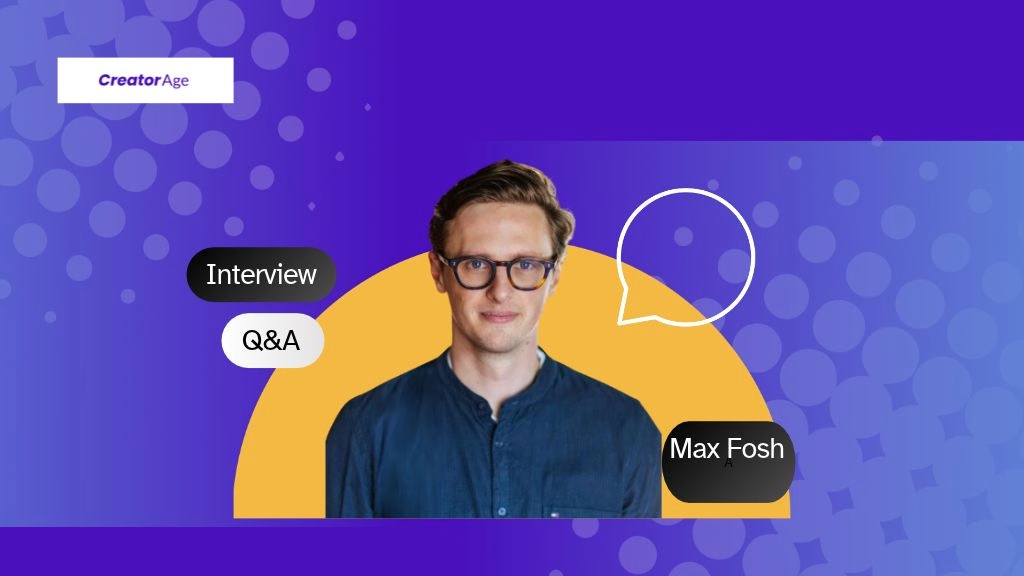
Creator Age sat down with Max Fosh, one of the UK’s leading YouTube creators, about the battle for legitimacy, the limitations of traditional broadcasting and why creators increasingly see themselves as media owners rather than marketing channels.
Creators are increasingly being described as media owners rather than simply a marketing tactic. Do you see yourself that way?
Absolutely. The biggest thing YouTubers still don’t have is legitimacy. I think we’re still seen as people making videos in our bedrooms, operating on the fringes of the entertainment industry.
The reality is very different. We’re creating content that can reach as many people as television, sometimes considerably more, with a fraction of the production resources.
We’re effectively running media businesses, but the perception hasn’t caught up with what we’re actually doing.
Why do you think creators still struggle to be taken seriously?
There’s still a perception that traditional television is somehow more important or prestigious than YouTube, regardless of the audience numbers.
Look at the number of creators appearing on major television programmes. You’ve got Kenny on The Traitors, Niko on The Traitors and Angry Ginge on I’m a Celebrity.
Of course, they might genuinely love those shows, but I think there’s another reason.
Appearing on television gives them a level of legitimacy that they don’t necessarily get from having millions of followers online.
Their audiences haven’t suddenly grown dramatically, and the quality of their content hasn’t changed. But the public sees them differently because they’ve appeared on television.
Is that starting to change as YouTube becomes a bigger part of mainstream entertainment?
It is, but I think it’s going to take a long time for creators to be fully taken seriously.
YouTube itself is pushing for that recognition. In the US, it’s been making efforts to get creators considered for Emmy Awards.
There have been events involving creators such as Michelle Khare and Sean Evans from Hot Ones, designed to introduce their work to the people involved in the awards process.
That’s significant because it shows YouTube actively trying to position its creators alongside established television talent.
What can traditional broadcasters offer creators that they can’t achieve themselves?
Primarily, legitimacy. Beyond that, I’m not convinced they necessarily offer very much.
Mark Rober, who’s an incredibly successful creator in the US, worked on a television programme with Discovery. He subsequently made the point that fewer people would watch the programme than if he’d released it on his own channel.
He’d also have less creative control and potentially make less money.
That captures the dilemma perfectly. Why would you give up control, audience reach and revenue to work with a traditional broadcaster?
Does that mean broadcasters are becoming less relevant to creators?
Not entirely. There are still fantastic opportunities to work with broadcasters, particularly if you love the concept.
But I think creators are increasingly in a position where they can be selective. They don’t necessarily need television to reach an audience or build a successful business.
When I work on something outside YouTube, it’s generally because I genuinely enjoy the idea, rather than because I need the exposure.
How important is maintaining control of your own platform?
It’s absolutely fundamental. The YouTube channel is the engine that powers everything else.
If that stops working, everything else starts to fall apart. So you have to protect it.
That’s why I make sure the channel is being properly looked after whenever I’m working on other projects.
There’s no point pursuing an opportunity that undermines the business you’ve already built.
Are creators now competing directly with traditional media companies?
I think we are, although we’re operating in a very different way.
From the outside, someone might look at my business and think I’ve only got four or five full-time staff, whereas a broadcaster like Sky has enormous teams and resources.
But that’s precisely the point. We’re much leaner, much faster and, in my opinion, much more proactive.
We can develop ideas, produce content and reach huge audiences without the infrastructure of a traditional broadcaster.
Will creators eventually be recognised as media businesses in their own right?
I think they have to be. We’re already doing many of the things that traditional media companies do, often with comparable or larger audiences.
The challenge is changing perceptions. People still associate legitimacy with television, even when the numbers suggest that digital creators are just as influential.
But creators shouldn’t have to appear on television to prove that what they’re doing matters. We should be recognised as media owners in our own right.