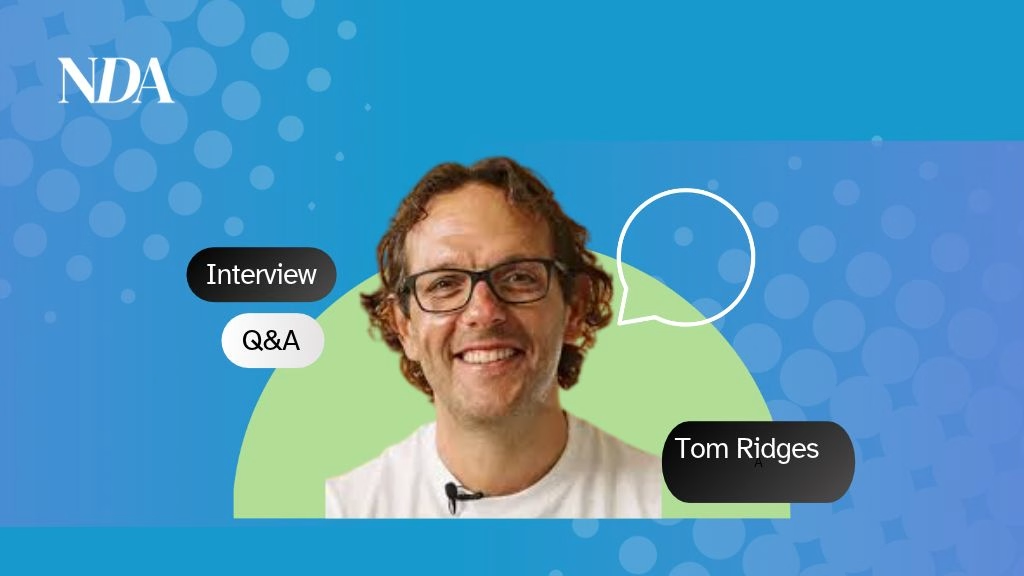
With more than twenty years of experience in data, software, and neural networks, Tom Ridges spent the first half of his career working with enterprise tech giants, including Microsoft. He later founded Herdify, a platform that applies network science and machine learning to help brands identify and harness their offline word-of-mouth.
NDA sat down with him to discuss herd mentality and how brands can leverage offline network science to drive business growth.
Growth at all costs has largely disappeared from the marketing agenda. Why are brands finding sustainable, profitable growth so difficult today?
Growth at all costs has gone. Five years ago, it was about pouring as much money as possible into social media and broad channels to acquire anyone you could. Today, the market has shifted towards acquiring the right customers, those who spend more and stay longer.
The problem is that many brands struggle because their strategies ignore the power of behavioural science. There is a fundamental mismatch between how consumers actually make decisions and how brands attempt to reach them.
We see examples of herd mentality everywhere, whether it is waiting for the first person to step out at a pedestrian crossing, choosing a busy restaurant over an empty one, or following the latest fashion trends.
Human actions influence other people disproportionately. That advocacy happens offline and inside private messaging channels, hidden from marketers. If you can identify where that offline social contagion is happening, you unlock high-value, durable customer growth.
How does that look in practice for an actual campaign?
Consider door-to-door fundraising for charities. It is tough work. When someone knocks on a door, you do not want the householder thinking, “Who are you?” You want them thinking, “I keep hearing about this charity everywhere”.
By analysing sales and donation data, we pinpointed the exact areas where word-of-mouth advocacy was active. The charity then directed its door knockers exclusively to those specific streets.
In areas where offline advocacy was present, donations were 120% higher than in areas where it was absent. The advocacy was already there. We simply illuminated it so the brand could capitalise on existing momentum.
How do you map that contagion without relying on standard social media tracking?
We do not use social listening or third-party social data at all. Roughly two-thirds of conversation still occurs offline. Instead, we analyse a brand’s first-party data.
We calculate the geographic distance and time elapsed between every single transaction, comparing each purchase against all others. It works on the same principles as the modelling some of our team carried out with the UK government during the pandemic.
If an outbreak has 50 cases but a specific transmission pattern, you can predict it will explode into a thousand cases soon. We track that exact acceleration curve, similar to a Bass diffusion model, across neighbourhoods, streets and cities to identify where communal adoption is taking off.
Generative AI is restructuring search and product discovery. Will this change how people make buying choices?
I do not believe it will fundamentally alter consumer decision-making. For low-stakes purchases, like grabbing a coffee in an unfamiliar town, convenience and habit win. For significant purchases, like a holiday, people still rely on trust and external validation.
Recently, I looked into buying an ice bath. I started on ChatGPT, but quickly wondered whether its recommendations were genuinely reliable. I ended up searching Google for reputable editorial reviews, landing on The Times because of its journalistic integrity.
The biggest risk for AI platforms is introducing advertising. As soon as commercial listings enter conversational interfaces, users will question whether suggestions are genuine or merely bought by the highest bidder. It risks destroying user trust, much like sponsored links degraded search purity.
The industry spends vast sums on personalisation. Is that focus misplaced?
Personalisation is often overvalued. What matters is relevance. If a friend buys a red Mini, you suddenly start noticing red Minis everywhere. The number of cars has not changed, but your brain has filtered that model as relevant.
Too many marketers treat personalisation as an exercise in templated tokens, inserting a first name and a birthday into an email.
True relevance is understanding what is already being discussed in a consumer’s peer group or neighbourhood, and arriving at the moment they are already primed to listen.
What is the biggest blind spot marketers have today?
Marketers are currently obsessed with asking what AI can do, rather than focusing on the human problems that need solving. Jeff Bezos famously noted that business leaders should focus on what will remain unchanged rather than what is changing.
Technology shifts constantly, but fundamental human psychology remains stable.
Every organisation would benefit from having a Chief Advocacy Officer. People are social creatures. We do not buy based on rational spreadsheets; we buy based on cues from those around us.
When brands stop chasing technological novelty and start aligning their marketing with natural human behaviour, sustainable growth naturally follows.