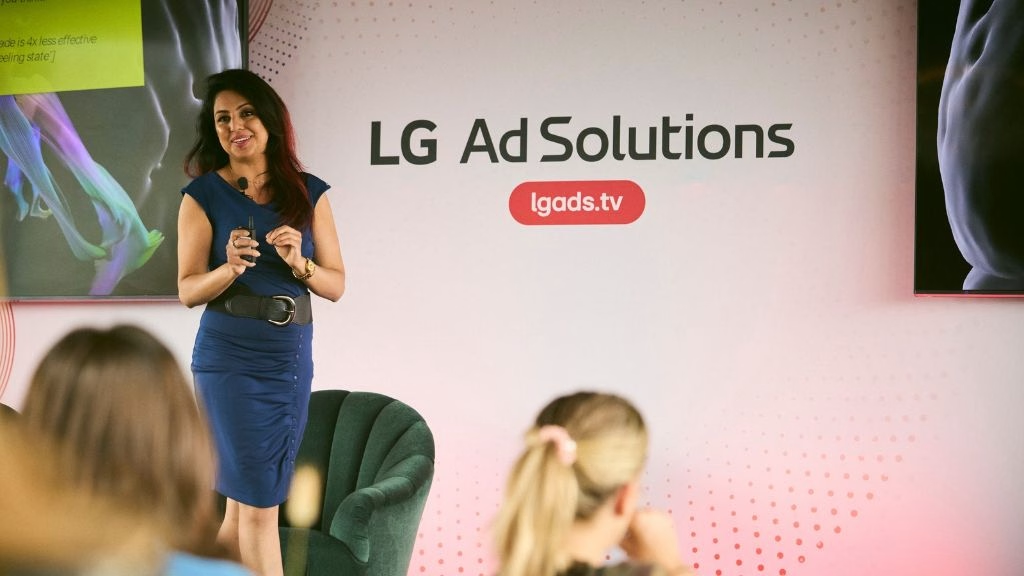
At the LG Ad Solutions Thought Leadership Breakfast, futurist and broadcaster Shivvy Jervis delivered a keynote that moved between the frontier of artificial intelligence and the enduring biology of the human brain.
Jervis opened by drawing a direct line between neuroscience and artificial intelligence, noting that the architecture of modern AI systems borrows heavily from the human mind’s structure.
“We have neurons, AI has nodes, we have synapses, AI has connections,” she said, stating that many of the foundational concepts in AI are built on the most fundamental architectures of the brain itself.
With around 80 to 90 billion neurons, each capable of forming up to 10,000 connections, and a storage capacity equivalent to roughly 3 million hours of television, the human mind, she argued, is still the most extraordinary piece of technology in the room.
From responsive tools to goal-driven agents
Jervis outlined the next phase of AI, beyond the now-familiar world of ChatGPT-style assistants. She described a shift from narrow, reactive systems towards what she termed agentic and autotelic AI – which are models that do not simply respond to a prompt but reason, plan, and act towards a goal.
“You do not give it a prompt, you give it a goal,” she said, describing how these systems gather information, break down tasks, execute them and even sync with other software to get the job done.
She illustrated this with examples already emerging in the real world, from AI avatars used in customer service that detect empathy and sentiment in real time to systems in cars designed to read drivers’ well-being. In each case, the technology is not pretending to be human, but is being shaped to respond to the biological signals we instinctively respond to ourselves.
Addressing planners and buyers, Jervis distilled the implications into what she called the three Ps: predictive, patterns and personas. Rather than relying on gut feel or lightly data-informed decisions, she described AI systems that can anticipate shifts in audience behaviour before they happen, helping planners adjust budgets and media mixes proactively rather than reactively.
Crucially, she was clear that this should not mean handing over control.
“We’re in a state of augmented intelligence, where it’s essentially us at the core of it, and these tools as a wrapper around it, not the other way around,” she said, framing AI as a layer that supports human judgment rather than replacing it.
Deepfakes, avatars and the trust question
Jervis did not shy away from the stranger corners of this new landscape, discussing platforms where autonomous AI agents can hire humans for real-world tasks, humanoid robots that have been granted citizenship, and the growing sophistication of deepfakes, including a viral account impersonating Tom Cruise to millions of followers. She said these things point to a significant opportunity for brands and media buyers to position themselves as a trusted source in an increasingly uncertain content environment.
Perhaps the most practical part of the talk focused on the neuroscience of motivation and persuasion. Jervis explained how distraction and pressure can suppress dopamine and kill motivation, while focus and engagement increase it, with direct implications for how campaigns are designed and timed.
She referenced research showing that people with damage to the emotional centres of their brain struggle to make even simple decisions, concluding that “we do not think our way to logic, we feel our way through to reason.”
She cited a three-to-one ratio in how strongly people respond to the emotional tone of an advert compared with its actual message, and highlighted three campaigns her team had analysed that outperformed their peers by 40 to 60% by tapping into exactly this.
Using examples including an augmented reality campaign for a home goods retailer and an automotive advert built around the idea of feeling something again, Jervis pointed to themes of home, family, nostalgia, and emotional reconnection as some of the most powerful levers available to advertisers.
She also explored the psychology of change, noting that people are far more motivated to avoid negative outcomes than to pursue positive ones. Also, research shows that gentle, autonomy-respecting language – simply asking whether someone is against trying something – can have a disproportionately strong influence.
Her final message was that as AI becomes more capable and more present in media and advertising, the real opportunity lies in using it to better understand and serve the very human audiences on the other side of the screen.
“Our minds are where we live,” she said. “Please, let’s make it a great place.”