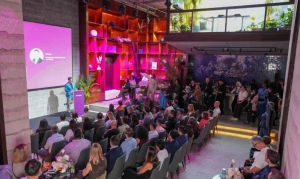
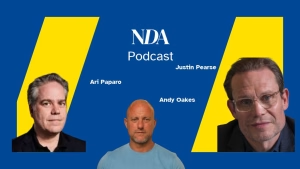
The battle for audience attention has never been more fragmented, and at the LG Ad Solutions Thought Leadership Breakfast, fragmentation was the starting point for a wide-ranging conversation between New Digital Age Editor in Chief Justin Pearse and Abi Watson, Head of Publishing at Enders Analysis. The conversation explored how broadcasters and media owners are adapting to an audience that no longer sits neatly in front of a single screen, and what that means for trust, quality and the future of premium content.
Meeting audiences where they are
For years, the dominant strategy for broadcasters was to drive viewers back to their owned-and-operated platforms. That thinking, Watson explained, has shifted significantly in the last two to three years.
“We’ve seen a real shift over the last two to three years in the way that broadcasters in particular think about the major social video platforms,” she said.
This is not, Watson stressed, a sign that brands need to be everywhere at once.
“It’s about meeting your audiences where they are,” she said, adding that this often leads to “a lot of overwhelm” among media professionals who feel they must chase every platform. The reality is more nuanced: audiences orbit a brand across multiple platforms before returning to its owned environment.
That sophistication is increasingly visible in how content is produced, not just distributed. Watson pointed to the growth of digital native formats, content designed specifically with the norms and expectations of social video platforms in mind.
Production values are rising, but unevenly
One of the most striking themes was the democratisation of high-quality production. Watson used the example of the Sorted Food channel, which began life as a handful of friends teaching each other to cook on YouTube and has since grown into something resembling a television production studio with a regular schedule.
The technology shift behind this has been dramatic. “If you think ten years ago, an aerial shot would require a helicopter and £25,000, and now you have drones that you can buy for £300 that will do the same job,” Watson said.
However, she was careful to note that expectations remain highly genre-dependent, with the bar for a makeup tutorial very different to that for a high-production-value drama or stunt sequence.
Trust as a scarce commodity
In an era of misinformation and AI-generated content, trust has become an increasingly valuable asset for traditional broadcasters and publishers. “Trust is becoming more of a scarce value,” Watson said, pointing to the role of regulation as a badge of credibility for public service broadcasters.
The challenge, she argued, lies in conversion. People may turn to a trusted source such as the BBC to verify information, but converting that instinct into sustained viewing habits remains “the tension.”
Despite the noise around social platforms, certain genres remain firmly in the territory of traditional broadcasters. Watson cited research analysing YouTube trending content over a four-year period, which found roughly 61% crossover with traditional TV genres, particularly live sport, drama and shiny floor formats.
“It’s about being able to sit down together and watch all at once,” she said, describing the shared, communal viewing experience that these formats still deliver and which platforms struggle to replicate.
Looking ahead, Watson predicted closer collaboration between broadcasters and social platforms than is often assumed. “I think there’s a lot more partnership between broadcasters and social needed, and symbiosis,” she said, rejecting the narrative that the two are locked in conflict.
She pointed to the emergence of creator labs within broadcasters as evidence of a more collaborative mindset, in which institutions provide production value and capital, while creators bring digital-native formats and incremental audiences.
An overlooked audience
Perhaps the most surprising insight concerned the over 55s.
Far from being disengaged from platforms such as YouTube, this demographic has driven a substantial growth in subscription video and YouTube usage over the past year, according to Watson.
Outdated assumptions about older viewers, she suggested, may be one of the industry’s biggest blind spots.
Watson ended on an optimistic note. The industry, she said, is reaching “an inflexion point” where broadcasters and publishers are genuinely grappling with how to work alongside creators, rather than viewing them defensively, a shift that bodes well for the future of premium media brands.