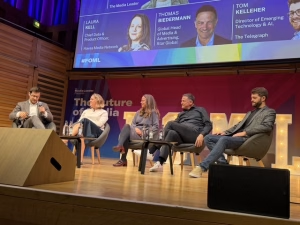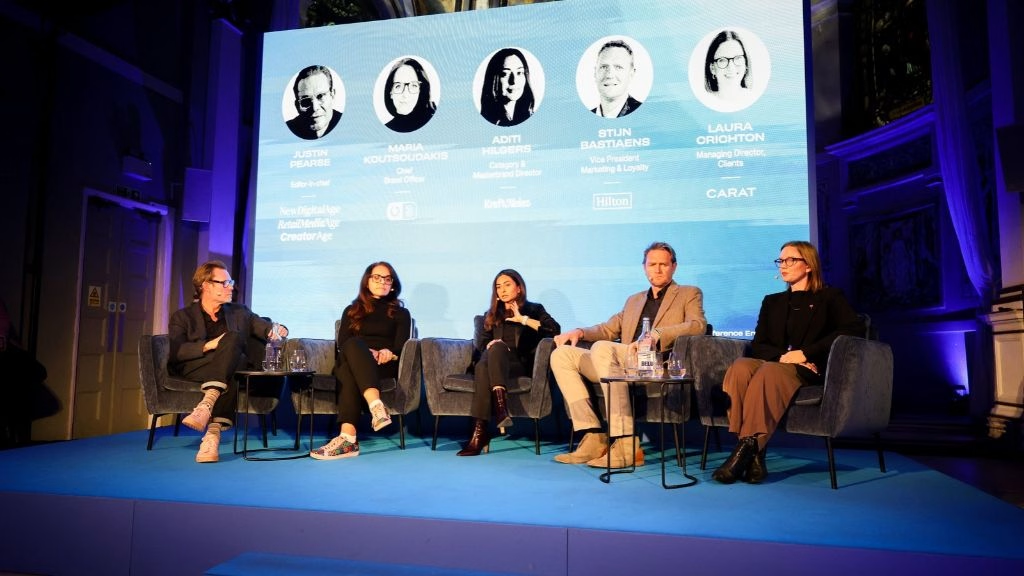
Predictive models and media optimisation have made brand marketing safer, yet far more uniform. When every marketing plan relies on the same metrics, distinctiveness can be hard to achieve. At Carat’s Difference Engineered event, New Digital Age Editor-in-Chief moderated a panel of marketing leaders to discuss how brands maintain true distinctiveness, and why short-term efficiency metrics can stifle commercial risk.
The discussion brought together Maria Koutsoudakis, Chief Brand Officer at VodafoneThree; Aditi Hilgers, Taste Elevation Category & Masterbrand Directorat Kraft Heinz; Stijn Bastiaens, Vice President of Marketing and Loyalty for EMEA at Hilton; and Laura Crichton, Managing Director of Clients at Carat.
Building memory in an attention-deficient landscape
Capturing momentary consumer attention is entirely futile if an interaction fails to create a lasting memory. For heritage brands, holding onto hard-earned distinctive positions while remaining culturally alert is the foundational balance required to survive.
Aditi Hilgers explained that for a 150-year-old business like Heinz, distinctiveness relies on staying obsessed with reliable taste while strictly guarding visual identities.
“What is important to me is the way we behave to build memory in an increasingly fragmented world, and really attention is nothing if you can’t build memory,” Hilgers explained. She pointed out that while keeping core assets consistent is essential, brands must also observe real consumer behaviour to stay culturally ubiquitous.
That appears in practical product tweaks, ranging from adding dipping tabs to French fry boxes for ketchup, to capitalising on the observation that millions of consumers were interacting with Gigi Hadid on her vodka pasta sauces recipe to inspire our own partnership with Absolut, and leaning into the national tradition of British tourists packing baked beans in suitcases for trips abroad.
For Hilton, managing twenty-eight separate brands across thousands of global hotels requires an entirely different approach to category distinctiveness. Stijn Bastiaens explained that in the wake of the pandemic, the hospitality sector fell into a collective trap.
“Most of our competitors talk about destinations, and everyone forgot about the hotel, about the actual stay,” Bastiaens explained. Hilton deliberately broke rank by putting the spotlight back on the accommodation through its platform Hilton For the Stay. Reclaiming the stay separated the brand from white-label booking portals and re-anchored the customer journey in emotional reassurance.
Maria Koutsoudakis outlined how telecommunications brands must work even harder because connectivity is functionally invisible.
With the Vodafone logo holding 92% unaided recognition, visual cues and bold colours serve as essential product packaging that must be protected. Beyond physical cues, distinctiveness stems from emotional clarity.
“From the Vodafone perspective, it’s to power those connections that lift the nation economically and emotionally,” Koutsoudakis said, whereas Three champions a simpler narrative built around pure enjoyment, “Let the fun in”.
Laura Crichton stressed that agencies cannot manufacture distinctiveness using off-the-shelf playbooks.
“Positioning has to be more than a sign above our door, we can’t just talk the talk, we have to walk the walk,” Crichton said, emphasising that agency teams must fully integrate with client teams to deliver real commercial outcomes.
Breaking out of boardroom risk aversion
The panel agreed that the greatest barrier to distinctive work is not a lack of imagination, but corporate structures that actively penalise calculated risks.
Bastiaens observed that business leadership is structurally wired to prize predictability.
“If senior leadership asks a marketer to deliver 5% growth, and the following year 5% growth, that keeps us all in jobs,” Bastiaens said. “If a marketer grows the business by 25% this year and therefore loses five or ten per cent next year, they’ve got a problem next year,” he added, explaining why teams often stick with the safe, tried-and-tested path.
To disrupt internal comfort zones, Hilton launched US campaigns that omitted the traditional logo entirely, using stark typography to dismantle long-held perceptions that the business only operates corporate convention hotels.
Koutsoudakis pushed back against the romanticised notion of bravery in marketing,
“I don’t like the negative idea that if you are not brave you are scared. For me it’s not about bravery, it’s about innovation, curiosity and relevancy in pursuit of effectiveness.”
“One of the challenges we have is the short-termism of the way businesses are run, and therefore if we even get the headroom and the grace sometimes to make mistakes,” Koutsoudakis said.
To navigate this reality, VodafoneThree uses a structured seventy-twenty-ten model.
“We have to deliver the bread and butter, 70%; you have to keep learning for tomorrow, 20%; and then 10% is where you throw a bit of caution to the wind,” she explained, urging brands to prioritise relevancy and effectiveness over narrow efficiency.
In fact, Hilgers argued, predictability can carry an immense financial risk. She pointed out that research proves boring creative work requires up to ten times more media investment just to cut through. Heinz relies on its core platform for evergreen ketchup campaigns, but flexes executions to align with cultural fixtures such as football and tennis events. or international football tournaments, to keep messaging fresh.
Crichton warned that modern dashboards encourage over-optimisation. “With the amount of data that we’ve got at our fingertips, there is a risk of over-optimising,” she said. While advanced econometrics and media mix models are invaluable, backward-looking metrics cannot predict how changing consumers will behave tomorrow. Over-relying on spreadsheets leads to risk paralysis rather than competitive advantage.
The overall message from the panel was that true brand distinctiveness is achieved when brand leaders trust focused craft, move with speed, and refuse to let algorithmic convenience dictate brand ambition.