My Other Life is a new NDA series that steps outside the day job. In each edition, we ask someone from across the digital media space about the hobby, passion project or side hustle they pursue when they’re not in the office.
This time round, we meet Terry Kane of The Trade Desk…
What is your day job?
I am Managing Director for the Middle East, Turkey and Africa at The Trade Desk. I lead the region, building markets, teams and trusted partnerships while helping brands and agencies make better digital advertising decisions. It is exciting, many times chaotic and never short of a plot twist.
What is the “other life” you lead outside the industry?
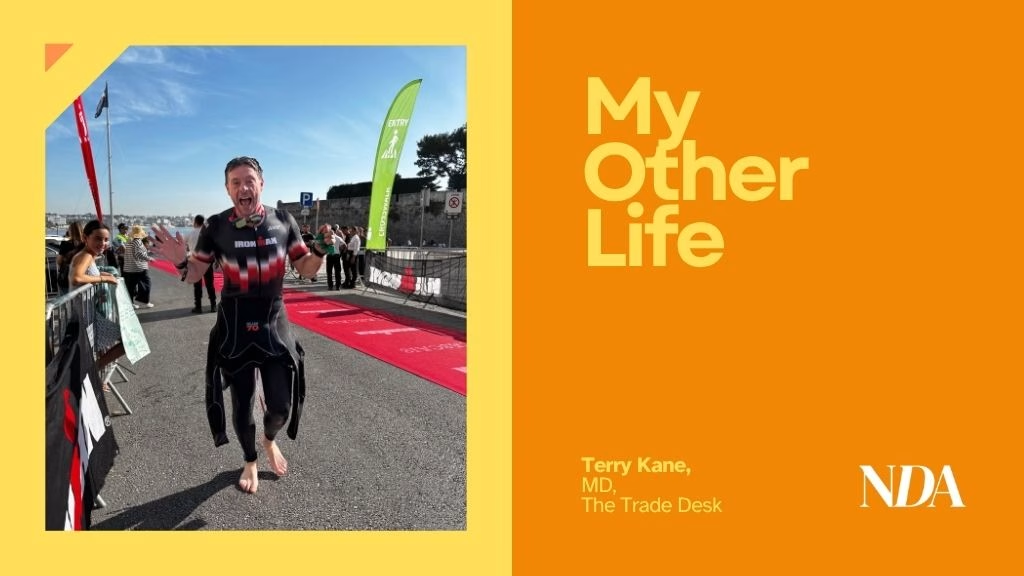
Outside work, I collect improbable adventure plans. That includes completing the Marathon des Sables (three times now), more than 100 of athletic competitions, multiple distance Ironman races and a 17 day trek to Everest Base Camp with my daughter, Aoife.
The attraction is choosing something beyond my capability, then learning my way towards it. I want my children to see life as something to enter fully: jump on an idea, commit and see where it leads.
I am also completing a doctorate focused on AI and organisational behaviour, so apparently my hobbies are running until my feet hurt and writing until my brain does.
How did you get into it, and how long have you been doing it?
It began in my twenties when someone told me, “You will never run a marathon.” My proportionate response was to search for the toughest footrace in the world and enter the Marathon des Sables the next day.
I waved the confirmation under their nose, then wondered how the hell I would do it. I started with one kilometre, then five, then marathon distances for training. Countless adventures later, I am still moving.
Each one has made the world feel bigger and my excuses smaller. Waiting for work to become quiet before living properly is a terrible strategy. Work never becomes quiet.
How much time does it take up in a typical week?
Usually eight to twelve hours, with more as an event approaches. Most sessions happen before Dubai and my diary are fully awake, with longer training at the weekend.
My 100 kilometre bike rides sometimes start at 9pm and finish after midnight. It is all the inconvenience of a night out, without the party or the hangover.
It can be a selfish pursuit, so training must fit around family. An Ironman finish means little if everyone at home is exhausted by the training plan.
What is the biggest misconception people have about it?
That endurance athletes are superhuman, naturally disciplined or deeply in love with suffering. An early session often remains a terrible idea right until it is finished.
Success rarely comes from one heroic performance. It comes from ordinary decisions, repeated consistently: train, recover, keep moving and do not panic. You do not need to feel fearless. You just need to take the next useful step.
Has it taught you anything that is actually useful in your day job?
On Everest, our guide repeatedly told us, “slow, slow, slow.” At altitude, ego burns oxygen. That lesson travels surprisingly well into leadership.
The Marathon des Sables is a 250 kilometre race across the Sahara. You need a strategy, but must adapt it constantly. An Ironman looks like an individual competition, but nobody reaches the start line alone. Mind, body and team must work in sync.
The same applies at work. Focus on the next checkpoint, choose consistency over brilliance and adjust the plan without abandoning the ambition. A mountain or desert does not care about your job title, which is a useful lesson in humility.
What is the proudest moment you have had doing it?
Reaching Everest Base Camp with my daughter Aoife when she was twelve. At 5,364 metres, she was among the youngest trekkers our expedition company had taken there. Reaching Base Camp was only half the achievement. She then walked every step back.
The 17 day journey was harder than either of us expected. It gave us time to talk, laugh, struggle and solve problems together. The confidence she gained has carried into other parts of her life.
It was fatherhood, adventure and education rolled into one. She learned she could do very hard things. I learned that a parent’s job is not to remove every obstacle, but to help a child build the confidence to face it. We both learned that altitude sickness takes no prisoners.
Does anyone at work know about it, and what was their reaction when they found out?
They know. It is difficult to hide when you arrive walking like a malfunctioning robot after a race.
The reaction is equal parts encouragement, curiosity and “what on earth are you doing next?” My colleagues are hugely supportive, although some probably view my event calendar as evidence of questionable judgement.
A career can be a huge part of life without becoming all of it. Health, family, curiosity and shared experiences deserve space in the diary. Life is short, and I would rather arrive tired with stories than perfectly rested with adventures I only meant to have.