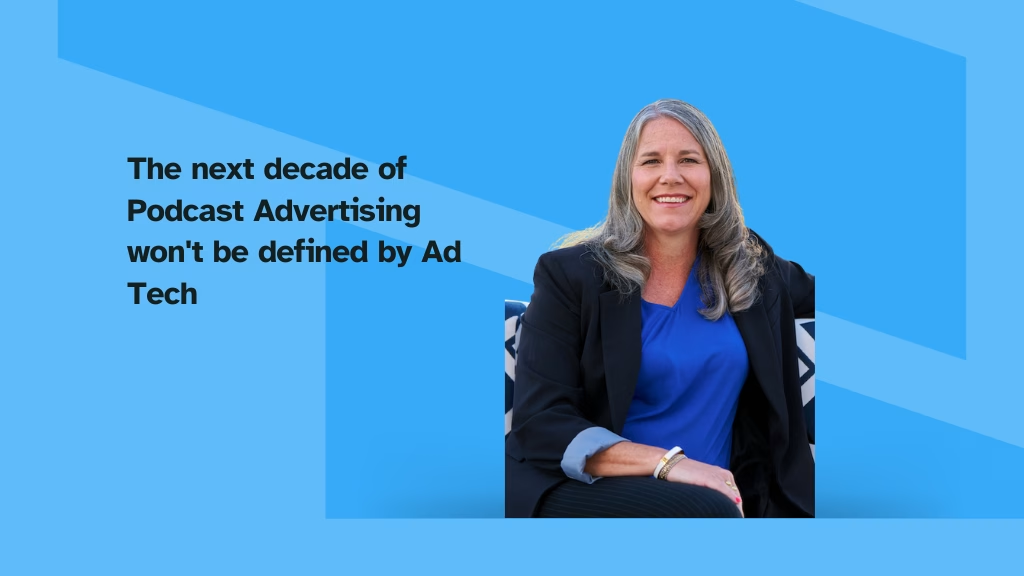
By Heather Osgood, CEO, True Native Media
When I founded True Native Media ten years ago, podcast advertising was still a relatively simple business.
Campaigns were managed through spreadsheets, email threads, and countless phone calls. Host-read advertising had already proven incredibly effective, but much of the work happened manually, and success was often measured through promo codes, vanity URLs, and a healthy amount of trust. We were building an industry on relationships first, with technology still catching up.
Today, nearly every aspect of podcast advertising looks different. Dynamic ad insertion transformed how campaigns are delivered. Programmatic buying expanded access to the medium. Attribution technology gave advertisers new confidence in measuring performance, while AI and increasingly sophisticated reporting tools have made planning and optimisation more data-driven than ever before.
Looking back, every major technological advancement has followed the same pattern: it solved one problem while introducing an entirely new set of challenges for the businesses responsible for making podcast advertising work. Every technology shift over the last decade changed how podcast advertising worked. None of them changed why it worked.
As someone who has spent the last ten years building an agency through each of those transitions, I’ve learned that adapting to technological change isn’t simply about adopting the newest tools. It’s about recognising how each shift changes the expectations of creators, advertisers, and partners and evolving your business alongside them. At True Native Media, that mindset has resulted in 27-fold revenue growth, an 850% increase in our team, and more than 530% growth in our exclusive creator roster over the past decade. Those figures aren’t the point; they simply reflect what becomes possible when you’re willing to continually reinvent the way your business operates.
To me, one of the first key transformational moments was the widespread adoption of dynamic ad insertion.
For advertisers, DAI unlocked flexibility that simply wasn’t possible before. Campaigns could launch faster, creative could be updated without rerecording episodes, and brands could reach listeners throughout an entire catalogue rather than only new releases. For agencies, however, it fundamentally changed the operational side of the business. Campaign management evolved from matching advertisers with podcasts into forecasting inventory, managing delivery, and navigating technology that barely existed when many of us entered the industry.
DAI didn’t simply change how ads were inserted; it changed how podcast advertising was managed.
Then came programmatic buying, which sparked plenty of debate, particularly among those who worried it might diminish the personal nature of podcast advertising. Instead, I believe it expanded the market by giving more advertisers an entry point into podcasting while preserving the premium value of host-read campaigns.
For agencies, that meant shifting from simply selling inventory to helping advertisers understand where automation created efficiency and where human expertise continued to deliver the greatest value.
But if we are being honest with ourselves, the one advancement that entirely reshaped client conversations more than any other was the birth of attribution.
Ten years ago, many advertisers invested in podcasting because they believed in the power of trusted voices. Today, they expect to understand household reach, website engagement, conversions, and incremental performance alongside those relationships.
That evolution has strengthened the industry by increasing confidence and attracting larger investments, but it has also reinforced something I’ve believed from the beginning: technology can validate a great strategy, but it can’t replace one. The most successful campaigns still begin with authentic creator partnerships and thoughtful audience alignment, not simply the availability of more data.
As I look at where podcast advertising stands today, I don’t believe our biggest challenge is measurement or even scale. It’s operational simplicity.
Every technological advancement has made podcast advertising more capable, but it has also increased complexity for everyone involved. Creators expect greater visibility into campaigns. Advertisers expect faster execution and more transparency. Agencies are coordinating increasingly sophisticated campaigns across more partners, platforms, and technologies than ever before.
That’s why one of our biggest priorities this year has been modernising the technology experience we provide our creators through a significantly enhanced podcaster portal. We wanted to create an experience that gives creators faster access to campaign information, communication, approvals, and reporting through an interface that feels less like enterprise software and more like the intuitive consumer apps we use every day.
Because when operational friction disappears, everyone benefits. Creators spend less time chasing information and more time creating. Agencies operate more efficiently. Advertisers gain confidence through faster communication and greater transparency.
If the first decade of podcast advertising technology was about proving the channel could scale and be measured, I believe the next decade will be defined by how seamlessly the industry works together.
The winners won’t necessarily be the companies with the newest dashboard or the most sophisticated attribution model. They’ll be the organisations that successfully connect creators, advertisers, agencies, hosting platforms, and technology into efficient ecosystems where information flows easily and partnerships become stronger because of it.
Podcast advertising has always been built on trust and relationships. That’s what made the industry special ten years ago, and it’s still what differentiates it today. Technology shouldn’t replace those relationships; its role is to strengthen them.
After spending the last decade watching podcast advertising evolve, that’s the lesson I find myself returning to most often. Every innovation has expanded what’s possible for our industry, but the companies that will define its next chapter won’t simply adopt the latest technology; they’ll use it thoughtfully to remove complexity, allowing creators, advertisers, and partners to spend more time doing what has always driven podcasting’s success: building meaningful connections.