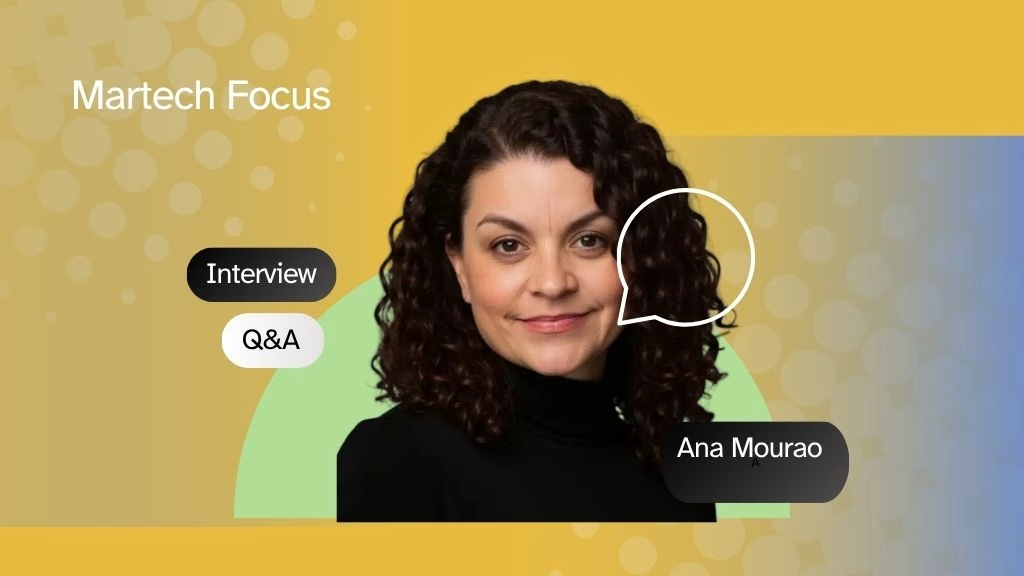
Ana Mourao is a Global Senior Manager CRM and Customer Data of Marketing Technology, focused on building scalable martech operations and customer data strategies across international markets, including four FORTUNE 500 companies.Originally from Brazil and now based in South Florida, she writes extensively about AI, marketing operations and experimentation.
How did you first get into martech and digital marketing?
I actually started as an economist, but I ended up moving into marketing and then digital marketing because I loved the fact you could measure things. I’m very iterative by nature, I like experimenting and seeing what works, so digital marketing felt like a natural fit for me.
That then led me into web analytics because I wanted to understand the data and how people behaved. From there, martech became the next logical step because it sits at the intersection of data, technology and marketing operations.
Governance over technology
What were the biggest challenges in creating a unified martech operation across so many different markets?
The biggest challenge was not the technology itself. Most people assume the hardest part is choosing the tools, but actually the operational side is much harder.
A lot of companies buy martech without really thinking about how it supports the people using it every day. Sometimes the technology can actually make marketers’ lives harder if it does not align with operational realities.
The first thing we needed to do was make sure the use cases came directly from the marketers who would ultimately activate the data. Then the second major piece was governance.
If leadership wants to compare performance across regions and brands, you need consistent definitions. For example, what exactly is a consented or marketable user? What are the minimum data points required globally before someone can enter a customer journey?
Without governance, you still end up doing manual work, even if the technology itself is very advanced.
Breaking down silos
What makes achieving that governance so difficult inside organisations?
Silos. That is the biggest challenge.
Often there is no clear owner for these definitions. Nobody really wants to own questions like what constitutes a consented user globally.
My view is that marketers are uniquely positioned to lead those conversations. Marketers understand the customer journeys, the activation challenges and the business goals.
Too often marketers step back and leave these discussions entirely to IT teams, then later complain that the technology does not work for marketing use cases. But the technology itself is usually functioning perfectly, it just was not designed around the marketer’s operational needs.
Marketers need to be proactive and say: “These are the data points we need for meaningful activation, these are the bottlenecks we need to solve.”
Managing global privacy and consent
How do you balance global consistency with very different privacy regulations across markets?
That is definitely challenging and requires close collaboration with legal teams.
You need to identify the highest common denominator when it comes to privacy standards. For example, even in markets where regulations are less strict, we still honoured rights such as the right to be forgotten because we had built systems capable of supporting that globally.
At the same time, some processes remain region-specific. Europe may require double opt-in, while North America may not. So your systems need enough flexibility to support both approaches while still maintaining consistent data structures underneath.
It is always a balance between global consistency and local requirements.
Personalisation at scale
How important is personalisation within a global martech strategy?
It is hugely important, but personalisation only works if you have the right data foundations.
We had to test different hypotheses around which data points actually mattered. For example, we looked at trade specialisms and whether content should differ for woodworkers versus construction workers.
Once those tests proved successful, we built those fields into the global data structure. Every region collected trade data in a consistent way, even if the specific dropdown options varied slightly by market.
That structure gave regional teams flexibility to activate around local needs while still maintaining comparable global reporting.
AI as an accelerator
What impact do you think AI is having on enterprise martech?
I see AI as an expediter. It helps teams move faster and gives them more tools, but the strategic decisions still need to come from the business.
AI cannot tell you what the best governance structure is because it does not fully understand your operational processes. What it can do is help enforce governance, identify anomalies or flag when data processes break down.
It amplifies the work of existing teams without necessarily requiring huge increases in headcount.
That said, large organisations need to approach AI carefully because it is probabilistic. If 10,000 employees all use the same AI tool, they may still get different outputs and interpretations.
My recommendation is usually to begin with AI capabilities already embedded within your existing platforms. That allows organisations to understand how decisions are being made before exposing sensitive company information to broader AI systems.
Why integrations matter
What role does integration play in building an effective martech stack?
Integration is critical.
We specifically looked for platforms with flexible APIs and simple integrations because businesses constantly evolve. New data sources appear all the time and you need to be able to bring them into the ecosystem quickly.
Marketers do not need to become deeply technical, but they do need a high-level understanding of how data flows through the stack.
If data gets stuck somewhere, activations fail and campaigns underperform. Understanding those flows helps marketers collaborate more effectively with technical teams and identify where bottlenecks exist.
Bringing martech and adtech together
How closely do you think martech and adtech should work together?
I’m a huge believer in using zero-party and first-party data as the foundation for advertising strategies.
If you have consented customer data, you can use it to build highly effective lookalike audiences while excluding existing customers from acquisition campaigns. That approach helped reduce cost per acquisition significantly for us, especially in regions with very limited media budgets.
I also think second-party data partnerships and clean room environments will become increasingly important.
Retail media and publisher partnerships create opportunities to identify overlaps between audiences in privacy-safe ways. That allows brands to create much more targeted and efficient campaigns.
Third-party data still has a role, but I see it more as an enrichment layer rather than the foundation itself.