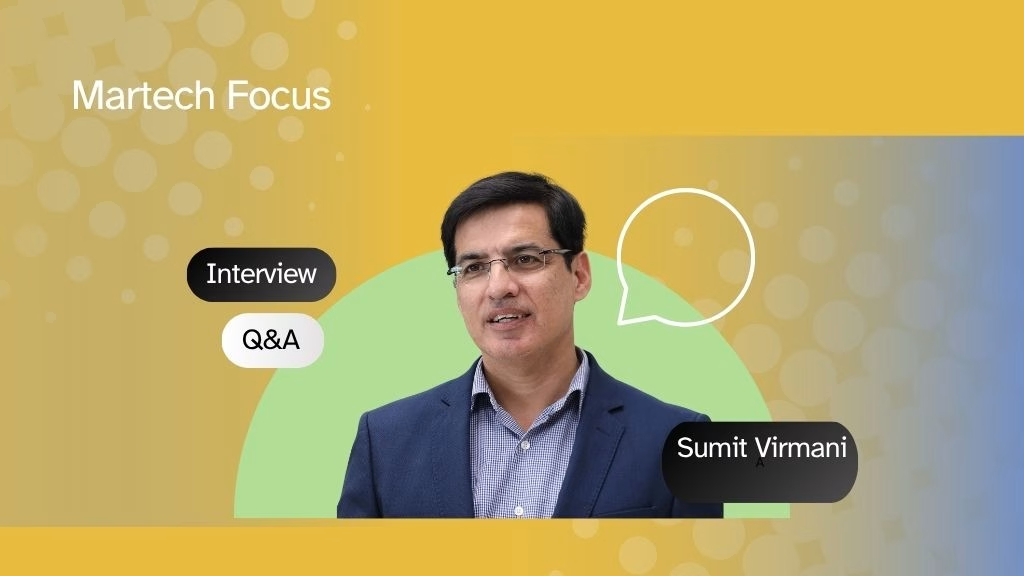
By Sumit Virmani, Global Chief Marketing Officer, Infosys
When software can autonomously create the brief, generate content, activate campaigns, learn from outcomes, and optimise the next cycle, it forces an uncomfortable but necessary question: what is the marketer’s role now?
This reality is arriving faster than most marketing organisations are prepared to acknowledge. Agentic AI, systems that sense, reason, plan, act, and learn, are dismantling long-held assumptions about how marketing gets done. The question is no longer whether AI will change marketing. That answer is self‑evident. The real question is far more consequential: which roles endure, which evolve, and which quietly disappear.
At Infosys, we are experiencing this shift firsthand by embedding agentic AI into marketers’ workflows through an assistant we call the ‘Marketing Buddy’. It is being designed to surface priorities, propose content, orchestrate journeys, and optimise campaigns, while humans remain accountable for judgment, direction and tradeoffs.
Roles under the most pressure
The marketing roles facing the most disruption share a common characteristic: they are dominated by repeatable execution rather than judgment.
Campaign execution and ad trafficking are compressing fastest. Scheduling ads, managing placements, adjusting bids, and running tests have been automating for years. Agentic systems now close the loop, detecting performance changes and acting on them with minimal human intervention. The traditional campaign coordinator role does not disappear overnight, but it compresses rapidly as execution becomes a machine‑run control loop.
High‑volume content production faces similar pressure. Generative systems can now produce on‑brand drafts, variations, and formats at scale. The most exposed work is templated and repetitive: resizing, localisation, versioning, and derivative assets. Where humans remain essential is not volume, but meaning: setting narrative direction, ensuring coherence across touchpoints, and protecting brand integrity and ethics.
The quietest casualty is analytics and reporting. Analysts who spent days assembling post‑campaign decks are being leapfrogged by systems that interpret performance and implement corrective actions simultaneously. Insight that arrives after the market has moved is no longer insight, it’s history.
Roles that change form, not value
Automation should not be confused with elimination. Many roles are rewired, not removed.
Campaign managers become campaign orchestrators, defining intent, guardrails, and learning goals while supervising autonomous systems. Their value shifts from “running campaigns” to deciding when to scale, pause, override, or redirect.
Marketing operations evolve from process administration into marketing systems design. Rather than managing tickets and handoffs, these teams architect workflows, governance, reliability, and adoption, ensuring agentic systems operate safely and effectively, at-scale.
Content teams evolve into brand editors and narrative directors. Generative systems handle heavy lifting, but humans decide what must remain human: originality, emotional resonance, ethical boundaries, and long‑term brand meaning.
Roles that grow in importance
The roles that endure and gain influence sit at the boundary between human judgment and machine capability.
Brand stewardship becomes more critical, not less. Agents optimise for signals; humans decide what’s worth signaling. Holding the line on what a company stands for and resisting short‑term optimisation that erodes trust is irreducibly human work.
The CMO’s role as a strategy orchestrator across the enterprise also expands. AI can surface patterns and options, but it cannot own the human work of tradeoffs: balancing long‑term brand with near‑term growth, aligning marketing with product and experience strategy, and navigating ambiguity under pressure.
New leadership roles grow alongside this shift: AI governance leads who ensure responsible use, experience designers who orchestrate agent‑driven journeys, brand stewards who set generative guardrails, and marketing technologists who architect the agentic stack. These roles demand cross‑disciplinary fluency, not narrow specialisation.
The next generation of marketing talent
There is a quieter risk embedded in this transition. The entry‑level roles most exposed to automation are the same ones that trained senior marketing talent for decades. Compress that pipeline, and you lose more than jobs. You lose the environment where judgment was formed and you starve the next generation of CMOs.
The deeper risk is not job loss; it is judgment loss. If agents do the heavy lifting, humans must still learn how to supervise, evaluate, and steer those agents. Organisations getting this right are redesigning junior roles as supervised decision roles, where early‑career talent works alongside agentic systems validating outputs, monitoring performance, checking brand integrity, and learning when to override the machine.
This shift also changes where talent comes from. The next generation of marketers won’t emerge solely from traditional ladders. Many will arrive through side doors, from behavioral science, product management, journalism and storytelling, data fluency, and governance. Agentic AI rewards systems thinking, ethical judgment, and cross‑functional perspective more than channel‑specific execution.
What determines who thrives
The reshuffle is already underway. The marketers who thrive won’t be the ones who automate the most. They will be the ones who are clearest about what must remain human.
Agentic AI will handle many complex tasks, while leadership will increasingly be characterised by the caliber of decision-making that persists.