Ad-supported streaming has overtaken every other form of TV viewing in the UK, according to Roku’s first VOD Evolution study of UK viewing habits.
Of the 26 hours a week UK streamers spend watching television, 14 hours are now spent on ad-supported streaming, through broadcaster apps (BVOD) such as ITVX, ad-supported subscriptions (ADSVOD) such as Disney+ Standard with Ads, or free ad-supported streaming (FAST) channels. Across all UK TV viewing, ad-supported streaming now accounts for 52% of the total — more than any other form of television.
Nine-in-ten (90%) now watch an ad-supported streaming service at least once a month, made up of 62% who use BVOD apps, 77% who use ADSVOD tiers, and 28% who use AVOD/FAST services.
What’s more the research points to a fast-growing audience that traditional TV advertising cannot reach at all. A third (32%) now watch nothing but streaming services, meaning they have no aerial or satellite connection through which to be served a linear TV ad.
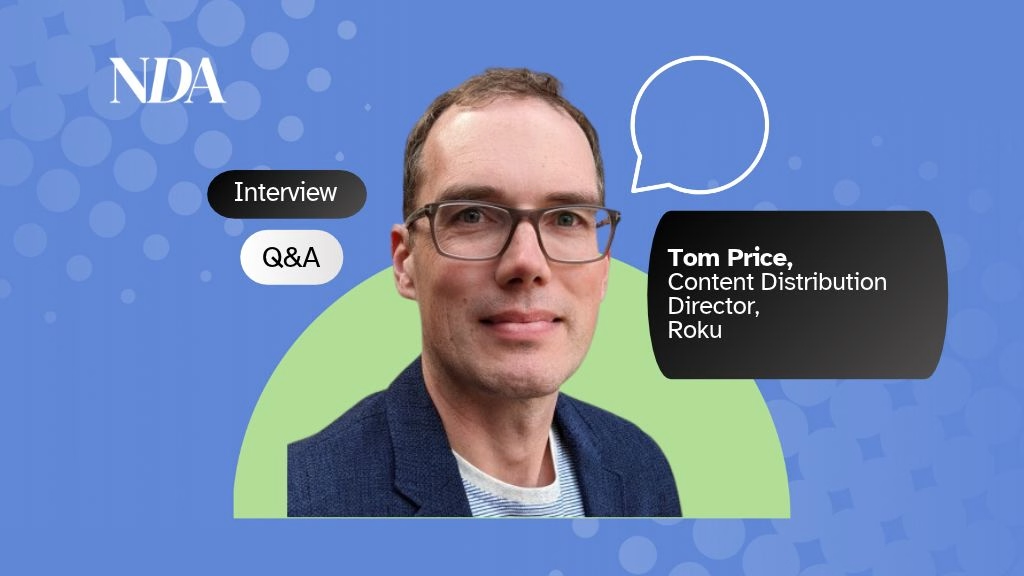
NDA spoke with Tom Price, director of content distribution at Roku, to discuss the changing economics of television, the measurement advantages of streaming and the convergence of creator content and traditional broadcasting…
Why did Roku commission its research into UK viewing habits?
It’s part of an ongoing programme that Roku has been running in other markets. We’ve been doing this for a number of years in Canada, for example, and it’s really about having a deep understanding of what people want from streaming television and how we serve them.
This is the first time we’ve done it in the UK, so it’s interesting to see how the UK compares. It’s also a sign of how the Roku platform here is maturing. We’re now operating at a bigger scale, with more of an advertising business running off the platform.
When Roku enters a market, the initial priority is to sell more televisions and streaming players, get more devices out there and build a customer base. Once you have a sizeable audience, you become more interested in partnerships you can build and the advertising proposition you can offer.
What were the headline findings of the new research for you?
I think it’s a confirmation of just how far we are through the transition to streaming. Roku was founded on the proposition that all TV will be streamed. I’ve worked in various parts of the industry, including Roku, BritBox, ITV and Discovery, and streaming has always been the thing that was coming. What I think this study confirms is that it’s here.
Nine out of 10 people in the UK stream television. That’s almost everyone. You’ve got a small group of holdouts, generally more traditional viewers and probably slightly older demographics, but a third of people only stream.
That means there’s a sizeable chunk of the country that isn’t really being reached by terrestrial and satellite broadcasting any more. You can only reach them through streaming, and you can reach almost everyone that way.
We’re well on track towards a world where everything is streamed. Whatever date might eventually be chosen for a formal switch-off of traditional broadcasting, people are already getting ahead of that. They’re finding that they can get the content and experience they want more effectively through streaming than through traditional broadcast media.
Was there anything in the findings that surprised you?
The thing that a lot of people might not have clocked is just how big streaming advertising has become. It’s less of a surprise to us because we’re looking at our own numbers and those of other players all the time.
TV advertising in the UK is still very much thought of as ITV, Channel 4, Five and Sky. Then you have online advertising, which people tend to associate with YouTube, Meta, Facebook and Instagram.
What this study really highlights is the scale of the ad-supported streaming sector, particularly high-quality content that you would think of as television, but delivered through streaming and supported by a digital advertising proposition.
That’s obviously at the core of Roku’s business globally. We’re a huge advertising business in the US, and we have a second pillar in subscriptions, with people paying for content.
In many ways, those are the two business models that have always funded television. Everything is generally paid for through advertising, subscriptions or a combination of both. Some of the best businesses have had a bit of both: a subscription channel that also carries advertising, or an advertising business with a premium upsell.
For the user, free is always a very attractive price point. You have completely free services, including FAST channels and services such as The Roku Channel and ITV. Then you have people who want a subscription service but would rather pay a little less and accept some advertising. That’s the right value proposition for them.
Most people are now watching ad-funded streamed content. For advertisers, there are two things that matter. First, many advertisers simply want big, broad mass reach. They want to make a splash, and what this research shows is that you can do that with streaming because you can reach so many people.
The second advantage is that streaming gives you a richer dataset, allowing you to run more targeted advertising propositions.
Targeting is particularly useful when you have a big platform and can find your target audience within it. If you buy something that is already very niche, you may not need that. If you’re selling caravans and advertising in a caravan magazine, you already know that the audience is relevant. But with a big platform, data allows you to identify the right people within a much broader audience.
I think the scale of streaming advertising is something people haven’t fully recognised, and the money has not yet completely followed the eyeballs. Ultimately, advertising money follows where people are watching. Traditional TV players have done a great job of building relationships with advertisers and retaining that investment, but I think more money will shift into streaming.
Broadcasters are already catching that investment through their own streaming services, but there are also a range of other streaming players coming into the market. I think we’ll see more advertisers looking at those opportunities and more broadcasters looking to collaborate in this space.
Do the measurement capabilities available through streaming genuinely outstrip those of traditional television?
They do, but it depends. There is still a place for some of the tools we use in the traditional TV world. Panel measurement isn’t dead, and I think most people will continue to use a hybrid approach.
However, the tools available through streaming allow you to do much more refined things than anything based on a panel of a few thousand people. If you’re trying to run a highly targeted, highly localised or very niche campaign, panel methodologies will eventually break down. What you really need is detailed, user-level data and profiling of the kind streaming platforms can provide.
If you look at how Roku sells advertising, there are a variety of methods, with different advertisers buying in different ways. But one thing at the core of it is that we have an understanding of who that person is. Other data can then be layered in as well.
The ad tech industry is something that we, and others, are investing very heavily in.
What are content partners asking Roku for help with, and what are their priorities as we move into 2027?
I spend most of my time working with the major content partners on the Roku platform. What Roku does for the user is bring everything together. People don’t want to consume just one service. They might have a favourite, and sometimes they’ll spend most of their time with one service, but there’s always a new big show somewhere else.
We’re not like the music industry, where you can get Spotify and potentially have every song you want to listen to. With television, the show everyone is talking about might be on another service.
Roku brings that content together through unified search and discovery features. You can find content across Netflix, the BBC, Disney and all the other services that are integrated into the platform.
The challenge for our content partners is to grow their reach and engagement. I think we’re at a point of real competition between the subscription streaming services – Netflix, Disney, Amazon and others – and the local broadcast sector. The BBC and ITV have really upped their game and have very strong, competitive streaming propositions on our platform.
It’s not simply a story of everyone moving towards one type of service or another. If you’ve got a great show or something new in your app, people will come to it. The challenge for everyone is finding ways to bring in that next user, whether through the depth of their catalogue or a big new programme.
Roku provides tools to help with both. If you’re launching a big new show, you need a way to make people aware of it. You can’t simply put it on after Coronation Street and assume everyone will see it.
One of the tools available is a large advertising placement on the Roku home screen. It’s a bit like a billboard that appears when someone first picks up the remote and decides what to watch that evening. That’s a very powerful way to promote a new programme and help it build momentum and word of mouth.
The other side of it is helping people discover something that’s already in a catalogue but might be exactly right for them. We’ve been pushing tools such as What to Watch, which offers personalised recommendations across the catalogues of the services that have integrated with it. We can build up a picture of the types of programmes you’ve watched and surface other content you might enjoy.
You might not even realise that a particular type of programme is available on the Channel 4 app, for example, especially if you’re not a regular user of that service. We can help bring it to your attention.
We’re seeing increasing convergence between online creators and traditional broadcasters. Is that something you’re seeing in the content coming through Roku?
Yes, I think there’s real convergence, and there are two aspects to it.
One is that this is where young talent often makes its name these days. Those people are often surprisingly interested in progressing on to traditional television as well. They’ll become big on one platform, demonstrate their talent and creativity, and then move on. They may have started on TikTok or YouTube, but they’re trying to build a portfolio of ways to reach their fans in different places.
The second thing is that Roku has a Creator Zone within The Roku Channel, where we host quite a lot of creator content. We also have some FAST channels that are essentially linear TV channels put together by people who started on YouTube or other social platforms.
They’ve now got a 24/7 channel broadcasting their content within the Roku service. Some people prefer that linear channel experience. They want to sit back and watch, and those channels do pretty well.
Ultimately, it’s about finding something good to watch. Your definition of what’s good isn’t necessarily the same as someone else’s. Something you might dismiss as a YouTuber filming something in their own set-up could be exactly what my kids are interested in. They might much rather watch that than a big-budget production from a traditional streaming service.
People will find the content that works for them.
How is the audience’s relationship with advertising changing as more streaming services introduce lower-priced, ad-supported subscriptions?
I think what’s changed for content providers is that they now have more flexibility to offer audiences all those options and let them choose.
If you want Netflix completely ad-free, you can pay more and get that. If you’re happy to have advertising, you can pay less. Sometimes you can find content from those streaming services completely free as well, because of the way they’re making it available.
There have always been paid and free channels, and there have always been services such as HBO that didn’t carry advertising. What’s different now is that you can make that choice within an app.
Take ITVX. It has a premium tier that’s pretty much ad-free, with a few exceptions for content-licensing reasons. You can upgrade from an ad-supported subscription to an ad-free one with a couple of pushes of a button on your Roku remote, because the service is fully integrated with our payment system.
If the advertising is really winding you up, you can make that change very easily. Channel 4 has a similar option, and most of the subscription streaming services that started out as ad-free still have an ad-free tier.
On the other hand, plenty of people are thinking about how to get the content they want for the best value, and they’re perfectly happy to have a few ads along the way.